
There is a strong case that the Commodore 64 is the most important computer ever made. Not the fastest, not the prettiest, not the one the museums put in glass cases first — the most important. It is, by common citation and by Guinness’s reckoning, the best-selling single computer model of all time: somewhere around seventeen million machines, built across twelve years, sold into bedrooms and living rooms on every continent. It put a real computer — not a toy, not a terminal, a computer, with a keyboard and a language and a sound chip that still fills concert halls — within reach of families who had never imagined owning one. It taught a generation to program by printing READY. on a television and waiting to see what they’d type. It launched the demoscene, midwifed modern game music, and ran a price war so savage it drove Texas Instruments out of the home computer business entirely. The beige breadbin did all that. This is its story.
Tramiel’s War
Jack Tramiel survived Auschwitz, emigrated to America, fixed typewriters in the Bronx, and built Commodore from typewriters into calculators into computers with a refugee’s understanding that business is survival. His genius move came in 1976: Commodore bought MOS Technology, the company that made the 6502 processor — which meant Commodore owned its own chip supply while rivals paid retail. “Computers for the masses, not the classes” was the slogan, and the VIC-20 of 1980 proved the model, becoming the first computer to sell a million units. The C64, unveiled at CES in January 1982 and shipped that August at $595, was the escalation: twice the VIC’s price, ten times the machine, aimed like a weapon at everyone.
The weapon fired. Through 1983 Commodore cut the price again and again — $400, $300, $200 — and offered a $100 rebate to anyone who traded in a rival machine, any rival machine. Texas Instruments, bleeding money matching the cuts on its TI-99/4A, announced its exit from home computers in October 1983; its stock and its strategy never recovered. The Christmas price war of 1983 cleared the field of a dozen lesser machines and left the C64 standing in the wreckage, suddenly the default computer of the English-speaking world and, soon, of Europe too. Manufacturing your own chips meant Commodore could sell at prices that were loss-leaders for everyone else and still make money. It was not a fair fight. Tramiel never intended one.
The Machine
What the money bought, in August 1982, was absurd overkill. Sixty-four kilobytes of RAM when rivals shipped sixteen and charged fortunes for upgrades. A processor — the 6510, a 6502 variant — at roughly one megahertz. And two custom chips that made the machine sing. The VIC-II graphics chip delivered sixteen colours, hardware sprites, smooth scrolling and the famous raster interrupt, which let programmers trigger code at exact lines of the television picture — the trick on which a decade of impossible effects would be built. The SID chip was stranger and greater: designed by Bob Yannes, a synthesizer enthusiast who put a real instrument — three voices, multiple waveforms, ring modulation, an analogue filter with a personality of its own — inside a family computer. Nothing under $600 was supposed to sound like anything. The C64 sounded like the future, and composers like Rob Hubbard, Martin Galway and Ben Daglish would spend the decade proving it.

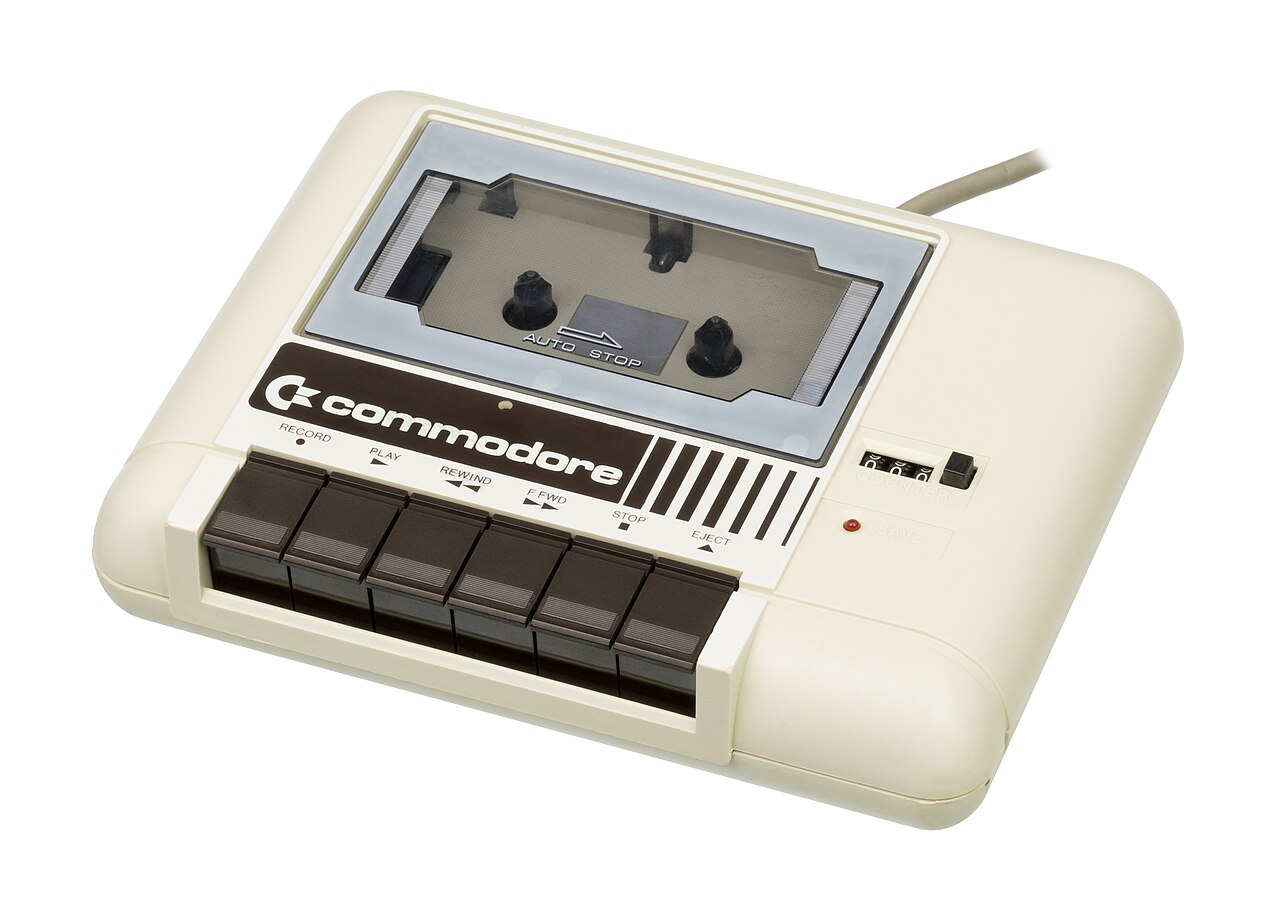
The peripherals told two stories about the same machine. In America, the 1541 disk drive — itself a small computer, as expensive as the C64 by the time you’d finished, and gloriously, legendarily slow — defined a disk culture of big adventures and serious software. In Britain and Europe, the Datasette tape deck ruled: games on cassette at £1.99 from Mastertronic, loaded over minutes of screeching while a loading screen and a Hubbard soundtrack tried to make the wait feel like an overture. Same computer, two civilisations — the disk epics of California and the bedroom coders of Britain, who turned the C64 into the games industry’s first true cottage industry.
The SID: Three Voices, Immortal
The SID deserves its own chapter because it refuses to stay a footnote. Bob Yannes was not a computer engineer dabbling in sound; he was a synthesizer designer who regarded other machines’ beeps with professional disgust, and he built the 6581 to be an instrument — three oscillators with real waveforms, pulse-width modulation, a multimode analogue filter, envelope generators with the bite of a proper synth. He left Commodore in 1982 to co-found Ensoniq, but the chip stayed, and a generation of composers treated it like a Stradivarius. Rob Hubbard, a trained musician who taught himself code to get the sounds he heard, turned loading screens into releases: the Monty on the Run theme, Sanxion’s drive, a discography that still gets performed. Martin Galway made the SID lush and strange. Ben Daglish made it sing in octaves. The “Ocean loader” — the music that played while a cassette loaded — became a genre with its own canon, because musicians understood the wait was stage time. The culture never ended: the High Voltage SID Collection archives some fifty thousand tunes; SID tunes play in clubs and concert halls; hardware synths and FPGA clones exist to keep the 6581’s famously inconsistent analogue filter alive, chip by chip, because no two old SIDs age alike. There are game consoles whose entire musical legacy is smaller than this one chip’s.
Christmas 1983: The War Reaches the Toy Store
Price wars are abstract until you stand in one. By the autumn of 1983 the C64 was stacked in toy shops and department stores — Kmart, Toys”R”Us, Sears — at prices that fell between the advertisement and the shelf: $199, then less, with the trade-in bounty on top for anyone surrendering a rival’s machine, working or not. Parents who had never touched a computer bought one the way they bought bicycles, because at those prices the risk had been abolished; the C64 was suddenly the sensible big present, the educational gift that also, incidentally, played Ghostbusters. Retailers reported the strangest phenomenon of that retail year: computers outselling toys in toy stores. The casualties piled up in public. TI’s exit in October was the headline, but the same Christmas broke a whole tier of hopeful manufacturers, and its aftershock fed the crash that gutted the American console business in 1984 — Atari’s games division, Warner’s write-downs, the landfill in New Mexico. The C64 sailed through the wreckage of its own war because it had never depended on the games business alone: it was a computer, bought for a hundred reasons, and every reason sold software. By the end of 1984 the question in most Western households was not whether to buy a computer, but whether there was any sane alternative to the beige one. For the next several years, there mostly wasn’t.
The Software Flood
Seventeen million machines is not a market, it’s an audience, and the audience got fed. The C64’s catalogue runs to ten thousand commercial titles and beyond counting in the unofficial ones. The Americans made cinema: Epyx’s Summer Games turned the joystick into an Olympic event and waggling into a sport; Impossible Mission’s sampled cry — “Another visitor! Stay a while… stay forever!” — proved the SID could talk; Sid Meier’s Pirates! invented the open-world career; Cinemaware’s Defender of the Crown brought film grammar to the disk drive; Maniac Mansion, born on the C64, introduced SCUMM and with it the modern adventure game. The British made alchemy: Jeff Minter’s psychedelia, Andrew Braybrook’s Paradroid and Uridium squeezing the raster beam, the Oliver twins writing hits in a bedroom for Codemasters, Sensible Software’s Wizball and the Cannon Fodder lineage to come. Elite arrived from the BBC and found its biggest audience here. The Last Ninja’s atmosphere, Boulder Dash’s physics, IK+’s three-man karate — the canon runs for pages, and the magazine culture, Zzap!64 above all, reviewed it with a wit the industry has never quite matched since.
The People’s Programming Machine
It is easy, forty years on, to file the C64 as a games machine, and the games were glorious — but the box said computer, and millions treated it as one. It booted into BASIC: flawed, slow BASIC 2.0, with no commands for its own sound and graphics, so that learning the machine meant learning the machine — POKEs into memory maps printed in the manual, type-in listings from Compute! and RUN and Commodore User, pages of numbers that became a game if you typed them perfectly and a lesson in debugging if you didn’t. Schools bought C64s by the roomful. Small businesses ran accounts on them. Berkeley Softworks’ GEOS gave it a mouse-driven desktop years before Windows mattered. The demoscene’s programmers, the SID’s composers, and half the European games industry of the 1990s were not trained by any institution: they were trained by a beige keyboard, a television, and a machine cheap enough to be theirs. That — more than any single game — is the C64’s claim on history. It didn’t just entertain a generation. It compiled one.
The Scene: Doing What It “Couldn’t”
And then there were the users the industry hadn’t planned for. The C64’s cracking and demo scenes — born in schoolyards and BBSes, swapping games and then out-swallowing them with intros that pushed graphics into the screen borders the manual said were dead space — became the demoscene: a worldwide art movement of code, music and graphics that UNESCO-recognised countries now list as cultural heritage. Multitudes of today’s professional programmers and musicians started as teenagers POKEing a C64 and wondering why the border had sprites in it. The machine’s online childhood ran at 2400 baud and proud — bulletin boards, Quantum Link (the service that would become AOL began on the C64), and a modem culture a decade before the web. Meanwhile the SID’s composers never really stopped: the chip’s music is a living genre, and projects like Matt Gray’s Reformation re-record its classics to standards the 1980s couldn’t.
1984: The Author Exits, the Empire Consolidates
The C64’s strangest plot twist happened in its boardroom. In January 1984, at the very height of the machine’s conquest, Jack Tramiel fell out with Commodore’s board and resigned — and within months had bought Atari’s computer division from Warner, turning his genius against his own creation. The sequel was corporate theatre of the highest order: Commodore and Atari fought over the Amiga chipset in court while the C64, indifferent, simply kept selling — through the 1984 crash that killed the American console business, through the arrival of the 16-bit machines it was supposedly obsolete beside. The C128 of 1985 was a fine machine and a footnote; the breadbin outsold it effortlessly. Peak C64 years came mid-decade, when it was less a product than a standard: the machine software was written for first, the one publishers could not skip, the default setting of home computing from Ohio to Oslo. Companies rose to serve it and were buried with lesser machines; the C64 just accumulated birthdays.
The Long Fade — and the Refusal to Die
Commodore redesigned the C64 in 1986 as the sleeker C64C and kept selling it — through the Amiga era it had itself created, through the 16-bit wars, through the arrival of the PC as the home default. The one true stumble was the C64 Games System of 1990, a cartridge console version launched into the teeth of the Mega Drive; the market’s shrug was total, and most of its cartridges ended up back in computers. Production of the C64 finally ended in April 1994, weeks before Commodore itself collapsed — the breadbin outlived nearly everything, including, almost, its own company. What it never did was disappear. It also outlived the Cold War: in the Poland, Hungary and former East Germany of the early 1990s, the cheap, rugged, tape-driven C64 became the newly open market’s first computer by the hundreds of thousands — magazine scenes and bedroom industries of its own, years after the West had moved to 16-bit; one more civilisation, on one more continent, raised on READY. Jeri Ellsworth’s C64DTV put the machine in a joystick in 2004. Retro Games’ THEC64 Mini (2018) and full-size THEC64 (2019) put it back on shop shelves — we marked the Mini’s eighth year here. And the original hardware remains a going concern: new commercial games still launch for it, most gloriously Sam’s Journey (2017), a platformer that stands with anything released in the machine’s own decade.
The Canon
Impossible Mission (1984) — the voice, the lifts, the dread: the C64’s first masterpiece. Summer Games (1984) — Epyx invents the multi-event sports game. Elite (1985) — the galaxy, in 64K, definitive here. Paradroid (1985) — Braybrook’s influence-device classic. Uridium (1986) — speed itself, raster-timed to the beam. The Last Ninja (1987) — atmosphere as a feature. Maniac Mansion (1987) — SCUMM is born; adventures change forever. Pirates! (1987) — the open-world career, invented whole. Wizball (1987) — Sensible’s colour-stealing oddity, perfect. IK+ (1987) — three fighters, one joystick, endless arguments. Project Firestart (1989) — survival horror before the name. Bruce Lee (1984) — Datasoft’s perfect little action-adventure; two players, one legend. Ghostbusters (1984) — Activision’s movie game that got everything right, singalong loading screen included. The Bard’s Tale (1985) — the dungeon epic that made the C64 an RPG machine. California Games (1987) — Epyx turns the Lynx’s pack-in trick early: a lifestyle in six events. Defender of the Crown (1987) — Cinemaware’s cinema-on-disk spectacle. Turrican (1990) — Manfred Trenz asks how much C64 is left; the answer broke benchmarks. Mayhem in Monsterland (1993) — released as the machine was dying, looking like it shouldn’t exist: the C64’s last miracle. Sam’s Journey (2017) — proof the story never ended: a modern masterpiece on 1982 hardware.
Ready.
Every machine on this site has a story; the Commodore 64 has a civilisation. It is the computer of the price war and the bedroom coder, of the £1.99 tape and the ten-thousand-game flood, of the SID’s three voices and the demoscene’s border-breaking art. It sold more than any single computer model in history not by being the best machine money could buy, but by being the most machine the masses had ever been offered — and then it stayed, and stayed, until staying became its legend. The blue screen still says it best, to anyone who ever typed LOAD and waited: READY. The C64 always was. And perhaps that is the final measure of the machine: other computers are remembered for what they could do — this one is remembered for who it made. The programmers, composers, artists and founders it compiled out of ordinary kids are its real production run, and they number in the millions more than seventeen.