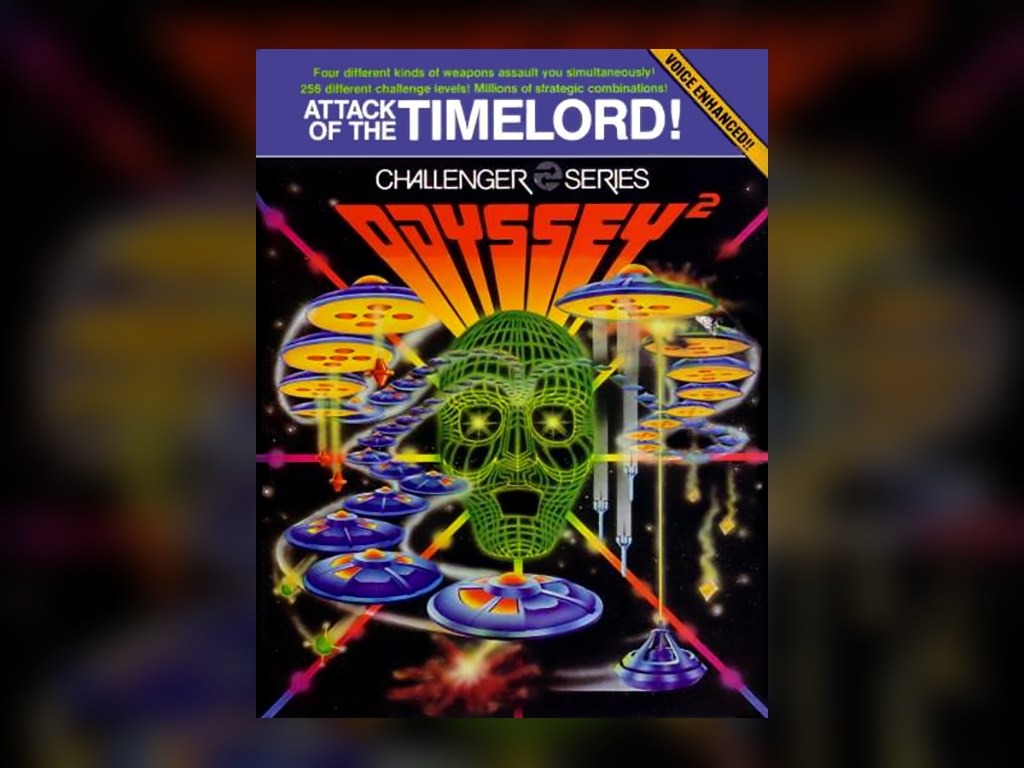
At a glance: Attack of the Timelord! · Odyssey 2 · Magnavox, 1982 · Fixed shooter · Score: 8.0/10
Fixed shooters usually let the aliens do the talking with their formation. Attack of the Timelord! gives the villain a literal voice. With The Voice module fitted, Spillane — a time-travelling warlord whose face looms as the game’s framing menace — announces attacks and taunts the player by name of weapon, and in 1982 a home game whose villain spoke to you was science fiction you could buy. Even without the module, the structure impresses: this is a shooter organised as a series of duels against distinct weapon systems rather than one descending swarm.
How it plays
Each attack arrives with its own behaviour — projectiles that split, that track, that rain in patterns demanding different movement — and the game cycles and combines them as rounds progress. Your ship holds the bottom of the screen in the classic manner, but the variety above it keeps the usual fixed-shooter rhythm from settling. It is closer in spirit to a boss-rush than to Space Invaders, years before that structure had a name, and it makes the cartridge feel bigger than its ROM.
The Timelord framing matters more than it should on paper. A named antagonist, an escalating vendetta, spoken taunts — narrative garnish that the Odyssey 2’s beeper-and-blocks presentation could not provide visually, provided instead by the module and the manual. Magnavox understood that The Voice was theatre, and this is its starring role: the game was sold as the module’s showcase, and owners who bought one usually bought the other.
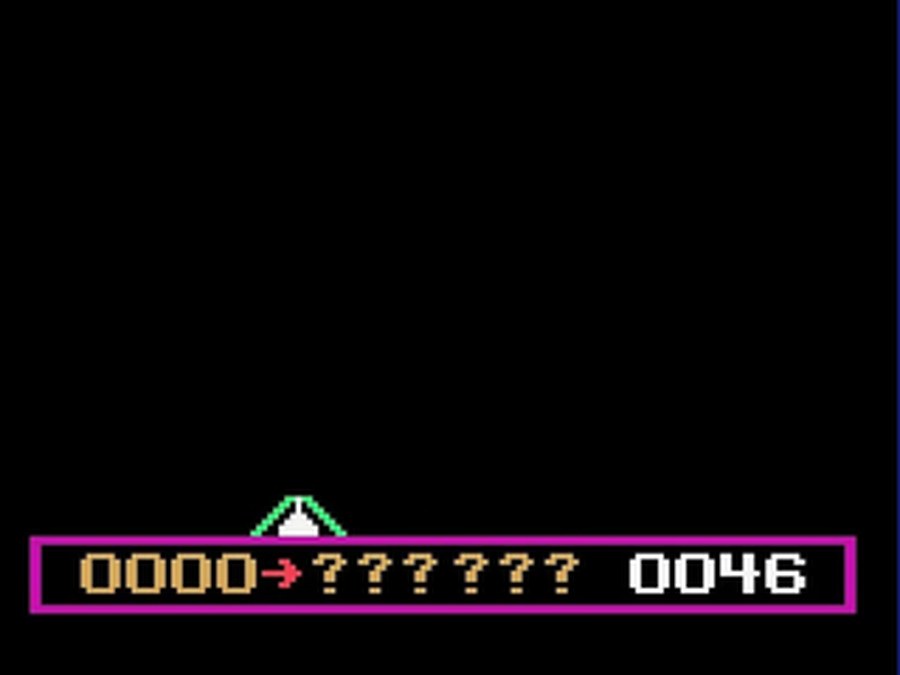
A boss-rush shooter whose villain talks back — in 1982, Spillane’s taunts through The Voice were the future arriving early and slightly muffled.
The details that decide it
Technically it is a late, polished production: busy screens by system standards, clean hit detection, and a difficulty curve that introduces each weapon fairly before combining them unfairly. The compromises are the system’s usual — single-channel ordinary sound without the module, and a visual plainness that the voice performance has to dress. Play it silent and it is a good shooter; play it with Spillane heckling and it becomes an event.

The longer game
Spillane’s arsenal is the substance under the theatre, and it repays study. The Timelord’s weapons do not merely speed up as rounds advance — the game layers them, so a pattern learned in isolation returns in combination, and the player’s real progression is a vocabulary of responses: which attack demands the screen’s edge, which rewards holding the centre, which punishes the instinct to keep firing. That structure, duel by duel, is why the game survives its own gimmick. Strip the voice away and the weapon design still distinguishes it from every other fixed shooter on the system; restore the voice and the duels acquire a host, a heckler and a plot.
The module partnership cuts the other way for collectors: Timelord is the cartridge that makes a Voice purchase feel necessary rather than nice, and the two are often sold and priced as a pair in practice. The European Terrahawks release is the same game under a television licence it has nothing to do with — a curiosity that Videopac collectors prize precisely because the mismatch is so cheerful — while the American Timelord branding carries the original fiction intact.
Playing it today
One design choice deserves isolating: the game talks about its attacks before and as they come, which turns The Voice into a warning system as much as a performance. Spillane’s announcements are information — a duel declared, a weapon named — and a player listening to the module is playing with an extra channel of foresight the silent game withholds. That is sophisticated accessory design for 1982: the hundred-dollar add-on does not merely decorate the game, it advantages the player who owns it, without ever locking out the player who does not. Modern downloadable content could stand to be this courteous.
The Timelord fiction, thin as it is, also gave the Odyssey 2 something its catalogue mostly lacked: a recurring villain with a name. The system’s games are systems — mazes, duels, swarms — and Spillane is nearly alone as a personality, a face attached to the difficulty curve. That personality is why the cartridge is remembered by name when other competent shooters on the system blur together, and why its box, its manual and its module belong together in a serious collection.
Silent, it is a good shooter. Voiced, it is the module’s flagship and one of the system’s signature experiences. There is no third way to own it that makes sense — find the cartridge, find the module, and let Spillane introduce himself.
Verdict
The European renaming to Terrahawks is a small licensing curiosity — the game has nothing to do with the television series beyond the title — and Videopac copies carry that name. North American copies with the Timelord branding are the ones to shelve. Either way, this is the cartridge that justifies the big plastic module sitting on top of the console.
One more virtue deserves recording: restraint about difficulty. The game introduces its weapons fairly, one at a time, at a pace a new player can follow, before it starts combining them — a courtesy many arcade conversions of the period never learned. The result is a shooter that teaches itself, taunts included, and a cartridge that belongs in the first rank of any Odyssey 2 shelf that includes the module it was born to sell.
Eight out of ten with the module, a still-respectable seven without it — that spread is the review, really, and it makes Attack of the Timelord! the easiest purchasing advice in this series: the cartridge and The Voice are one product sold in two boxes, and they should be collected, priced and played as such. What the pairing buys is the period’s most complete illusion of an opponent — a villain who announces himself, names his weapons, and heckles from a speaker sitting on top of the television’s own console, in a year when most home games could not yet manage a convincing explosion. The weapon-duel structure underneath would carry a good shooter on any contemporary system; the voice makes it this system’s shooter, the one with a nemesis. Spillane has been losing this duel in living rooms for over forty years and announcing the next round anyway, which is more personality than most modern villains manage with a thousand times the dialogue. Let him announce yours.
In this series: Attack of the Timelord! is one of eighteen Odyssey 2 cartridges reviewed in this build-up of the system’s shelf, alongside features on The Voice, the Master Strategy Series, the keyboard and the Videopac years, a hidden gems list and a full buying guide. Read it with the flagship history, Odyssey 2 Forever, for the whole story of the keyboard console — and if you are choosing a first cartridge from the set, the scores in this series are the shortlist, with the buying guide’s hedged price ranges as the shopping list.
In Europe the same game was renamed Terrahawks, Videopac 51, after the Gerry Anderson television series. Our verdict: The Voice module’s killer app and a genuinely inventive shooter underneath the theatre. Play it with the module or you are only playing half of it.