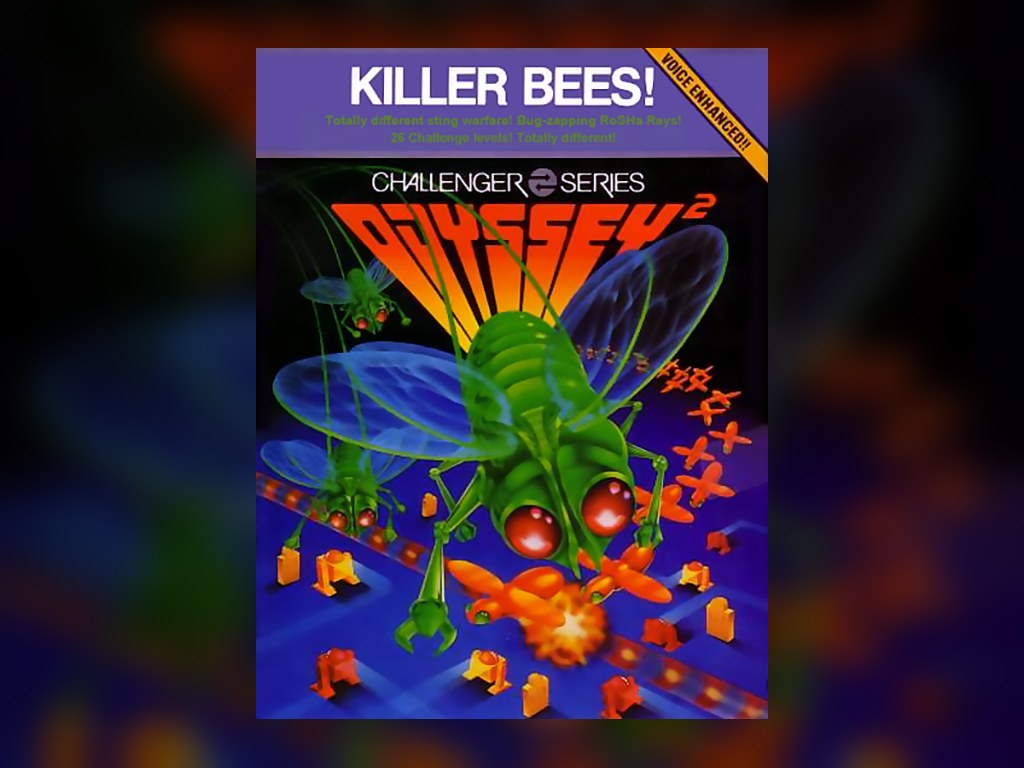
At a glance: Killer Bees! · Odyssey 2 · Magnavox, 1983 · Action shooter · Score: 8.5/10
Every shooter of the era put you in the ship. Killer Bees! puts you in the weather. You control a swarm of white bees pouring from a hive at the top of the screen, and your enemies are the beekeepers creeping in from the sides and rival coloured swarms invading your territory. Touch a beekeeper with enough bees and he collapses — famously, a little tombstone marks the spot, and the tombstones accumulate across the screen as the body count rises. It is cheerful, morbid and completely unlike anything else on a 1983 cartridge.

How it plays
The swarm is the control problem and the joy. Bees string out behind your movement, so the swarm has a shape — a comet of insects you whip around corners and pour onto targets. Rival swarms thin your numbers on contact, and your bees are a resource: lose too many and the hive must replenish you while beekeepers advance unopposed. Then there is the masterstroke, the RoSHa Ray: a screen-sweeping zap you can fire to annihilate everything hostile at once, rationed so that spending it is always an argument with yourself. Few games of the period hand the player a panic button this satisfying and this well judged.
With The Voice module fitted, the cartridge produces its other signature: a rising electronic buzz that tracks the action, the speech chip repurposed as an insect chorus. It is genuinely atmospheric — players remembered the sound of this game decades later — and it made Killer Bees! a fixture of Voice demonstrations. Without the module the game plays complete; with it, the game sounds alive.

You are not the ship. You are the swarm — and the tombstones piling up under your bees tell the story of every round.
The details that decide it
Released in 1983, right at the edge of the crash, it is one of the most original designs the first-party library ever produced, and retrospective lists have steadily promoted it toward the top of the system’s rankings where it belongs. The visuals are spare but purposeful — colour-coded swarms, readable beekeepers, those tombstones — and the difficulty escalates by invasion pressure rather than cheap speed. Sessions build from pest control to genuine siege.

The longer game
The swarm management underneath the novelty is more systematic than it first appears. Bees are lost individually — clipped by rival swarms, sacrificed in the press around a beekeeper — so aggression has a budget, and the hive’s replenishment rate is the game’s real clock. The beekeepers, meanwhile, are an advancing problem with a geography: they enter at the edges and cross toward the hive, and the tombstones they leave behind are not merely jokes but a map of where your defence has already succeeded, round by round. The RoSHa Ray reframes all of it. Because the zap clears the screen but must be re-earned, the expert game is about refusing to spend it — holding a degrading position one wave longer than comfort allows, so the lightning is still there when the siege truly breaks.
Design credit belongs to the late-period first-party teams who, by 1983, were working the 8048 hardware like a familiar instrument. Killer Bees! could not have been a launch title; it depends on everything the company had learned about movement, density and readability on the chip. Its European release as Videopac 52, with enhanced backgrounds on the G7400, gave it a second, prettier life abroad — one of several late Odyssey 2 designs that Europe’s longer support for the platform rewarded.
Playing it today
The endgame deserves its own paragraph, because Killer Bees! builds toward sieges of a density the early rounds never promise. As invasions stack — rival swarms arriving while beekeepers press from both edges and your bee count runs thin — the screen becomes a genuine crisis of allocation: defend the hive’s mouth or hunt the beekeepers, spend the Ray or trust the swarm. That a game about bees on an Intel 8048 generates resource-allocation tension at all is the design’s quiet triumph; that it does so while remaining instantly readable — your bees white, theirs coloured, the tombstones marking the war’s progress — is its loud one. Few action games of 1983, on any system, ask this many interesting questions per minute.
There is a sound-design footnote for Voice owners: the buzz is not a loop but a response, rising with the action, so the module functions almost as an instrument the game plays. Players who know the cartridge only in its silent form know a good game; players who know the buzz know the famous one. When demonstrating the module to newcomers, this — not speech — is often the moment that lands, because it proves the chip was a creative tool and not a novelty peripheral.
Complete the thought with the buying note: mid-priced, findable on two continents, enhanced in Europe, essential everywhere. The swarm is waiting, the beekeepers are patient, and the tombstones are not going to carve themselves.
Verdict
The Odyssey 2 is a system of ingenious answers to tiny hardware. Killer Bees! might be the most ingenious: a strategy-flavoured action game about controlling a fluid, losing pieces of your own weapon, and deciding when to call down the lightning.
For today’s player it is the easiest of the system’s great games to recommend to a sceptic, because its first thirty seconds communicate everything: you are the swarm, the beekeepers are coming, the tombstones are funny. Copies are mid-priced and findable. Fit The Voice if you have it, and turn it up — the buzz is half the atmosphere, and the atmosphere is half the game.
Eight-and-a-half, and the half is for the Voice performance — without the module this is an eight, still comfortably among the system’s elite. The full accounting: the most original design in the first-party library, a control scheme that turns the player’s own weapon into a resource to be managed, a panic button rationed like a sacrament, tombstones for punctuation, and a siege endgame that generates genuine strategic tension from an insect metaphor. Its only true limitation is that its brilliance is systemic rather than visual — a screenshot sells it badly, which in 1983 was a commercial handicap and in 2026 is merely a warning to buyers to trust the footage and the reputation over the box art. New owners should schedule it early in the library’s exploration, ideally with the module fitted and the volume honest, because Killer Bees! recalibrates what a player expects the Odyssey 2 to attempt. After the swarm, the rest of the catalogue’s ambitions make a different kind of sense: this was always a console of strange, elegant solutions, and here is its strangest, most elegant one, still stinging.
In this series: Killer Bees! is one of eighteen Odyssey 2 cartridges reviewed in this build-up of the system’s shelf, alongside features on The Voice, the Master Strategy Series, the keyboard and the Videopac years, a hidden gems list and a full buying guide. Read it with the flagship history, Odyssey 2 Forever, for the whole story of the keyboard console — and if you are choosing a first cartridge from the set, the scores in this series are the shortlist, with the buying guide’s hedged price ranges as the shopping list.
In Europe it was Killer Bees, Videopac 52, with enhanced backgrounds on Videopac+. Our verdict: One of the system’s most original games and a mandatory Voice experience. Weird, witty and wonderfully playable.