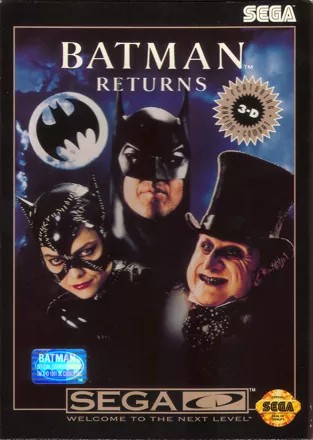
At a glance: Batman Returns · Sega CD · developed by Malibu Interactive · published by Sega · 1993 · platformer and pseudo-3D driving · five stages in each mode · single player
Some games are good, some are bad, and a select few are both at once, in clearly labelled halves. Batman Returns on Sega CD takes the platform stages of the Genesis cartridge wholesale, then interleaves them with brand-new driving sequences built to show off the add-on’s scaling hardware — and the joins could not be more visible. One half is a drab, frustrating brawler in which the world’s greatest martial artist cannot block, run or reach as far as a clown with a stick. The other half is among the finest arcade driving the 16-bit era produced at home, good enough that its approach later grew into a game of its own in The Adventures of Batman and Robin. The disc even lets you choose your poison: platforming only, driving only, or the full alternating campaign. Most owners, then and now, make the same choice.
The Batmobile Earns the Disc

The full game opens, wisely, behind the wheel. Gotham unrolls as a linear course of scaling sprites — shopfronts, decorations and snow-heavy trees whipping past — with bends that demand you manage speed in the OutRun manner, changes of elevation that launch the Batmobile airborne, and a smoothness that home players in 1993 had no right to expect. Enemy vehicles arrive in waves tracked by a red quota meter, each section runs against the clock, and you have options for dealing with traffic: nose-mounted guns for the car ahead, a limited stock of homing rockets for the stubborn ones, or the connoisseur’s choice — light the afterburners and shoulder a rival into the scenery for an instant kill. Boss vehicles punctuate the stages, each wanting its own approach, and later the action swaps four wheels for the Batskiboat, threading sewers at speed, leaping ramps and blasting lock gates on the Penguin’s trail.
Technically it remains a small marvel. The road is built without the obvious segmented strips that betray lesser scaling engines, textures dress the surroundings, and explosions, burning wrecks and smashed barriers sell every collision. Control has one wart — firing means tapping one button while another is held down for acceleration — softened by the mercy that holding up also maintains speed, freeing your thumb during boss fights. Spencer Nilsen’s CD soundtrack completes the package: real piano and guitar were still a novelty from a console, the tunes are moody and memorable enough that Sega reused them in promotional videos, and if the track list is short enough to recycle pieces across stages, the driving sections’ engine roar and tyre squeal fill the gaps handsomely.
The stage list underlines the ambition: Streets of Gotham, a snowbound Winter Wonderland that is the prettiest thing on the disc, City Limits, the sewers, and the Penguin’s lair, each in both modes. In driving form the winter stage, trees hanging over the road, is close to beautiful — a word the platforming half never earns. And the connective tissue between modes in the full campaign is frankly slapdash: you drive purposefully towards a circus and arrive at a department store, race for Wayne Manor and materialise at the circus instead. Nobody sequenced this with a map of Gotham open beside them, and in a licensed production of this polish elsewhere, the carelessness is conspicuous.
“Two games share this disc. One of them is the best reason to own a Sega CD in 1993. The other one is also on this disc.”
Meanwhile, Back on Foot
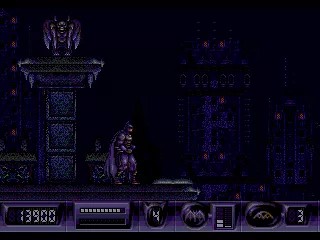
Then the platforming resumes, and the temperature drops twenty degrees. These are the Genesis levels unaltered — film locations in film order, sewers, cathedral, department store, rooftops — populated by the Red Triangle Circus Gang stretched by creative licence into living gargoyles, shrinking fire jugglers, mirror-appearing beanpole clowns and penguins that parachute in and detonate on contact. Batman’s difficulties are fundamental. He walks, sedately, everywhere; he cannot run even when a giant steel ball is rolling behind him. Standing still he throws a short punch, moving he extends a kick that still loses on reach to most enemy weapons, he cannot block, and his only dodge is a duck. Acrobatic opponents simply somersault back and forth over his head, briefly invulnerable, while Batman absorbs the lesson. Five gadgets wait in the utility belt — straight-flying Batarangs, freezing smoke bombs, a homing bat swarm, a grappling-gun bolt and a free-roaming electronic Batarang — but every one is rationed, the common Batarang needs several hits to drop anyone, and so the sensible player hoards everything for bosses and spends the ordinary stages being kicked about by clowns. It is a strange fantasy to sell.
Sound design splits along the same fault line as everything else. The platform stages keep effects that would have embarrassed the cartridge — scratchy, sparse, generic thuds — while the driving sections rumble, squeal and explode with conviction, as though two different audio teams worked on two different games and only one of them was told about the CD. Played back to back in the full campaign, the alternation is almost comic: cinema-grade rock score and engine noise one minute, a man being kicked by a clown to the sound of a dropped saucepan the next.
Movement between levels is better: a grappling hook fires upward or, mid-jump, diagonally for an uncertain swing, and the cape opens for a slow glide across pits, an ability itself rationed by “glide power” pickups, because of course it is. Visually the stages chase the film’s gloom so faithfully that nearly everything is rendered in shades of violet — serviceable for visibility, deadly for variety — with the snowy park and circus tents the honourable exceptions, and a duel atop the Penguin’s enormous yellow duck as the one image that stays with you. The unforgivable omission, though, is structural: there are no passwords. Every failed attempt at this long, punishing half restarts the whole evening, which guarantees that most players see the opening stages dozens of times and the ending rarely.
History has been kind to the driving half, at least. The scaling engine’s programmer later released its source code, preservationists cite these stages whenever the Sega CD’s custom graphics hardware is discussed, and the formula — chase, quota, boss — was strong enough for Sega to build an entire cartoon-styled sequel around it two years later. Nobody, meanwhile, campaigns for the platform stages. They were the compromise that let a cartridge game fill a CD, and they play like one: adequate in 1992 on the Genesis, exposed in 1993 by the company they keep on their own disc.
The Verdict

As a package, Batman Returns is a driving game of genuine brilliance lashed to a platformer of genuine mediocrity, and your score for it will depend entirely on which half you weight more. The driving stages are short — five of them, over quickly — but they are the Sega CD’s hardware used for joy rather than novelty, and the mode select means you can enjoy them unencumbered. The platforming, bulk of the disc though it is, frustrates with limited moves, stingy gadgets and that missing password system. Bought for the Batmobile, remembered for the Batmobile: the rest is the toll you pay at the gate.
Verdict: sublime driving, dreary platforming, no passwords — a split decision at 6.5.
Keep reading: the Sega CD system archive