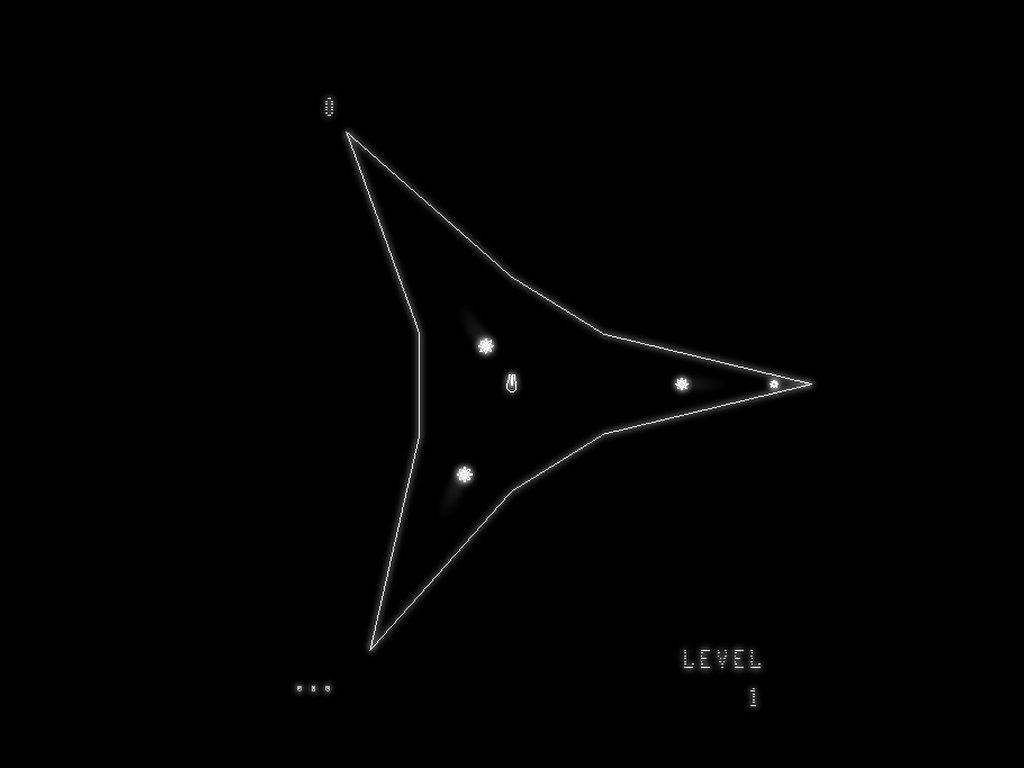
At a glance: Bedlam · Vectrex · GCE, 1982 · Radial defence shooter · Score: 7.5/10
Bedlam is the Vectrex library’s exercise in beautiful reduction. No maze, no terrain, no scrolling world: a shape at the centre of the screen — your post — and a geometric chamber around it, and things coming in from the dark at the edges to kill you. You rotate to face them and shoot. That is the whole game, and for surprising stretches of an evening it is enough, because Bedlam understands something its more elaborate contemporaries sometimes forgot: escalation is a design. What begins as a gallery of slow intruders becomes, by increments too smooth to notice, a genuine panic — the chamber spinning, the intruders converging, the player’s rotation sense dissolving. The name is not a metaphor. It is a warning.
The lineage is visible if you know where to look: Bedlam belongs to the family of centre-defence games that runs from the arcade’s radial experiments towards later twin-stick and arena designs, and its closest spiritual relative is the feeling of being the turret in somebody else’s invasion. The Vectrex version surrounds your post with a rotating geometric frame — a great stellar outline that turns as the action turns — so the arena itself seems to be in motion even when you are not, and orientation becomes a skill rather than a given. Enemies materialise at the perimeter and press inwards along their spokes; each one you miss arrives. The geometry is the difficulty: a threat behind you is exactly as deadly as the one in your sights, and the game is a continuous act of choosing which direction to be facing when the music stops.

The art of turning around
Bedlam’s control problem is its design problem, and GCE solved both with the machine’s strengths. Rotation is fast and exact on the controller, fire is instant, and the whole game runs at a clip that makes faster-feeling cartridges seem sedate — the vector display drawing the chamber, your post and a dozen converging threats without a flicker of strain. Because there is nothing else on the screen, everything on the screen matters: the intruders’ silhouettes code their behaviour, the chamber’s rotation codes the tempo, and the player’s attention is the scarcest resource in the system. Good Bedlam play develops a rhythm almost musical — sweep, check, sweep back — and bad Bedlam play has a sound too, which is the sound of something arriving from the direction you just left.
It is also, quietly, one of the library’s most modern-feeling games. Strip the decades away and Bedlam is an arena-survival score-attack of a kind the medium would later industrialise: one screen, one verb set, escalating density, death by encirclement, a high score as the only epilogue. Players who bounce off the Vectrex’s arcade ports for their fidelity to old structures sometimes find Bedlam the easiest early cartridge to love, precisely because its structure never aged — it was always this.
Where reduction cuts both ways
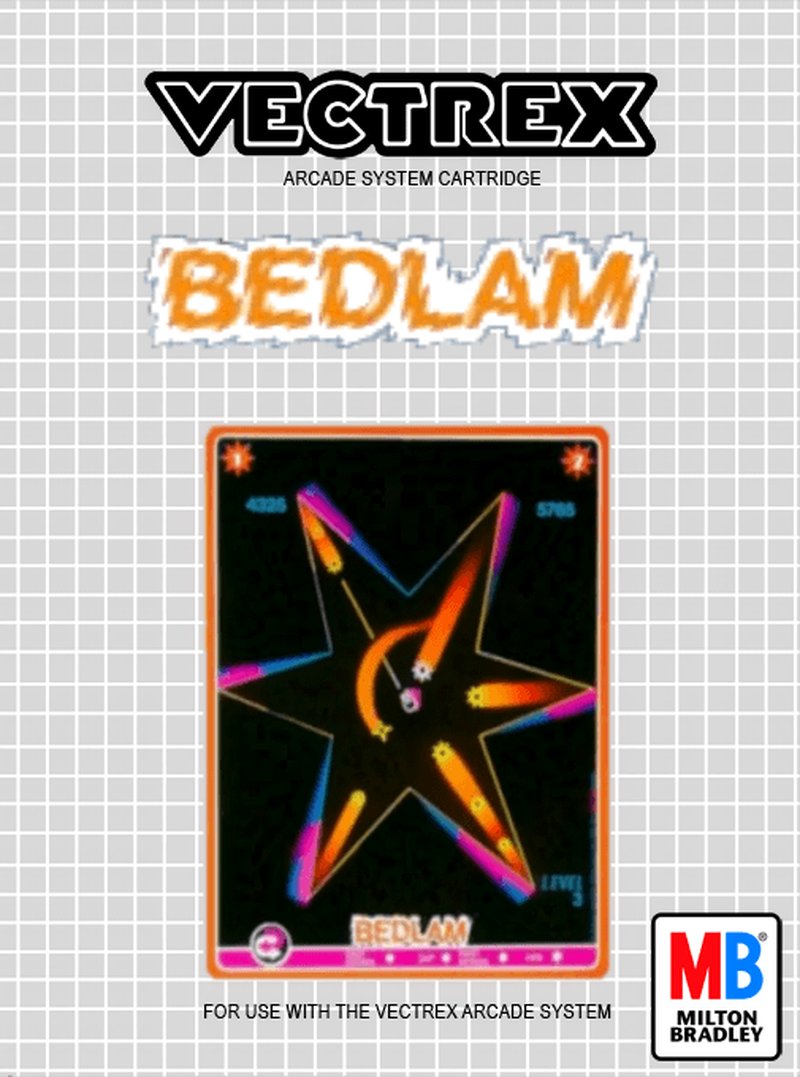
The debit side of minimalism is monotony’s mailing address, and Bedlam does not entirely escape it. The intruder variety is modest, the chamber never changes its nature, and the game’s entire vocabulary is rotation and fire — a player who does not click with the rhythm in the first ten minutes will find little else in the cartridge to persuade them. It is also, even by 1982 standards, an unsociable game: no two-player drama of the Rip Off kind, no duel to settle, just you and the converging geometry and a score that accuses. The overlay and presentation do their jobs without ever becoming the attraction. Bedlam is a mechanism, and it knows it.
Bedlam is escalation as a design: a gallery of slow intruders becoming, by increments too smooth to notice, a genuine panic.
But mechanisms age better than pageants, and this one has. As a palate cleanser between the library’s epics — five fierce minutes of pure spatial panic — Bedlam earns shelf space that cartridges with ten times its content never will. It is the game you lend a sceptic who thinks the Vectrex is all ports and nostalgia: nothing in it is borrowed, and nothing in it is old.

Tempo, the invisible enemy
Every Bedlam session has the same shape, and the shape is a heart-rate graph. The opening intruders arrive at a pace that flatters the player into a rhythm — turn, fire, turn, fire — and the game then works on that rhythm the way a tide works on a sandcastle: not by sudden jumps, but by a pressure increase so evenly applied that the player cannot name the moment the gallery became a mob. This is the game’s real craft. Random spawns would feel unfair; faster spawns would feel crude. Bedlam instead thickens — an extra intruder here, a crosser there, two arrivals timed to punish a long look in one direction — until the player’s sweep pattern, so recently a comfort, becomes the exact habit the game is exploiting. The deaths that end good runs almost never come from the intruder you were watching. They come from the arithmetic of attention itself, and they feel fair because the game showed you every term of the sum.
The sound design carries more of that tempo than the visuals do. Bedlam’s audio is a rising conversation of warnings — the intruders announce their pressure in the Vectrex’s native buzz and tick, and an experienced player is effectively playing by ear half the time, using the soundtrack’s thickening texture as a sixth sense for the perimeter they cannot see. It is a trick the medium would later build entire horror games around. Here it is in 1982, in a cartridge with one mechanic, teaching players to listen to a room they are standing in the middle of. Small wonder the arena-survival genre, when it eventually industrialised the form, kept returning to the same ingredients: a centre, a perimeter, a tempo, and a player whose composure is the real health bar.
The verdict
Bedlam scores as an excellent miniature: a radial defence game of real speed and escalating pressure, reduced to the essential and polished until the essential gleams. It will not carry a whole evening and never pretended it would. In a library being built to twenty-five games deep, it is exactly the kind of cartridge that depth means — a small, perfect gear in the machine. Step into the middle. Start turning. Try to keep up.
Setup, for the uninitiated, is half the experience: Bedlam wants the dark room and the volume up, because its perimeter is an audio space as much as a visual one, and its panic is engineered in both channels. Give it those conditions and five minutes becomes the library’s most reliable adrenaline. Deny it them, and you have only yourself to blame when the chamber’s music stops sounding like a warning and starts sounding like a diagnosis.
It is, in short, the library’s espresso: small, intense, and entirely itself — and no shelf of slower, larger pleasures should be without one.
Score: 7.5/10 — Minimalism at full speed: the library’s purest panic, five fierce minutes at a time.