
At a glance: Rip Off · Vectrex · GCE, 1982 · Cooperative defence shooter · Score: 8.0/10
Before co-op was a genre, a marketing bullet or a matchmaking filter, it was this: two little tanks, a pile of fuel, and pirates coming to steal it. Rip Off, designed by Tim Skelly for Cinematronics in 1980, is one of the founding documents of cooperative play — a game where two players defend together, cover together, and lose together, against thieves who are not even trying to kill them. The pirates want the fuel canisters clustered at the centre of the screen. They swoop in, latch on, and haul the cans away to the screen’s edge, and every can they steal is gone for the round. Your tanks are the only security the depot has. On the Vectrex, with two controllers and a sofa, Rip Off remains what it was in the arcade: the purest fifteen minutes of teamwork 1982 can offer.
The mechanics are a study in how much design you can build from theft. The pirates arrive in waves of increasing nerve — lone opportunists first, then coordinated pairs, then whole raiding parties with covering fire. A pirate that has grabbed a canister moves slower and becomes the screen’s most important target; a pirate still hunting is a lesser threat, and triage — who shoots the laden thief, who intercepts the next arrival, who guards the pile — emerges naturally from the geometry, no orders required. Your own fire is not free of consequence either: the depot’s defence is a crossfire waiting to happen, and Rip Off veterans all carry a scar from a partner’s helpful shot arriving half a second after their own tank crossed its line.
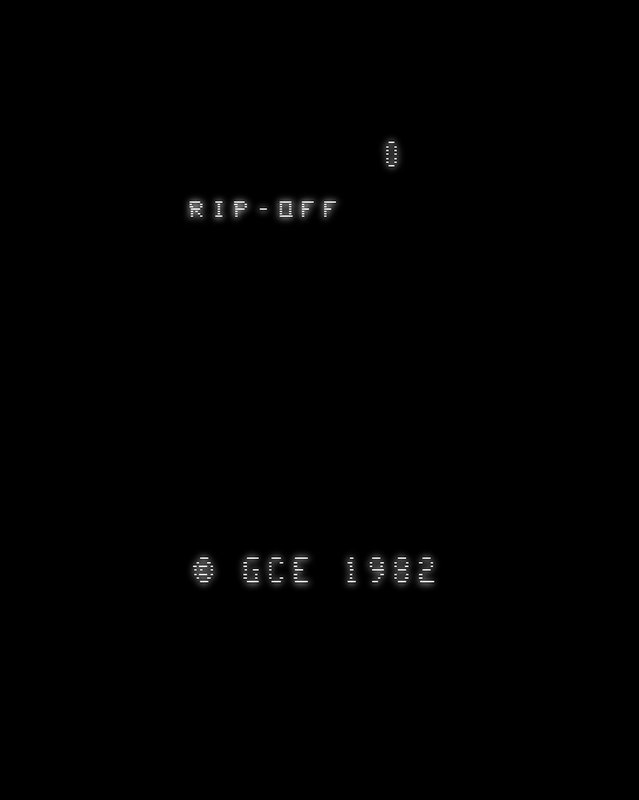
Teamwork, or the appearance of it
What makes Rip Off a classic rather than a curiosity is that its cooperation is unforced and therefore real. The game never assigns roles, never splits the screen, never tells you to cooperate; it simply presents a theft in progress and lets two armed friends discover division of labour for themselves. In practice every pair invents the same doctrines independently — one high, one low; one chasing, one camping the pile — and then invents the same argument when a canister sails off-screen between two tanks each assuming the other had it. The scoring, shared in spirit and compared in fact, keeps a competitive ember inside the cooperation: you are a team, but somebody drove better, and both of you know who. Decades of co-op design, from horde modes to heist games, live in this cartridge’s debt.
Solo play exists and is respectable — the machine gives you the depot, the pirates and your own two hands’ worth of work, and it plays as a stern little defence shooter in its own right — but the honest verdict is that Rip Off, like Space Wars, is a game whose second controller is half the design. GCE’s port keeps the arcade’s essentials untouched: the pirates’ behaviour, the escalating raids, the bonus structure for a defended pile, the tanks’ crisp rotation and fire. The vector rendering suits the depot perfectly — fuel cans glowing at the centre like a campfire the whole game gathers around — and the overlay zones the arena so a laden pirate’s escape route reads at a glance.

Small game, long shadow
Debits, for the record: Rip Off is a single-screen game with a single idea, and while the idea is perfect, the cartridge makes no attempt to disguise the fact — no new arenas, no second act, just better pirates. The difficulty of the late raids, tuned for two alert players, can feel punitive solo, and the game’s sessions, glorious as they are, run short: this is a cartridge you play in fierce bursts between bigger games, the way its arcade original was played between other cabinets. None of that has stopped it becoming a fixture of Vectrex gatherings, where it is routinely the game strangers can be taught in one sentence and playing well in five minutes.
The game never tells you to cooperate. It simply presents a theft in progress and lets two armed friends invent teamwork for themselves.
Its historical standing deserves the final word here rather than the footnotes: when the industry remembers the birth of cooperative play, Rip Off is one of the names that must be spoken, and the Vectrex version is the most accessible way to experience that birth as it actually played. Not a remake, not a homage — the thing itself, drawn in light, waiting for two players and a pile of fuel.

Skelly’s second lesson in geometry
Tim Skelly’s Cinematronics work forms a kind of curriculum in vector design — Starhawk taught the trench, Armor Attack the intersection — and Rip Off’s lesson is the open field: how to make an empty arena interesting by putting something worth stealing in the middle of it. The fuel pile is one of the great simple devices in early game design. It is a score bank, a defensive obligation and a magnet for every actor on the screen, all at once, and it means the game’s drama never needs to be manufactured by timers or ambushes: the pirates manufacture it themselves, one grabbed canister at a time. Contemporary arcades were full of games about shooting everything that moved. Rip Off asked a ruder question — can you protect something? — and discovered that protection is the more social verb. You cannot guard a pile alone at both ends. You need the other tank. The cooperation is not a mode; it is arithmetic.
The raids’ escalation is worth study by any player who finds the early waves gentle. The pirates learn in the only way 1980 code could teach them: numbers, angles and nerve. Solo raiders give way to pairs that split a defence’s attention; pairs give way to waves where a feint at one side of the pile is the raid, and the single canister quietly leaving at the other side is the point. Losses teach the depot’s central paradox — the canister you chase is rarely the canister you lose — until a good pair stops chasing altogether and starts herding: shaping the pirates’ approaches into lanes the two tanks have already divided between them. It is, in miniature, the entire future of cooperative defence games, from tower defence to the modern horde mode: a valued centre, escalating theft, and two friends discovering that the plan they never spoke aloud was the same plan.
The verdict
Rip Off is the library’s essential two-player cartridge alongside Space Wars, and the warmer of the two: a duel makes rivals, a defence makes partners. Its score reflects a small, perfect design rather than a large one — and perfection, even in miniature, is what this collection exists to honour. Plug in both pads. Guard the fuel. Trust your partner, mostly.
One housekeeping note for collectors: Rip Off is a game whose value doubles with its company, so judge a copy by whether it will be played by two. Solo, it is a stern and charming defence; paired, it is the library’s warmest evening. Either way, the fuel pile is lit and the pirates are punctual.
Score: 8.0/10 — Co-op’s founding document, still the best fifteen minutes of teamwork in the library.