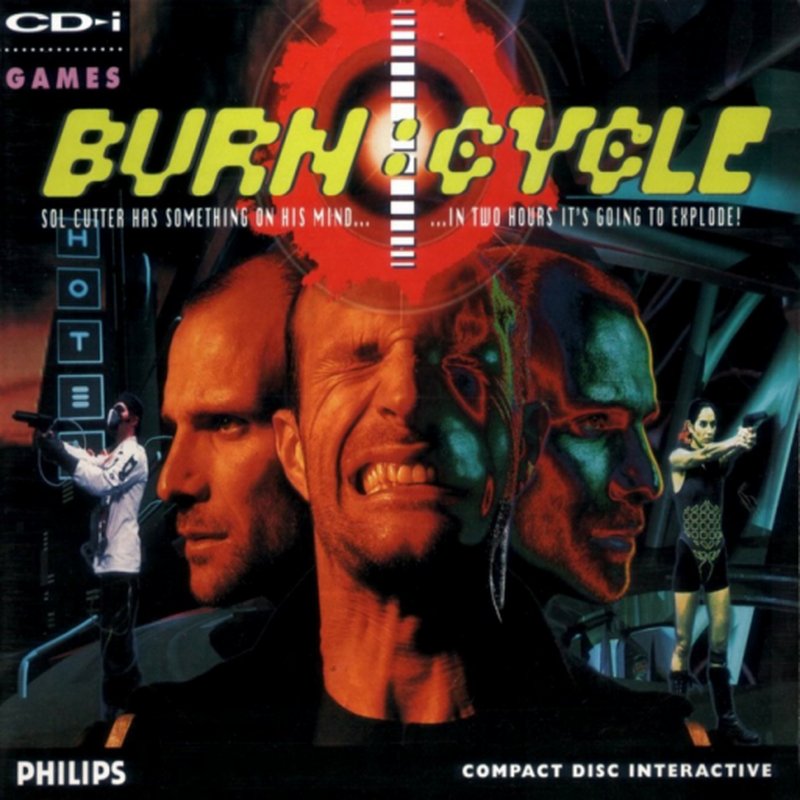
At a glance: Burn:Cycle · Philips CD-i · Trip Media / Philips Interactive Media, 1994 · FMV adventure · Score: 8.5/10
Every failed format has one game its owners point to when the mockery starts, and for the CD-i that game is Burn:Cycle. Trip Media’s cyberpunk adventure, released in October 1994, casts you as Sol Cutter, a small-time data thief whose latest heist goes wrong in the worst way a heist can: the Burn:Cycle virus is implanted in his brain, and he has exactly two hours — real time, ticking — before it kills him. What follows is a first-person adventure through a rain-slick, neon-rotten future city and the virtual Televerse beyond it, told in live-action video composited over Silicon Graphics-rendered 3D worlds. Electronic Gaming Monthly named it the best CD-i game of 1994. Three decades on, it remains the strongest argument that the CD-i’s multimedia dream could, occasionally, produce an actual game.
The production ambition is the first thing that hits you. Written by Eitan Arrusi, performed by a live-action cast shot against blue screen — Aaron Swartz as Cutter, with a supporting cast of fixers, bartenders, cultists and corporate killers — and scored by Simon Boswell and Chris Whitten with a techno soundtrack so central to the package that initial copies shipped with a bonus audio CD of it, Burn:Cycle was built as a flagship in an era when most CD-i software was built as a brochure. Crucially, it is a base-case title: no Digital Video Cartridge required. Trip Media streamed its world directly from the disc with a technique that kept loading near-invisible, which is why the game moves with a fluidity almost nothing else on the platform matches.
Two hours to live
The countdown is the design’s masterstroke. Adventure games of the era were stately, forgiving things; Burn:Cycle gives you a dying man and a clock. The timer can be extended — a backstreet trader named Zip can buy Cutter time, at a price — and the game can be saved, but the pressure never fully lifts, and it transforms routine adventure behaviour. You do not idle in the Sum Zero Bar soaking up atmosphere. You work your contacts, you memorise the city’s geography, you decide which lead is worth your remaining minutes. Death, when it comes — and the game is happy to kill Cutter for carelessness, in shootings, traps and failed negotiations — feels like the clock winning rather than the game cheating.
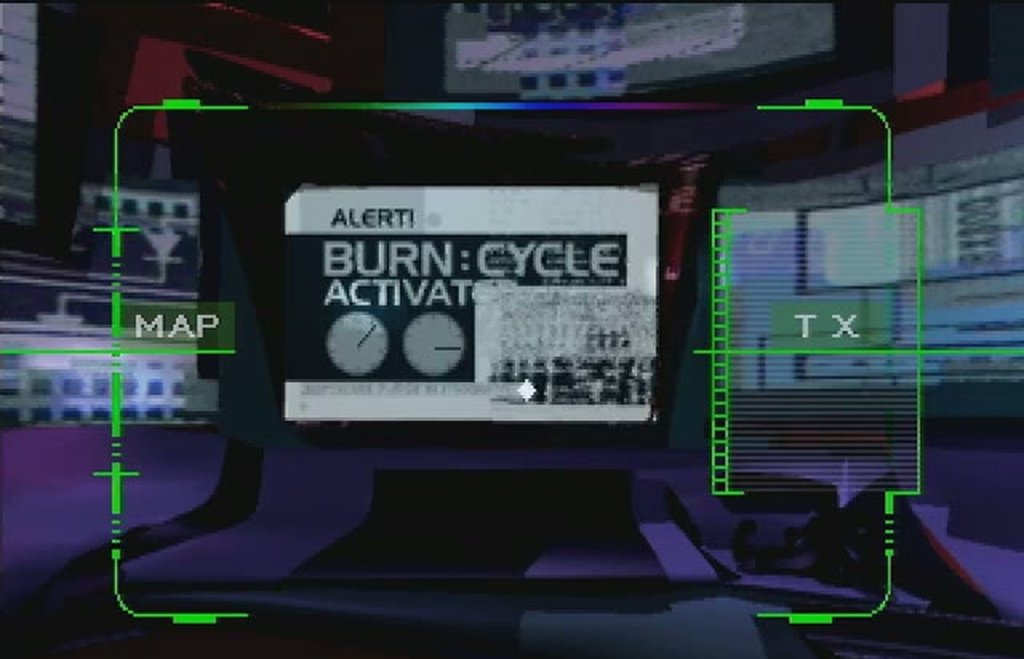
The structure alternates between the physical city and the Televerse, the virtual realm where the virus must ultimately be confronted. In the city, play is point-and-click adventure grammar — a context-sensitive cursor that becomes an arrow, a hand, a gunsight — across locations like the Sum Zero Bar and the Karmic Church of the future’s lost souls. In the Televerse, the game turns surreal: pure digital landscapes, logic puzzles, and a finale that tips its hat to arcade history with a Pac-Man-styled endgame. Between the two sit the puzzles proper: rewiring circuits, games of chance including the notorious Psychic Roulette, bartering, shooting sequences, and a running thread of e-mails and documents that build the conspiracy behind the virus. The famous fold-out packaging even included printed e-mails to Cutter as a physical prop — world-building in the box, years before that was fashionable.
Where it creaks
An honest review has to mark the faults, because Burn:Cycle has them. The shooting sequences are the weakest link — cursor gunplay against video targets, more reflex test than marksmanship, and a source of cheap deaths. Some puzzles are under-signposted to the point where a guide stops being a crutch and becomes equipment; the story, deliberately paranoid and convoluted, occasionally crosses from intriguing to merely confusing, and first-time players will hit the two-hour wall at least once before the route through the game reveals itself. The video itself, miraculous in 1994, is soft and compressed by modern standards — this is a game you now play partly as a period film. And the cursor, steered by the CD-i’s pointer controllers, is workable rather than pleasurable; of all the platform’s games, this is the one whose design most forgives the hardware, but forgiveness is not delight.
Burn:Cycle is the CD-i game that understood the assignment: not a film you occasionally interrupt, but a world you inhabit against a clock. It is the platform’s high-water mark, and it is not particularly close.
What lifts it above those faults is coherence. The writing, the performances, Boswell’s score, the Softimage-rendered architecture of a future that is all wet concrete and advertising glare — everything pulls in the same direction, toward a specific, sleazy, paranoid mood that games with fifty times the budget regularly fail to find. Cutter is a genuinely good protagonist for the form: frightened, compromised, funny under pressure. The Televerse sequences, pre-rendered and strange, still have the power to unsettle. And the ending pays off the countdown honestly, which the marketing of the era rarely allowed anyone to guarantee.

The soundtrack in the box
One detail from the original release deserves preservation in any review, because it captures the era’s ambition better than the game itself: the first pressing of Burn:Cycle shipped with a separate audio CD of Simon Boswell and Chris Whitten’s soundtrack, playable in the CD-i or any ordinary CD player, inside packaging that also carried printed e-mail messages advancing the fiction. Philips and Trip Media were selling a world, not a disc — a transmedia package before the word existed, from a platform whose whole pitch was that a disc could be more than a game. The PC re-release of 1995 carried the game to a wider audience, and a planned Saturn and PlayStation afterlife, announced in 1996 with Burn:Cycle as its lead title, would have carried it further. Neither happened. The CD-i original is the whole legacy, which concentrates the mind wonderfully: everything Trip Media built lives or dies on this one disc, and on this disc, it lives.
It is also worth saying plainly who should play it now. Adventure players who tolerate period video will find a complete, confident thriller. Cyberpunk readers will find a period-perfect artefact of the genre’s pre-millennium mood, all corporate conspiracy and bodily betrayal. CD-i collectors already know. The two-hour clock, which sounds like the game’s most dated feature, turns out to be its most modern: a session with a shape, an ending that arrives whether you are ready or not.
One last measure of the game’s standing: ask CD-i owners to name the platform’s essential discs and Burn:Cycle is the only original, exclusive production that appears on every list, ahead of ports of Myst and The 7th Guest and beside the Nintendo curiosities it outsells in reputation if not in price. Formats are remembered by their exclusives. The CD-i has exactly one that the wider medium agrees was excellent, and this is it — which makes the score below less a judgement on one game than a measurement of how much of the platform’s honour a single disc can carry. It carries it.
Verdict
Burn:Cycle was ported to PC and Mac in 1995, and announced — in one of the era’s great might-have-beens — as the lead title in a plan to bring Philips’ CD-i catalogue to Saturn and PlayStation that never happened. The CD-i original remains the version that matters: the game the platform was, for one release, exactly good enough for. It is not flawless, and the FMV form caps its score below the era’s very best adventures, but as a piece of cyberpunk storytelling and the single strongest reason to own the machine, it stands alone in this catalogue. 8.5/10.