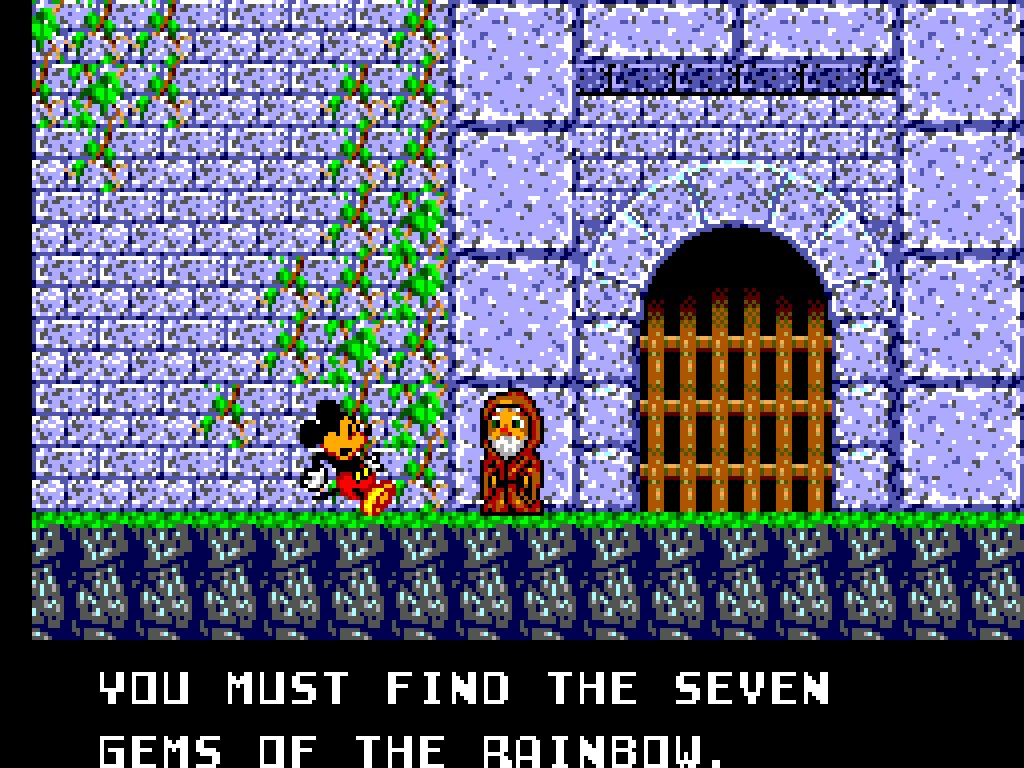
At a glance: Castle of Illusion Starring Mickey Mouse · Game Gear · Sega, 1991 · Platformer · Score: 8.5/10
There are two Castle of Illusions, and the 8-bit one is not the consolation prize. The Mega Drive game is a famous beauty; the Master System and Game Gear version, built separately by Sega in 1991, is a different and in several ways cleverer game — a platformer of bouncing, block-carrying and gem-hunting through the witch Mizrabel’s castle to rescue Minnie, designed from the ground up for 8-bit hardware and still, in its handheld edition, one of the finest platformers Sega ever made. If Land of Illusion is the series’ masterpiece, Castle is its foundation, and on the Game Gear it loses almost nothing in the telling.
Mizrabel has kidnapped Minnie, and Mickey’s rescue runs through the castle’s enchanted domains — the forest, the toybox, the library, the clock tower, the castle’s candy-coloured depths — each guarded by a Master of Illusion holding one of the rainbow gems that will build the bridge to Mizrabel’s tower. The structure is classic and clean: five worlds of three stages, a boss, a gem, onwards. What distinguishes it is the play. Mickey bounces on enemies in the style his series made famous, but the 8-bit game adds hands: Mickey can pick up blocks, barrels and springs and throw or place them — as weapons, as steps, as solutions — and that single addition deepens every stage into a small puzzle of positioning.
The clever Castle
The block mechanic is the design’s pride. A barrel is a shield, a projectile and a platform; a spring is a lift you carry with you; whole secret areas hinge on noticing that the scenery is portable. Combined with the bounce’s precision — Mickey’s arc is perfectly judged, his landing forgiving by a pixel of grace — the game achieves the Illusion series’ signature feel: gentle on the surface, exact underneath, with speed available to players good enough to chain bounces through a stage without touching the ground. Practice mode, a kindness of the 8-bit editions, lets new players learn the forest without consequence — a small, humane feature decades ahead of standard practice.

Presentation is storybook-perfect. The forest’s greens, the library’s lamplit browns, the clock tower’s blues — the Game Gear’s palette is this game’s native soil, and in colour the 8-bit Castle is arguably prettier, area for area, than its television sibling, whose identical art was tuned for the Master System’s more limited range. The music is the series at its most hummable: the forest theme alone has lived in players’ heads for three decades. Mickey’s animation — the strut, the bounce’s wind-up, the dizzy stars — is a masterclass in making eight pixels of mouse into a character.
Game Gear versus Master System, plainly
The two 8-bit editions share their design almost completely — same stages, same bosses, same gems — and the differences are the system’s eternal pair. The Game Gear shows a smaller window: in the toybox and clock tower, a few descents ask for faith the Master System’s television view does not. The Game Gear shows richer colour: every world glows a little warmer, Mizrabel’s castle a little more enchanted. Bosses are identical twins on both machines, and charming ones — the forest’s great tree, the clockwork guardians — though none will trouble a practised player for long, this being the gentlest of the Illusion games by design. Choose the handheld for colour and portability; choose the console for view; love both for the game.
The Mega Drive game is the famous beauty. The 8-bit Castle is the cleverer design — and on Game Gear, in full colour, it is the one that feels like home.
Its brevity is the standing caveat: a skilled player finishes Castle of Illusion in well under an hour, and the adventure offers no second quest beyond score and mastery. In 1991, on batteries, that brevity was a feature; the game is a perfect handheld length, a complete fairy tale in a sitting. Modern players raised on its sequel’s sprawl should adjust expectations accordingly — and then notice how little fat there is on this smaller, tighter design.

The foundation stone
Everything the Illusion series became starts here: the bounce, the carried blocks, the gems, the Masters of Illusion, Mizrabel herself. Land of Illusion would add the tools and the map; Castle keeps the purity. As the Game Gear’s library settles into history, this cartridge’s reputation has only grown — the rare licensed game, the rare launch-era title, that needs no apology, no asterisk, no you-had-to-be-there. You did not have to be there. It is still wonderful now.

The bosses and the gems
The Masters of Illusion repay a roll call. The great tree of the forest, all snapping branches and falling fruit; the toybox’s jack-in-the-box menace; the library’s literary hazards; the clock tower’s mechanical guardians — each is a gentle puzzle of pattern and bounce placement rather than a test of reflexes, which suits the game’s fairy-tale register exactly. Mizrabel herself, when the rainbow bridge finally carries Mickey to her tower, escalates with a witch’s full bag of tricks, and the rescue that follows lands its storybook warmth without a wasted frame. None of it will frighten a veteran. All of it is pitched, deliberately, at wonder rather than challenge — and wonder, sustained across five worlds without a dip, is the rarer achievement.
A final word on the two-console question this game always raises. Players meeting the Illusion series today usually arrive via the Mega Drive’s famous edition, and the kindest service a review can do them is this: the 8-bit Castle is not the same game in worse clothes, it is a second Castle, with its own stages, its own mechanic in the carried blocks, and its own claim on the series’ heart. Own both if you can. If the Game Gear is your machine, know that your Castle is nobody’s runner-up.
Length, stated one final way for the buyer: the five worlds run an experienced player perhaps forty minutes, a first-timer a wondering couple of hours, and the game’s restraint is precisely why it replays so well — it is the platformer equivalent of a perfect short story, the one pulled down from the shelf most often. In a medium addicted to bloat, Castle of Illusion’s discipline only looks better with age, and the Game Gear edition — colour, practice mode, pocket size — is its most pullable form.
The soundtrack’s afterlife makes the same point in miniature: its forest theme has been rearranged, covered and quoted for thirty years, and players who could not name the game can hum the tune. Music that survives its hardware is the surest signature of a classic, and Castle of Illusion signs every page.
Verdict
Castle of Illusion on Game Gear is an 8-bit classic in its best edition: cleverer than its famous 16-bit namesake in design, warmer in colour than its Master System twin, and short only in the way fairy tales are short. The cropped view is its one inherited flaw. For platformer fans and Game Gear collectors alike, it is essential — the first stone of the Illusion series, and still one of the brightest.