
The Game Gear’s dirtiest secret was printed in its spec sheet all along: it is, to a first approximation, a Master System. Same Z80 processor family at the same speed, a video chip descended directly from the Master System’s VDP, the same sound hardware, the same cartridge logic — Sega’s handheld was not a new platform so much as its 8-bit console reborn in a smaller body, with a bigger palette, a smaller screen and a stereo headphone jack as its birthright gifts. And that heritage had a physical consequence that remains the best party trick in retro gaming: with one plastic adapter, the Game Gear could play the Master System’s library. Hundreds of cartridges. In your pocket. In 1991.
The adapter was the Master Gear Converter — sold as the Gear Master Converter in some territories, and cloned, copied and reissued by third parties ever since. It is an unglamorous slab of plastic that slots into the Game Gear’s cartridge port and presents a Master System slot on top, pass-through electronics doing little more than rerouting pins: because the two systems are electrically near-identical, the converter needs almost no intelligence of its own. Slot a Master System cartridge in, switch on, and your handheld becomes the console — Alex Kidd, Wonder Boy, Phantasy Star, the whole 8-bit Sega canon, on the bus.
Why it works — and what changes
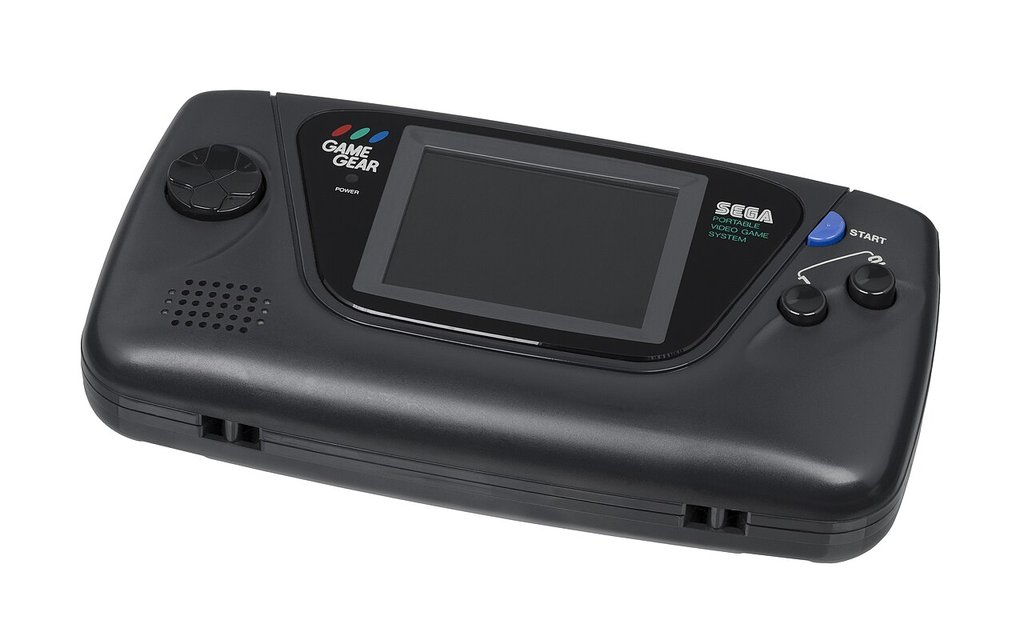
The reason it works is that shared bloodline. The Game Gear’s graphics chip is the Master System’s VDP with its colour palette expanded from 64 colours to 4,096 — Master System games simply use the subset they know. The screen is where the translation happens: the Master System’s 256-by-192 image is scaled down to the Game Gear’s 160-by-144 display, and that scaling is the converter experience in miniature. Sprites shrink, text in RPGs becomes an exercise in squinting, and fine detail softens. Phantasy Star is playable; Phantasy Star’s menus are a young person’s game. Action titles fare best — the Wonder Boys, Shinobi, the Sonics — because they were drawn bold to begin with.
There are honest limits, and a good feature should list them. The Game Gear’s Start button does duty where the Master System expects its own inputs, and a handful of Master System peripherals and oddball cartridges simply have no handheld life: no light guns, obviously, no 3D glasses, and the SG-1000 back-catalogue that Japanese Master Systems could run stays locked away. Card-based games from the early Master System era need the console’s card slot, which the converter does not provide. Battery life, too, treats a converter-and-cartridge tower with the usual Game Gear contempt. But the core promise — the cartridge library, hundreds strong — holds.
The Master Gear Converter was not an accessory. It was a second library, sold for the price of a slab of plastic, hiding inside a spec sheet.
The library it unlocked
Consider what the converter did to the Game Gear’s value in 1991. The handheld’s native catalogue at launch was a dozen titles; the Master System’s back catalogue was years deep and, in Europe especially, still growing — Europe, where the Master System outsold the NES and kept receiving games deep into the nineties, became the converter’s natural homeland. A European Game Gear owner with a converter had access to one of the largest 8-bit libraries in the world, much of it cheap, much of it excellent, all of it portable for the first time. The flow ran the other way too, in spirit: the shared architecture is precisely why so many games exist in near-identical Master System and Game Gear editions — Castle of Illusion, Land of Illusion, Ecco, the early Sonics — because porting between the siblings was a matter of weeks, not reinvention.

The converter today
Time has been kind to the idea and mischievous to the hardware. Original Master Gear Converters are common enough and affordable; the third-party clones that proliferated in the nineties — some excellent, some with slot tolerances that chew cartridge edges — remain in circulation, and modern reproductions have joined them. The collector’s caveats are practical: the converter stacks the cartridge high, making the whole assembly comically top-heavy; the Game Gear’s own capacitor plague must be cured before any of this matters; and Japanese Master System cartridges, which use a different cartridge shape and pinout from Western ones, need their own adapter chain or a Japanese machine’s library played another way. None of it stops the trick from working, thirty-five years on, exactly as advertised.
What the siblings taught each other
The shared architecture shaped both libraries in ways that are easy to miss. Because conversion between Master System and Game Gear was measured in weeks, Sega’s 8-bit division could treat the two formats as one market: a game greenlit for the console had a handheld edition by default, and the handheld’s best originals fed ideas back to the console line. The result was a combined catalogue far larger than either machine could have sustained alone — one of the quiet reasons 8-bit Sega remained a living ecosystem in Europe years after North America had moved on. The converter merely made visible what the release schedules already knew: these were not two platforms. They were one platform with two front doors, and the Game Gear’s door happened to fit in a coat.
There is an irony in where the idea ended up. Modern retro hardware has reinvented the converter a dozen times — adapters that let one handheld play another system’s cartridges are now a product category of their own, marketed with exactly the wonder Sega’s slab offered in 1991. The Master Gear was first, cheapest and simplest, because Sega had done the clever part years earlier, at the drawing board, when it decided its handheld would be its console’s blood relative. The adapter is not the trick. The genealogy is the trick.
There is a coda that makes the whole story sweeter. Sega itself eventually admitted the family resemblance in product form: the Master System’s DNA ran through the Game Gear, the Game Gear’s palette became the envy of its class, and the modern retro scene treats the two libraries as one ecosystem — flash carts serve both, emulators share cores, and a recapped Game Gear with a converter in the drawer is, in 2026, close to the complete 8-bit Sega experience in a single handheld. The Master System in your pocket was the pitch. It was also, unusually for a pitch, simply true.
Which leaves the converter where it began: in the slot, doing nothing clever at all, while the machine underneath it does something quietly extraordinary — being two consoles at once, and having been designed, from its first transistor, to be exactly that.
Practical collectors’ notes, to end where a feature should: seat the converter firmly, support the cartridge tower in play, and keep the whole assembly out of bags where the leverage can worry the slot. The electronics are immortal by the standards of the era — there is almost nothing in the slab to fail — so a converter bought once is a converter kept for life, which is more than can be said for most of the machines it serves. It will outlast us all, passing Master System cartridges into handhelds not yet recapped, exactly as it did in 1991.