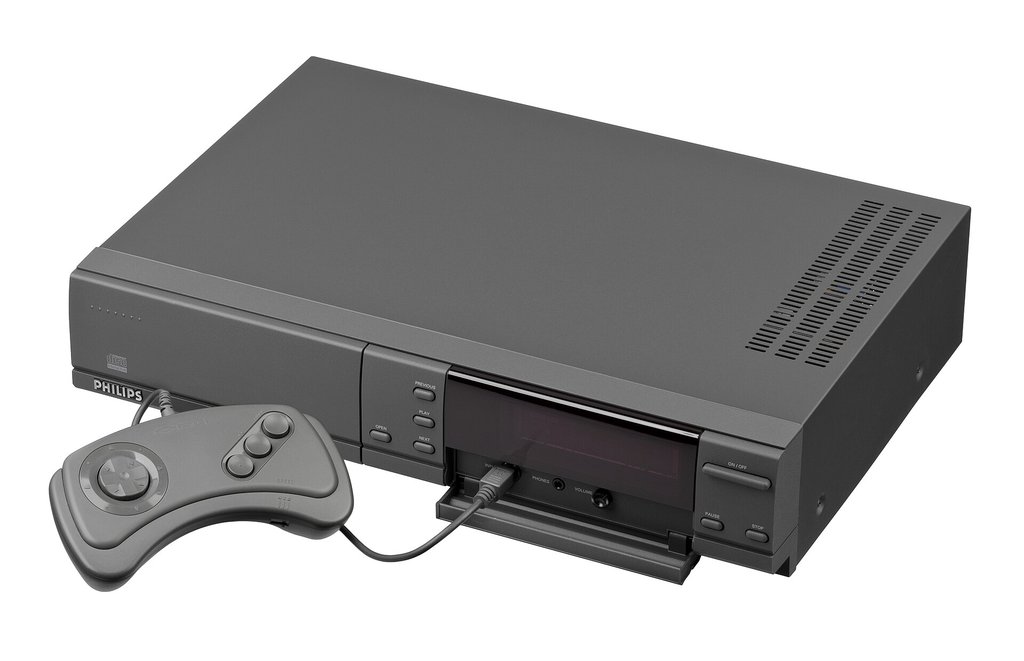
Ask a collector to picture “the CD-i console” and you have already made a category error — there is no such single object. The CD-i was a format before it was a product, an open Green Book standard that Philips licensed the way 3DO would later try to: any manufacturer could build a player, and several did. The result is one of the strangest hardware families in home entertainment: professional rack units and portable briefcases, hi-fi separates and game-oriented budget boxes, Philips machines wearing Magnavox badges in America, a GoldStar, an LG, a Kyocera, a Sony professional line that history mostly forgets. This is the family album — the players that carried one format into a thousand living rooms that never agreed on what it was for.
The line begins in 1991 with statement pieces. The CDI 910 was America’s first consumer player, sold under the Magnavox name Philips owned, at a launch price that made headlines of the wrong kind — around a thousand dollars for a machine whose software library was mostly encyclopaedias and children’s titles. Its European sibling line, the 200 series, set the template: the CDI 205 entry model, the CDI 210 that became the workhorse of schools and kiosks, and above all the CDI 220, the family’s most beloved machine. The 220’s later revisions are the connoisseur’s choice today: a robust loading mechanism in its mature versions, front and rear controller ports that both accept pointing devices, S-Video output, and 32KB of save memory where lesser players carried 8KB. If the CD-i has a flagship in collectors’ hearts, it is a late 220.
The family spreads
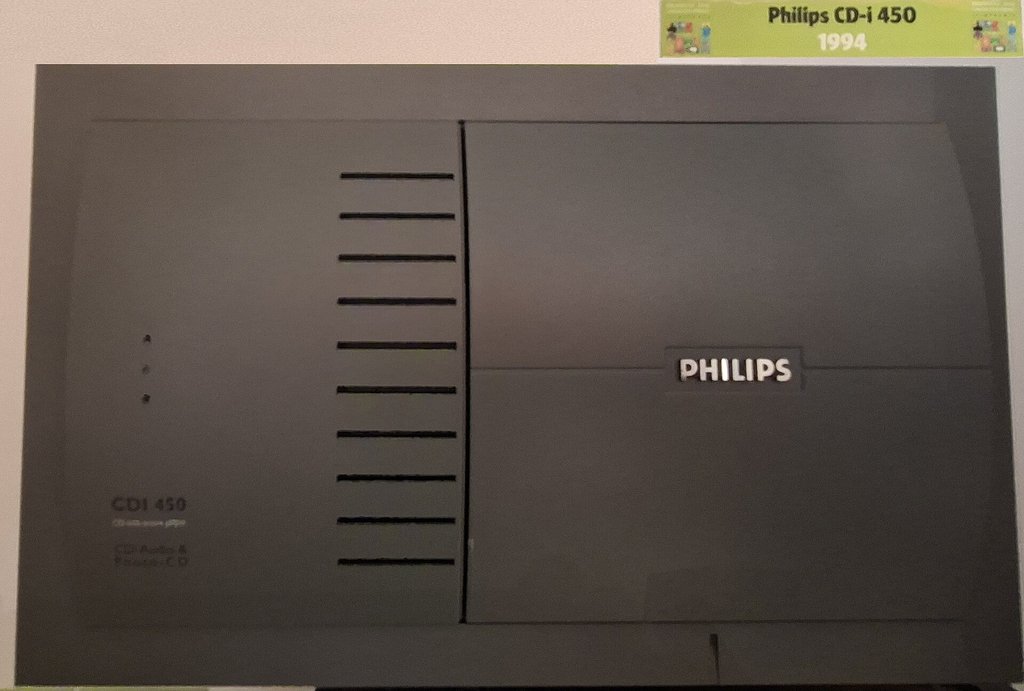
Philips segmented the line the way hi-fi ranges segment, not the way consoles do. The 300 series went portable: the CDI 350 is a briefcase player with its own screen, built for salesmen and trainers, often found with the 9142 extension module that adds a Digital Video Cartridge to its hip. The 400 series went for the games Philips kept half-apologising for: the CDI 450, smaller, cheaper, styled like a console, aimed at players rather than families, is the machine most likely to be found in a retro games collection today — and the one whose lighter build and fussier drive keep repair forums busy. The 500 and 600 series faced the other way entirely, toward business: the CDI 550 and the professional 605, a developer-grade unit with expansion for authoring work, floppies and hard drives, the machine the software was actually made on.
Then there are the partners, the proof that the format was a standard and not a product. GoldStar — soon to be LG — built the GDI 700, a compact player that modern enthusiasts rank among the very best: built-in digital video, 32KB of memory, a replaceable clock battery that spares it the family’s defining fault, and unusually sharp picture output; it also lives a double life rebadged as the DVS player in America. Kyocera built the Pro 1000S. Sony — yes, that Sony, Philips’ partner in the CD itself — built professional CD-i players for the education and kiosk market even while its own PlayStation plans were gestating. Philips itself blurred every boundary it drew: Magnavox-badged machines in the States, combined TV-player units in Europe, and a final cost-reduced wave as the format wound down toward its 1998 discontinuation, with total player sales somewhere between 570,000 and a million depending on whose history you trust.
One format, a dozen personalities
What the family shares is the guts: a Motorola 68000 at 15.5 megahertz, a megabyte of RAM, Microware’s CD-RTOS operating system, and the format’s signature weakness — a timekeeper chip, battery and memory sealed in one module, whose slow death now haunts every model in the range to one degree or another. What the family does not share is everything else: drive mechanisms from swing-arm antiques to the mature loaders, memory sizes, video outputs from RF-adjacent misery to proper S-Video, controller ports present, absent or half-functional depending on model and revision. Two machines both called CD-i can be as different in ownership experience as a games console and a laptop. That was the licensing model’s promise and its curse: variety for every niche, coherence for none.
The CD-i family is what happens when a format is designed like hi-fi and sold like a console: a dozen machines, each somebody’s ideal, none of them the standard the software needed. Collectors today inherit the whole argument, one player at a time.
The afterlife has sorted the family with a collector’s clarity. The 220’s late revisions and LG’s GDI 700 top the wish lists; the 450 carries the games-room flag; the 350 portable and the 605 professional unit have become the exotic exhibits; and the early 910/205 machines stand as museum pieces of the thousand-dollar dream. Prices follow condition and, above all, the timekeeper — our buying guide has the full triage. But the family album itself is the point: no other failed format left so many different machines behind, because no other format was ever so unsure, so prolifically, about what it was. Every CD-i player is a different answer to the same question. The question was the future. The answers are now antiques, and fascinating ones.

Stand the family in a row — rack unit, hi-fi deck, briefcase, games box — and you are looking at the multimedia decade’s whole identity crisis in brushed aluminium and grey plastic. It never resolved. That is precisely why it rewards collecting: each machine is a hypothesis, and the library of discs is the experiment they all shared.
Badges, clones and the American detour
The family’s oddest branch grew in America, where Philips sold its own machines under the Magnavox name it owned — so the same 200-series engineering appears in US listings as Magnavox players, a source of permanent confusion in the second-hand market and a gift to bargain hunters who know the badges are interchangeable. Around the edges sit the true exotics: combined television-and-player units for the European market, hotel and airline variants, the Sony professional machines built for education contracts, and a tail of late, cost-reduced models assembled as the format wound down, some of which blur into the professional line entirely. A complete CD-i hardware collection is a genuinely open-ended project — new variants still surface in enthusiast documentation — which is either the family’s curse or its charm, depending on the size of your shelving.
What unifies the hunt is that every model tells you which future Philips thought it was selling that quarter: the classroom, the boardroom, the games room, the hotel room, the living room. The format’s failure is usually told as a single story. The hardware tells it as a dozen, running in parallel, in brushed aluminium. That is why the family, as hardware, out-argues the software: the software is mostly one story told many times. The machines are many stories, told once each.
A collector’s footnote completes the album: because the players were sold through hi-fi, education and professional channels as much as through games shops, surviving machines arrive with biographies — ex-kiosk 210s with thousands of hours on their drives, ex-training 350s with their briefcases and extension modules, ex-retail Magnavox units with American service histories. Model numbers alone do not price a CD-i player; provenance and servicing do, which is why the family’s modern market is a connoisseur’s market in the true sense. Our buying guide gives the triage. The album, though, is the pleasure: no other format asks its collectors to become historians of a dozen machines at once, and rewards them this well for it.
