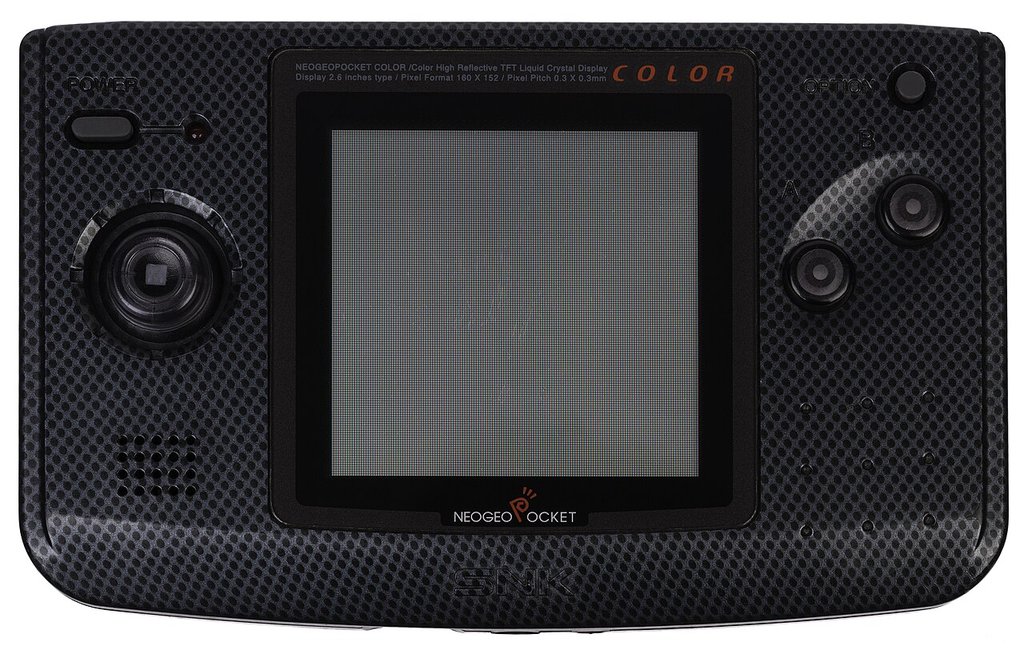
Pick up a Neo Geo Pocket Color and, before the screen even lights, your left thumb finds it: a small black stick that does not tilt so much as click. Push it in any of eight directions and there is a tiny, decisive snap — mechanical, audible, certain. Owners have a name for it, spoken with the reverence usually reserved for engine notes and guitar tones: the clicky stick. It is, by broad consensus of everyone who has ever used one, the finest directional control ever fitted to a handheld. This is the story of how a budget handheld came to carry a piece of arcade engineering — and why nothing since has matched it.
To understand the click, understand the switch. Under the stick sits a ring of microswitches — the same technology as an arcade cabinet’s joystick and buttons — and the stick’s shaft actuates them directly. A microswitch is binary and proud of it: it is either pressed or it is not, and it tells you so through your thumb with a sprung click. Nintendo’s cross-shaped D-pad, by contrast, presses on a membrane or rubber dome; the Game Boy’s control feels soft because it is soft, a squish interpreted as input. SNK, a company whose entire identity was arcade hardware, looked at the handheld problem and simply miniaturised the arcade answer.

Why it changed the games
The consequences show up the moment a fighting game boots. Quarter-circle motions — the fireball, the dragon punch — are the grammar of SNK’s fighters, and on a D-pad they are a thumb-sliding approximation that membranes often misread as diagonals or miss entirely. On the clicky stick, a quarter-circle is a tiny mechanical journey with audible checkpoints: down clicks, down-forward clicks, forward clicks. Players of the NGPC’s fighting library — Match of the Millennium, King of Fighters R-2, Samurai Shodown! 2 — consistently report the same surprise: the moves just come out, every time, in a way they never quite did on rival handhelds.
The stick’s virtues are not only about specials. Eight positive directions with tactile confirmation make for precise cursor work in strategy games, clean gear changes in racers, and — because the mechanism has a proper neutral and a short throw — remarkably few accidental inputs. It is also, by the standards of moving parts, tough: the switches are rated for the kind of cycle counts arcade operators demanded, and working NGPC sticks a quarter-century on still click with factory crispness. The rubber cap can wear; the mechanism beneath it rarely dies.
Down clicks. Down-forward clicks. Forward clicks. A fireball as a tiny mechanical journey with audible checkpoints — once felt, never forgotten.
The road not taken
The industry, of course, went the other way. Analogue sticks conquered home controllers in the late nineties, and handhelds followed with sliding pads and miniature analogue nubs optimised for 3D movement — a genuine need the clicky stick could never serve. But for 2D games, the dominant forms became the membrane D-pad and, later, the touchscreen: both cheaper, neither better. Modern retro handhelds have rediscovered the appeal — a few recent machines advertise clicky, micro-switch-style controls as a premium feature, which is the market quietly admitting SNK was right in 1998.

There is an engineering footnote collectors should know: the stick is integral to the motherboard’s front assembly, not a drop-in part, which is why a genuinely dead stick usually means a board-level repair rather than a swap. Fortunately the failure mode is rare. The common ageing issues are cosmetic — a worn or missing rubber cap, a dust-grimed ring — and gentle cleaning restores the feel. When you are buying a machine, test the stick first: eight clean clicks, no mushy directions, no grinding. A good stick is the whole reason to own the hardware.

The sound of a philosophy
Measured in clicks
There is a technical romance to the numbers, too. A microswitch does not drift, wear into vagueness or need recalibration the way potentiometer-based analogue sticks do — it is a spring, two contacts and a promise. Arcade operators, whose income depended on controls surviving public abuse, standardised on microswitches for exactly this reason, and SNK’s handheld inherited that industrial logic wholesale. The same philosophy shows in the buttons and in the machine’s general repairability: the NGPC was built by people who expected their hardware to be serviced, not replaced.
Players discovering the library today through compilations often ask why veterans insist the games ‘feel different’ on original hardware. This is why. Emulation reproduces the software perfectly and the stick not at all; the click is information — timing, direction, certainty — delivered to the thumb. Lose it and the fighters still play well. Keep it and they play as designed. The difference is the whole argument for the hardware in a single sound.
There is one more audience for the click worth naming: players for whom controls are accessibility. The stick’s decisive actuation — a definite click at a definite point, requiring modest, consistent force — is genuinely easier for many hands than the progressive squish of a membrane pad, where the difference between a diagonal and a cardinal is a matter of pressure and luck. Nobody marketed it that way in 1998; the industry barely marketed accessibility at all. But a quarter-century of owners includes players who found, in this little machine, the first handheld they could play fighting games on properly. Design that respects the thumb tends to respect thumbs generally.
Which returns us to the sound. Owners describe it the way vinyl people describe surface noise or photographers describe a Leica shutter — as the signature of a philosophy you can hear. Click. The arcade, miniaturised without being diminished. Click. A company that built its name on cabinets refusing to build down. Click. Twenty-five years, and it still tells you, eight times a second, exactly where you stand.
Manufacturers almost never get to be this right about an interface. The D-pad was a compromise that conquered the world; the analogue stick was a necessity that conquered a different one. The clicky stick was simply the best answer to its specific question — how should a 2D game feel in the hand? — and its tragedy is only that the question stopped being the industry’s favourite right after SNK answered it. The answer remains, clicking away in a million pockets and collections, waiting for the question to come back around.
SNK’s great rival in 1999 sold tens of millions of handhelds with a control that squished. SNK sold a fraction of that with a control that clicked. History recorded the sales; players recorded the feel. The clicky stick is the Neo Geo Pocket’s philosophy made physical — arcade standards, applied without apology, at any scale. Every revival of the library, every emulation handheld that maps these games to a pad, is in conversation with that little stick. Click it once, and you will understand the whole machine.