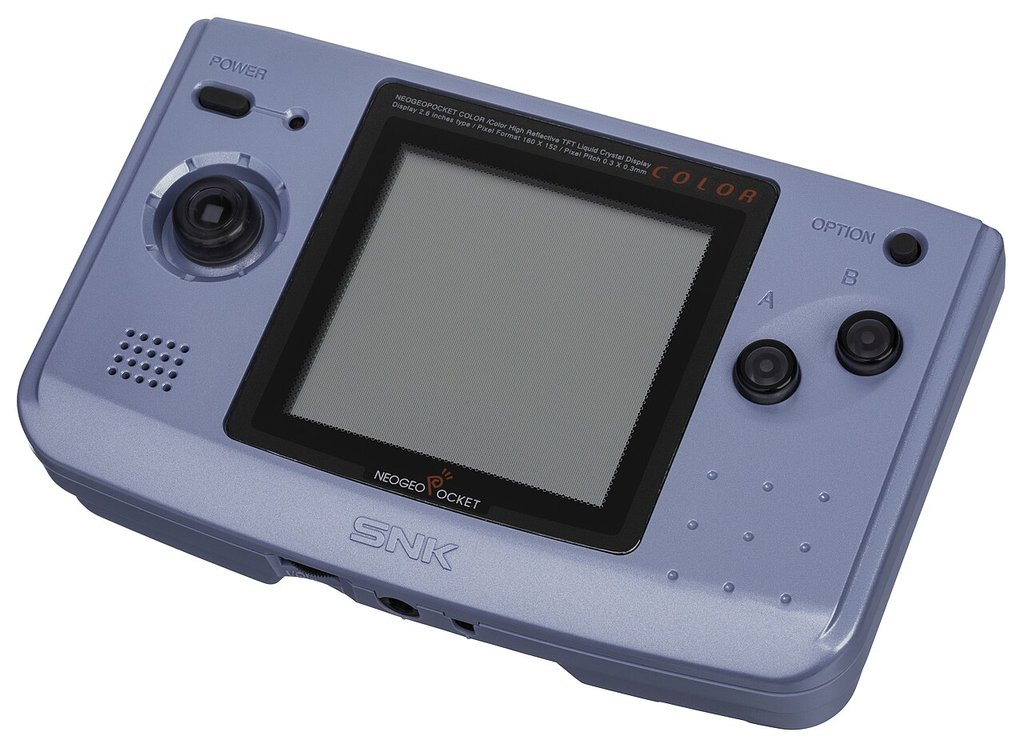
It is easy, now, to file the Neo Geo Pocket Color as a footnote — another Game Boy rival that wasn’t. The numbers invite it: Nintendo’s machine sold in the tens of millions; SNK’s sold in the low millions at best before the plug was pulled. But that filing misses the strangest part of the story. For fifteen months, from the spring of 1999 to the summer of 2000, SNK’s handheld was not failing. It was working. The NGPC is not a story about a bad product. It is a story about a good one whose parent company was sold out from under it.
The launch was the strongest any Game Boy challenger had managed. The Color reached Japan in March 1999, five months after the monochrome original had tested the waters, and it arrived with answers to every standing complaint about handheld gaming: a crisp colour screen that showed 3,932 colours from a palette of 4,096, a micro-switched stick instead of a squishy pad, battery life quoted around forty hours on two AAs, and a launch line-up with real games — King of Fighters R-2, Samurai Shodown! 2, Puzzle Bobble Mini — rather than the usual port-and-pray filler. In America it debuted in August 1999 at $69.95, initially as an online exclusive, and sold briskly enough to expand into national retail, Wal-Mart and Best Buy included. Critics were kind. Players were kinder.

The bet SNK made
SNK’s wager was that the arcade diaspora would follow it into pockets. The library reads like a manifesto: home-grown conversions of King of Fighters, Samurai Shodown, Fatal Fury and Metal Slug, all purpose-built rather than ported; third-party coups like Sega’s Sonic the Hedgehog Pocket Adventure — Sonic, on a rival’s hardware, two years before Sega left the console business; Taito and Data East puzzlers; even a Dreamcast link cable, built with Sega, connecting pocket fighters to their home counterparts. This was a company leveraging thirty years of arcade relationships to stock a handheld the way it had stocked the Neo Geo. For a while, the shelves looked great.
The cracks were structural rather than creative. Nintendo’s Pokémon phenomenon was eating the entire children’s market the NGPC needed; the Game Boy Advance was already looming, freezing retail enthusiasm; Bandai’s WonderSwan squeezed from the other side in Japan; and SNK’s American management, by the testimony of developers of the era, communicated poorly with the third parties it needed most. Sales in America were respectable — by some lights the best any Game Boy rival had achieved since the Game Gear — but respectable was not enough for what happened next.
The NGPC is not a story about a bad product. It is a story about a good one whose parent company was sold out from under it.
Aruze, and the summer it ended
In January 2000, Aruze — a pachinko giant — acquired SNK. Aruze’s interest was in SNK’s characters for its pachinko machines, not in a long war with Nintendo, and the handheld’s economics never stood a chance in that boardroom. In June 2000, barely fifteen months after the Color’s Japanese launch, SNK withdrew the NGPC from North America and Europe, recalled unsold stock (some of it later resurfaced in Asia, and in those famous loose-cartridge blister packs), and cancelled finished or near-finished Western releases — Faselei! and Evolution among them, their English editions already manufactured. SNK itself followed the handheld into the grave in October 2001, when the original company was declared bankrupt. The games division’s spirit passed to SNK Playmore, and eventually back to a revived SNK — but the Pocket’s war was over.

What remains is the library: around eighty games, a hit rate few systems of any size can match, and a reputation that has only grown in the emulation and compilation era. The NGPC Selection volumes on Switch and PC exist because new players kept discovering what 1999’s players knew: this was the connoisseur’s handheld, killed by a balance sheet, not by its games.

The last stand, judged
What the shelves said in 1999
It is worth reconstructing how the machine actually felt at retail, because the obituaries tend to skip it. The NGPC’s launch games were reviewed warmly across the press of the day; the hardware was praised precisely where Nintendo was weakest — screen quality per dollar, controls, battery life — and the $69.95 price undercut the Game Boy Color’s effective cost once games were counted. SNK’s American arm secured real distribution, television advertising and retailer support that rival handhelds of the era never achieved. The failure, when it came, arrived from the boardroom in a single summer: acquisition, withdrawal, recall. Retailers who had stocked a going concern were asked to return it. That is not a market rejection; it is an execution.
The human residue is in the library’s unfinished business: the Western releases manufactured but never shipped, the sequels announced and abandoned, the WonderSwan war in Japan left mid-battle. Every great NGPC game carries a small alternate history in its credits — the audience it was building toward, the follow-ups it earned. Few consoles leave so much potential energy on the table, and few are remembered with so little bitterness by the people who bought them. The last stand, in the end, worked: the machine is loved, on the record, forever.
One statistic frames the achievement. The NGPC’s Western life — launch to withdrawal — lasted roughly ten months in North America; its library of English-language releases was assembled in that window, at a quality-per-title ratio that systems with ten times the lifespan rarely match. Imagine the second year that never happened: the announced sequels, the mature third-party wave, the library at 150 games instead of 80. The counterfactual is unbearable precisely because the evidence of the first year is so strong. SNK was not guessing. It was compounding.
So file the NGPC correctly: not with the Virtual Boys and the Gizmondos, the follies and the frauds, but in the smaller, sadder category of machines that were winning their niche when the money moved. The Game Boy Color kept the market. The Pocket kept the argument. And arguments, unlike markets, can be re-opened — as every new player who picks up the little machine, feels the stick click, and asks ‘why have I never heard of this?’ proceeds to do.
If you want the whole tragedy in one artefact, find a copy of Faselei! in its UK clamshell: a finished, translated, manufactured game, released in one country, cancelled in another, by a company that ceased to exist the following year. The cartridge works perfectly. That was never the problem. It never was.
Could it have won? Against Pokémon, the Advance and Nintendo’s retail gravity, almost certainly not outright. But the NGPC was not losing when it died — it was building, at a price and quality that had earned it a durable niche. Handheld history is full of machines that failed because they deserved to. This is the one that didn’t. That is why collectors speak of it the way they do: not as a footnote, but as a last stand worth saluting.