
At a glance: ColecoVision vs Atari 5200 · Christmas 1982 · Coleco vs Atari · Feature
Christmas 1982 was the first great console war fought at full strength, and it had exactly two armies. In one corner, the ColecoVision: launched that summer by a company that had made leather goods and children’s pools before it made the Telstar, now armed with the home licence to Donkey Kong and the boldest graphics claims the industry had ever seen. In the other, the Atari 5200 SuperSystem: the empire striking back, a machine built from proven Atari computer technology, launched in November with the biggest name in home gaming behind it. Both cost around two hundred dollars. Both promised the same thing — the arcade, faithfully, at home. Only one of them would be a going concern by the end of 1984, and it was not the one with Atari on the box.
The challenger lands first
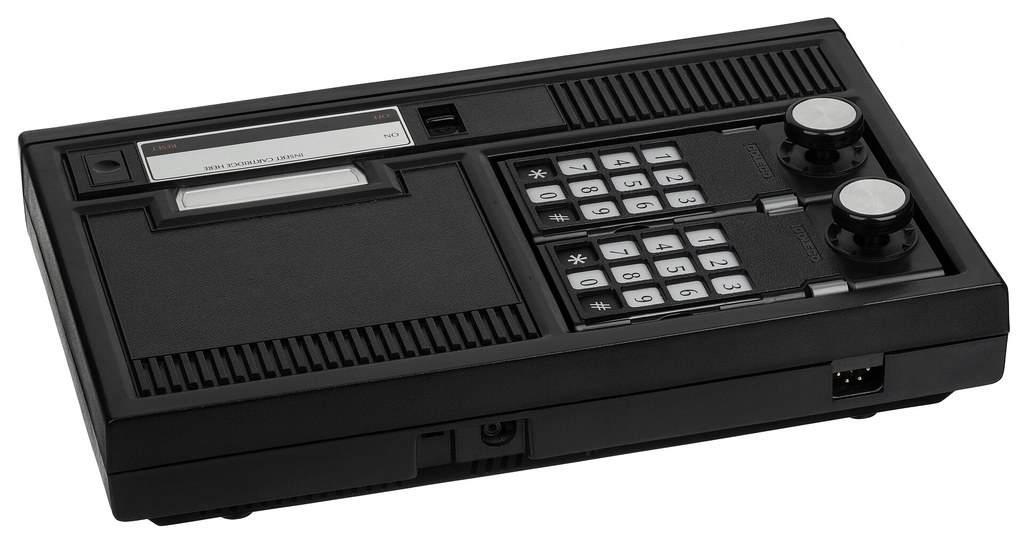
Coleco’s opening move was close to perfect. The ColecoVision arrived in August 1982 with Donkey Kong in the box — the biggest arcade game in the world at that moment, demonstrated on a machine that could actually do it justice. Reviewers who had spent years grading home conversions on a curve suddenly had nothing to forgive. The system’s Z80 processor and Texas Instruments video chip were arcade-adjacent technology, and Coleco backed the hardware with a licensing spree — Zaxxon, Venture, Lady Bug, and a shelf of Sega, Exidy and Universal titles nobody else had thought to buy. Coleco also sold an expansion module that played Atari 2600 cartridges, an act of cheerful corporate aggression that Atari’s lawyers could not stop.
The empire’s answer
Atari’s reply, three months later, was on paper the stronger machine in several respects. The 5200’s hardware descended from the Atari 400/800 computers — a MOS 6502 processor with the ANTIC and GTIA graphics chips and the POKEY sound chip, a combination with a richer colour palette and more flexible graphics than the ColecoVision’s, and sound that was arguably a generation ahead. Its launch catalogue leaned on Atari’s own arcade treasury: Galaxian, Centipede, Space Invaders, Super Breakout in the box. And it was enormous, in every sense: a vast black wedge of a console with a storage compartment for its controllers, four joystick ports on the original model, and an automatic RF switchbox that also carried the power — an industry first that baffled as many owners as it delighted.

But the 5200’s launch was where the war turned. There was no Donkey Kong — Coleco had it sewn up, and worse, Coleco advertised its version relentlessly. The pack-in was Super Breakout, a fine game and a six-year-old one, when the moment demanded a headline. The console could not play the mountain of 2600 cartridges in homes across America — Coleco’s machine, via the adapter, could. And then there were the controllers: the 5200’s analogue sticks, innovative in specification, proved fragile in service and imprecise in the hand, with a non-centring design that fought exactly the kind of games both machines were selling. Coleco’s controllers were nobody’s favourites either — squat sticks with keypads — but they were digital, predictable and replaceable. Atari’s became the story.
The war the crash decided
Through 1983 the contest was real: the ColecoVision’s catalogue kept growing stranger and stronger, Atari answered with excellent conversions of its own — Ms. Pac-Man, Joust, Robotron — and revised the 5200 into a cheaper two-port model compatible with a 2600 adapter of its own. Then the North American market collapsed. The crash of 1983–84 did not so much declare a winner as close the battlefield: Coleco pivoted to its Adam computer, fumbled it, and exited games by 1985; Warner sold Atari’s home division in 1984, and the 5200 was discontinued that year to clear the decks for the 7800. Both Christmas 1982 champions were gone almost together.

The machines by the numbers
For the record, the tale of the tape. The ColecoVision ran a Z80 at 3.58 MHz with a Texas Instruments TMS9928A video chip — 256 by 192 pixels, 32 sprites, 16 colours — and a sound chip that was competent rather than loved, with 1 KB of main RAM and the heavy lifting done by 16 KB of video memory. The 5200 answered with its 6502 at 1.79 MHz, 16 KB of RAM, and the ANTIC/GTIA pair producing up to 256 colours and the flexible display lists that let its best programmers build screens the ColecoVision’s hardware could not approach as easily, plus POKEY’s four-channel sound, which musicians still mine today. On paper the Atari had the better palette and audio; Coleco had the crisper sprites and, decisively, the better controller reliability and the better box game. The specification war was a draw. The marketing war was not, and specification wars never decide anything — a lesson the 5200’s spec sheet, the finer of the two, has been teaching on Atari’s behalf ever since.
The verdict of the afterlife
The catalogue war, shelf by shelf
It is worth pausing on the libraries, because that is where the war was actually decided. Coleco understood earlier than Atari that a console is a licensing portfolio: it bought the home rights to games Atari had never thought to want — Sega’s Zaxxon with its isometric clout, Exidy’s Venture, Universal’s Lady Bug and Cosmic Avenger — and it manufactured a sense of momentum, the feeling that the interesting games kept arriving on its side of the shelf. Atari’s 5200 catalogue answered with quality at the top — its own arcade conversions were often superb, and its Lucasfilm and twin-stick titles had no Coleco equivalent — but with less breadth and a slower cadence, and it never solved the Donkey Kong problem. Coleco did not merely have the game; it had the sequels, the computer versions, and the advertising line that wrote the era’s headline: the arcade experience, at home, was wearing Coleco’s badge.
The adapters tell the same story in miniature. Coleco’s Expansion Module #1, which let its machine play the 2600 library, was a declaration that the past belonged to whoever could run it; Atari’s answer for the 5200 arrived later and only for the revised two-port model. In a market where most households already owned a box of 2600 cartridges, backwards compatibility was not a feature — it was the argument. The 5200’s eventual counter, and the four-port model’s incompatibility with it, stranded the machine’s earliest and most loyal buyers, a detail that still surfaces in collectors’ buying decisions today.
There is a human footnote to the numbers. Both machines were designed by teams who believed, correctly, that home games were about to become indistinguishable from arcade games, and both teams were right about everything except the date and the company they worked for. The engineers’ consolation is the afterlife: the ColecoVision and the 5200 are now collected, studied and argued over by the same people, often on the same shelf, their war long since settled into a shared respect that the market never allowed them in 1982.
Forty years on, the honest scorecard is more even than the sales figures. The ColecoVision won its war on catalogue and timing; it has the bigger library and the better claim on 1982. The 5200, game for game at the top end, is arguably the finer machine to play now — its best conversions are superb, its sound is better, and its twin-stick and Trak-Ball tricks have no ColecoVision equivalent. The war’s real lesson is the one the industry keeps relearning: launches are won on the game in the box, the games on the shelf and the controller in the hand — and in Christmas 1982, the empire got two of the three wrong.