
At a glance: Inside the 5200’s hardware · Atari 5200 · Atari, 1982 · Console hardware · Feature
Pick up an Atari 5200 — and you will need both hands, because it is enormous — and you are holding a decision: rather than design a new games machine from scratch, Atari built its 1982 flagship directly out of its home computers. The SuperSystem is, at silicon level, an Atari 400/800 in a wedge-shaped black case the size of a small suitcase. That choice gave the 5200 a mature, capable chipset on day one, graphics and sound that outclassed most of what came before, and a library that could draw on years of 8-bit development experience. It also gave the machine its peculiar personality: powerful, over-engineered in some places, baffling in others, and — through one infamous accessory — misunderstood for forty years.
The computer inside
The core is a MOS 6502 running at about 1.79 MHz, the same heart as the Atari 8-bit computers, working with Atari’s custom team: ANTIC, the display processor that builds the screen from display lists and frees the CPU from drawing duties; GTIA, which handles colours, sprites — the famous player/missile graphics — and collisions; and POKEY, which combines sound generation with controller and keyboard duties. It is POKEY that quietly explains two of the 5200’s defining traits. Its four audio channels made the machine sound richer than its rivals, from Centipede’s heartbeat drums to the musical flourishes in Dig Dug. And because POKEY also reads potentiometers, the 5200’s controllers were specified as analogue devices read through those circuits — the architectural seed of the most debated joystick in console history.

The specification around that core was modest in the ways 1982 dictated: 16 KB of RAM, a cartridge ROM window that grew as bank-switching matured, and a palette of 256 colours of which games typically used a bright, confident subset. None of those numbers tell the story by themselves. In practised hands — and the 5200’s best programmers were often 8-bit computer veterans — ANTIC’s display lists and GTIA’s sprites produced the dense, colourful, fast screens of Robotron: 2084 and Rescue on Fractalus!, games that simply had no business looking that good on a machine designed in 1981.
Four ports, two ports, and the switchbox saga
The original 1982 model carries four controller ports across its front edge, a statement of intent about four-player gaming that the software catalogue only occasionally honoured, and a storage bay in the top where the controllers nest when the machine is put away — a thoughtful touch in a case the size of a coffee table book. Its party trick was the automatic RF switchbox: a single box that carried both the television signal and the console’s power, switching the TV to the game automatically when the console powered on. It was the first arrangement of its kind, and it is now the machine’s most notorious component, because when the switchbox or its unusual combined cable fails — and forty years is a long time — the console presents as completely dead. The 1983 revision simplified everything: two controller ports, a conventional separate power supply and RF connection, and internal changes that let it work with the CX55 adapter for playing 2600 cartridges.
The peripherals that showed the plan
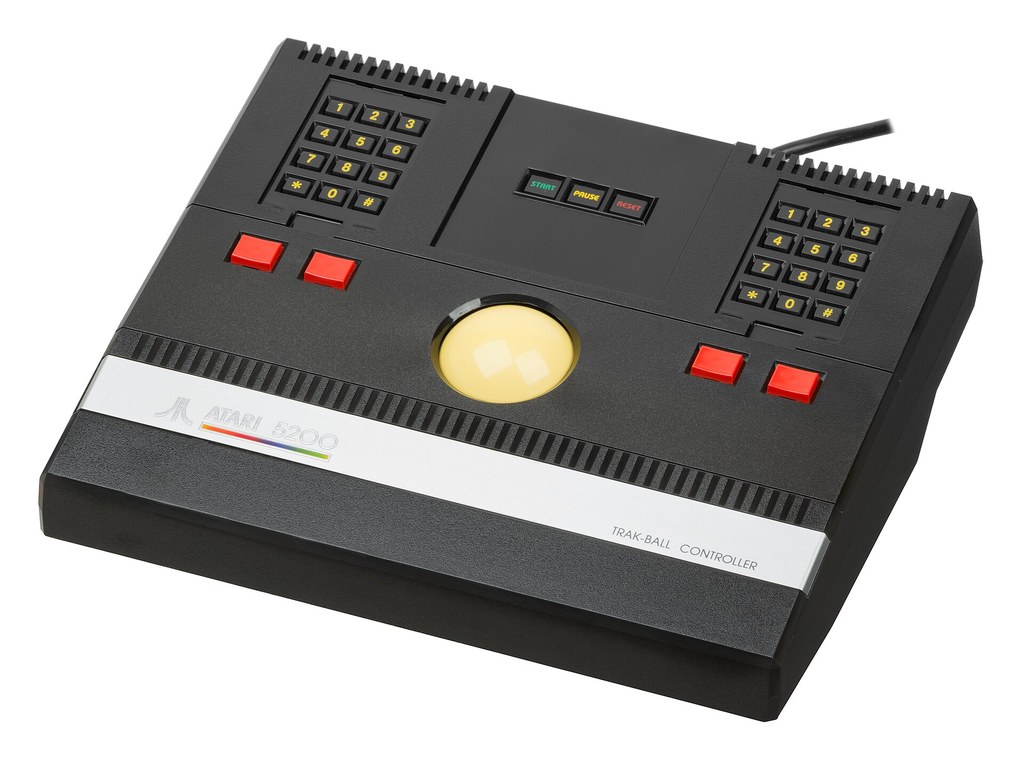
The Trak-Ball is the peripheral that reveals what Atari thought the 5200 could be. It is not a toy: a heavy desktop unit with a proper cue-sized ball, its own keypads and fire buttons, supported natively by the games that mattered — Centipede above all, where it delivers the true arcade experience, and Missile Command, Pole Position and others besides. Nothing comparable shipped for a rival console in the era. The twin-controller holder packed with Robotron and Space Dungeon belongs to the same story: cheap plastic, radical implication — a console designed to let two of its standard controllers become one twin-stick device, because the hardware team had given the machine generous ports and the software team had the sense to use them.
Big box, bigger ideas
Cartridges and the adapter gambit
The cartridge format tells its own hardware story. The 5200’s carts are chunky, shuttered boards — bigger than 2600 cartridges, with a sprung dust cover in the slot and a satisfying mechanical clunk — and they grew more capable as the library matured, with later titles using bank-switching to reach sizes the launch software never needed. The system’s expansion thinking culminated in the CX55, the adapter that let the revised two-port console run the entire 2600 library through the cartridge slot: a neat piece of engineering that is really a tiny 2600 in a cartridge shell, borrowing the 5200 for its power and video output. It worked well. It also arrived too late to change the war it was built for, and the original four-port model cannot use it at all — a compatibility fork that collectors still have to navigate, and a perfect emblem of the platform’s story: good engineering, deployed a season behind the moment it was needed.
A note on size, honestly
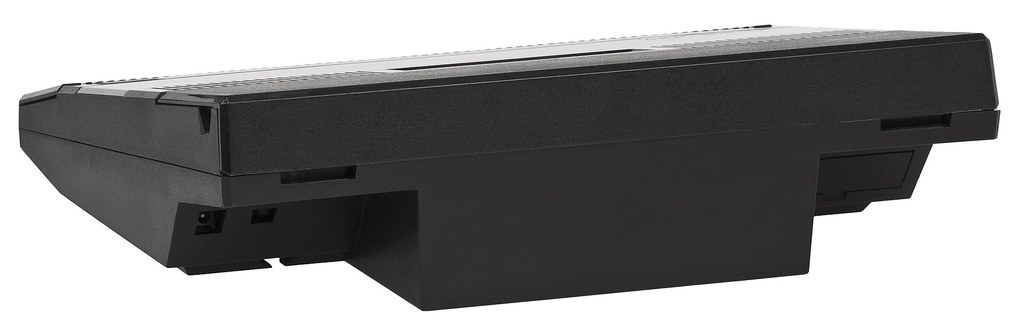
It would be evasive to discuss this hardware without confronting the footprint: the 5200 is roughly the size of two modern consoles side by side, and it was mocked for it even in 1982. The defence is that the case is mostly air and intention — room for the controller bay, the cartridge mechanism and a board layout a technician could service — but history’s verdict stands: in an industry learning to miniaturise, Atari shipped a sideboard. Owners today make their peace with it the way hi-fi owners do with big amplifiers. The shelf space is the price of admission, and the machine’s presence — that long silver band, that purposeful wedge — turns out to be part of the pleasure of owning it.
Living with the hardware today
The good news for owners in 2026 is that the hardware’s fundamentals have aged better than its finishing. The custom chips are robust; the boards are spacious, well-made and repairable by the standards of the era; and the failure points are known, catalogued and fixable. Capacitors get replaced as a matter of course. The four-port’s switchbox can be bypassed by a well-documented power modification. Video modifications that take composite or S-video directly from the board turn the machine’s clean internal picture into output a modern television can respect, and replacement controller internals — better flex circuits, better buttons — have quietly solved the reliability problem that defined the machine’s reputation, while leaving its unusual analogue feel intact. Few consoles of 1982 have this depth of aftermarket care, and it exists because the platform underneath the plastic was always worth caring for.
There is a design-historical point here, too. The 5200 was the last console built the old way — derived from a computer line, designed by engineers who assumed software would find the hardware’s strengths — before the industry standardised around purpose-built game hardware and, later, licensed development. Its strangenesses are the strangenesses of that transition: a keypad because computers had keypads, analogue sticks because POKEY read pots, a storage compartment because someone in industrial design thought about where controllers live. Judged as engineering, the 5200 is a machine of strong fundamentals and strange finishing decisions: computer-grade silicon and a rich palette, wrapped in a case twice the size it needed to be; four ports and an eye on multiplayer, paired with controllers whose analogue potentiometers and rubber boots would wear and wander; a clever switchbox that merged power and picture a decade before that was normal, and became a single point of failure for the whole console. But the fundamentals are why the machine still rewards its owners. The hardware was never the weak link in the 5200 story — the best of its library proves what the silicon could do — and nearly everything that frustrates collectors today can be rebuilt, replaced or bypassed. The big box had big ideas. It still does.