
At a glance: PAM and the prototypes · Atari 5200 · Atari’s unreleased games, 1982–84 · Feature
Before the Atari 5200 was the 5200, it was PAM. That was the project’s internal name — said to stand for “Personal Arcade Machine” — and it fits the ambition: a home machine built directly from Atari’s 8-bit computer technology, designed to put the arcade under your television with none of the compromises of the ageing 2600. PAM shipped in November 1982 as the SuperSystem, lived fast, and was discontinued in 1984 as Atari’s home division collapsed around it. But a games machine’s story is never only the cartridges that reached shops. The 5200 left behind one of the richest trails of finished-but-unreleased and nearly-finished games of any console of its era — prototypes that have since become playable history, and a window into exactly where the system was heading when the music stopped.
The Starfighter that never launched
The most famous of the lost is The Last Starfighter. Atari had the licence to the 1984 film — a film, delightfully, about a teenager recruited to an interstellar war by an arcade game — and built a first-person space combat game around it for the 5200 and the 8-bit computers. The hardware was pushed hard: a detailed cockpit, planetary surfaces, enemy fleets, the works. The cartridge was essentially complete when the decision came down that it would not be released under that name. The commonly told story, supported by the game’s later history, is that it was simply too late and too costly in a dying market; the code survived, and the game eventually reached the public years later reworked and renamed as Star Raiders II for Atari’s 8-bit line — a fine game, but one that arrived on the wrong machine, under the wrong title, to a fraction of the attention the film licence might have earned it in 1984.

Play the 5200 prototype today — it circulates in the preservation community and runs on real hardware via multicart — and what strikes you is how finished it feels. This is not a sketch. The presentation, the mission structure and the sense of scale are all in place. It plays like a flagship release, because that is what it was supposed to be: the licence-led blockbuster of the 5200’s second wave, cancelled by economics rather than quality.
Tempest, turning in the dark
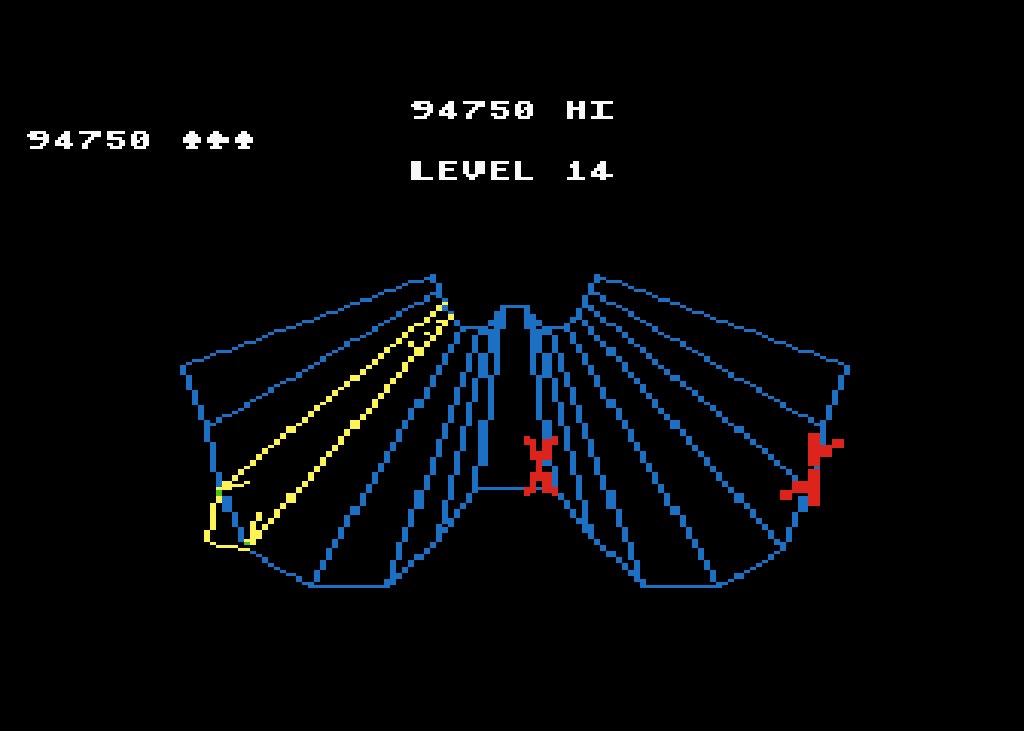
If Starfighter is the famous casualty, Tempest is the heartbreaking one. Atari’s own vector-arcade masterpiece — Dave Theurer’s tube shooter, all neon geometry and mounting dread — was in development for the 5200, and the surviving prototype shows a conversion well advanced: the web selection screen is there, the webs themselves are drawn in clean raster lines that evoke the vector look with real ingenuity, the Claw moves, the enemies climb. What the prototype also shows is a game straining at the hardware’s edges; the full Tempest experience, with its speed and its particle chaos, was a lot to ask of a raster display and a 1.79 MHz processor. The project was shelved unfinished. Decades later, the story got its ending: a completed version of 5200 Tempest was finally finished from the original code lineage and released through AtariAge in the 2010s, letting the SuperSystem own, at last, the game its designers had started for it thirty years before.
A drawer full of nearly
Around those two headline cases sits a whole drawer of nearly-games that the prototype scene has documented over the years. There were conversions in progress of arcade titles the 5200’s catalogue conspicuously lacks, experiments with the system’s peripherals, and finished or near-finished cartridges from third parties whose publishers folded or pulled out as the crash of 1983–84 gutted the market. Some survive as polished, playable builds; some as rolling demos; some as a title screen and a promise. Each is a small fossil of a decision made in a meeting in Sunnyvale or a warehouse write-down made in a panic, and together they redraw the 5200’s library from “what it was” to “what it was becoming”: more ambitious, more licence-driven, and increasingly confident with the hardware.

What a prototype actually is
A word on the physical evidence, because it shapes what survives. A 5200 prototype is usually a development cartridge — a board with socketed EPROM chips where the production mask ROM would sit, often in a lab-labelled shell, sometimes in no shell at all. Builds were burned, tested, revised and burned again, so a single game can exist in several dated states, and part of the historian’s craft is establishing which state a given board represents: near-final, like Starfighter, or an obvious work-in-progress with provisional behaviour. That is why the careful writers on the subject hedge where they hedge — release intentions were minuted in a company that was dissolving, and the paper trail is thinner than the plastic one. What is not in doubt is the trajectory the surviving builds describe together. The 5200 of the prototypes is a system preparing a second act: bigger licences, flagship conversions, deeper games. The act was cancelled. The rehearsals, thankfully, were recorded.
Why the prototypes matter
It would be easy to treat the unreleased games as trivia — a footnote for completists. They are more than that. First, several of them are genuinely good: Starfighter and the completed Tempest stand comparison with the best of the released catalogue, and playing them on a real 5200 is not archaeology, it is entertainment. Second, they correct the standard story of the machine. The 5200 is usually told as a system that failed out of the gate, but its prototype drawer shows a platform mid-stride — flagship projects, in-house conversions of Atari’s crown jewels, third parties still building — when the parent company fell over. The games did not fail. The calendar did.
How the lost games came back
The recovery story is worth telling, because the prototypes did not survive by accident. Through the 1990s and 2000s, collectors and historians traded EPROMs, dumped development cartridges bought from former Atari employees and estate sales, and cross-checked builds against internal part numbers and memos — the unglamorous archival labour on which all retro history quietly depends. The 5200 scene benefited more than most: because the machine shared architecture with the well-documented Atari 8-bit computers, recovered code could be analysed, repaired and understood, and because the community organised itself early around forums and, later, AtariAge, the recovered games found an audience equipped to appreciate exactly what they were. Some builds reached the public as limited cartridge releases, produced with a care — labels, boxes, manuals in the period style — that treated them as the commercial launches they never had. Others circulate as ROM images for multicarts and emulators, preserved if not packaged.
The Tempest completion is the emblematic case: an unfinished Atari work, documented in the prototype record, taken up decades later and finished in sympathy with the original code, then released on cartridge to reviews that judged it simply as a game — and judged it well. That is the moment the prototype story stops being about the past. A console whose unreleased games can still be completed, reviewed and argued about is not a dead platform at all; it is a slow one.
And finally, the prototypes gave the 5200 its afterlife’s first chapter. Long before the homebrew scene began writing new games for the machine, it was the recovery and circulation of these lost cartridges that kept collectors talking, kept the emulators honest, and kept PAM’s story from ending in 1984. The SuperSystem’s most poignant feature is that some of its best games were released twenty years late — and were worth the wait.