
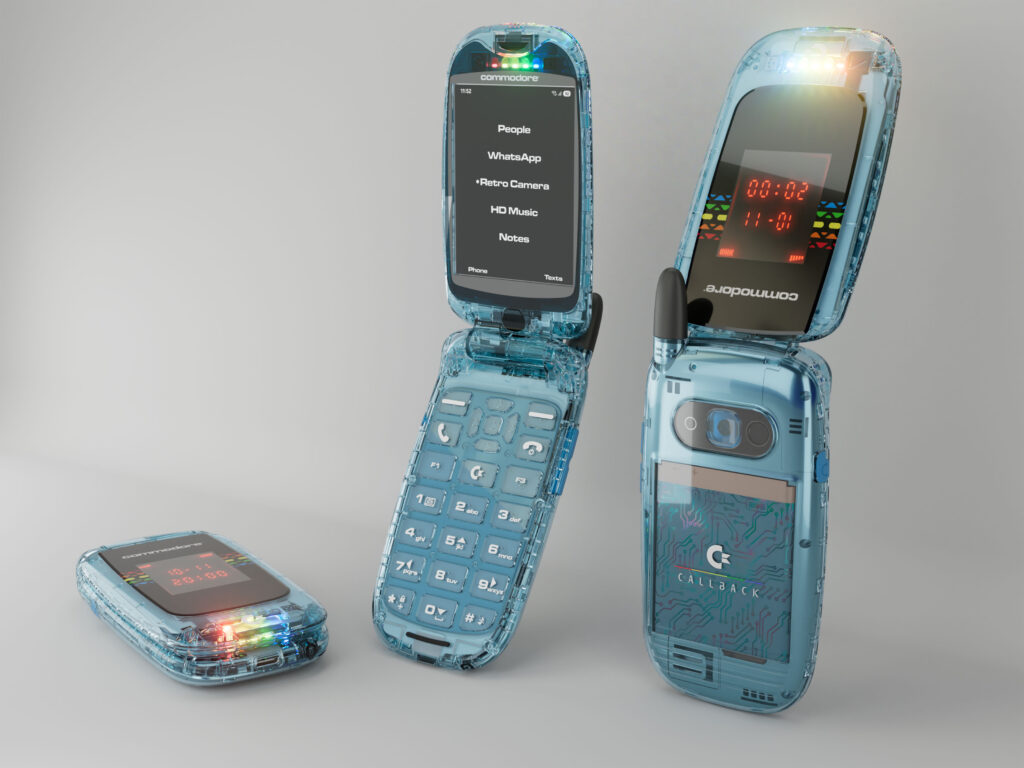
The Commodore Callback 8020 — the flip phone that blocks social media at system level and refuses to be talked out of it — has crossed the line from render to manufactured object. After trial production runs in Shenzhen in October, Commodore says full production ramped up in early November, and the first pre-order customers are forecast to receive their phones from late November into early December. This week the company also published the phone’s final app guide, confirming exactly what will and won’t run on it. Five months after the announcement, here is the state of the strangest phone of 2026.
Quick refresher. The revived Commodore — the brand bought in 2025 by retro YouTuber Christian “Peri Fractic” Simpson — announced the Callback 8020 on June 16 and opened pre-orders on June 30. The pitch is a phone placed precisely between dumb and smart: calls, texts, WhatsApp, maps, music and a proper camera, wrapped around a blocklist that cannot be switched off. Simpson’s own story is the sales pitch: he switched to a dumbphone after becoming a parent, found the minimal phones “too minimal,” and built the one he actually wanted. Commodore calls it “the not dumb dumbphone.”
At a glance — Maker: Commodore International Corporation · Announced: June 16, 2026 · OS: Sailfish OS (Jolla) with Android AppSupport · Display: 3.25in 480×640 IPS, touch off by default · Cover display: 1.77in VFD-style · Chip: MediaTek Helio G81 · Memory: 4GB RAM, 64GB storage, microSD to 256GB · Camera: 48MP Sony · Battery: 1,850 mAh, removable · Network: 4G LTE — no 5G, NFC or eSIM · Price: from $399 · First deliveries: late November–early December 2026 (forecast)
The Blocking Is the Product
Start with the bans, because Commodore does. Browsers and social media are blocked at the operating-system level using patent-pending tech, and the blocks are not a setting: there is no toggle, no PIN, no override. “Callback is built around those blocks,” the FAQ says. “That is the point.” The blocked list runs Facebook, Instagram, Snapchat, Threads, TikTok, X, YouTube, Reddit, Kick and Twitch, plus Discord, Roblox and Tumblr. Browsers are banned for a stated reason that is hard to argue with — “the browser is the back door,” because every blocklist leaks through a web view eventually.
The nuance the launch headlines missed: email is not banned outright. It isn’t preinstalled and isn’t offered in the setup wizard, but mail and work apps like Slack and Teams can be installed later from the app stores or sideloaded by APK. What you can never install is a browser or a social app.
Everything else runs on Sailfish OS — Jolla’s Linux system, built by ex-Nokia engineers — with an Android compatibility layer called AppSupport. Commodore quotes 99 percent Android app compatibility, and to its credit the fine print attributes that number properly: it is Jolla’s estimate for AppSupport, not a Commodore test result. The same fine print names the casualties: anything needing Google’s Play Integrity checks or Play Services underneath — Android Auto, Google Wallet tap-to-pay, many banking apps, some streaming apps — won’t work. There is no Play Store and no Play Services at all; a MicroG layer fakes the bits ordinary apps ask for. WhatsApp, Signal, Telegram, Spotify, maps and rideshare are all confirmed working.
Commodore Callback 8020 Hardware: 2004 Manners, 2026 Specs
Under the hinge it’s a MediaTek Helio G81 with passive cooling, 4GB of RAM and 64GB of storage. Commodore defends those numbers rather than apologising for them — the phone is sized “for essentials” — and a microSD slot takes cards up to 256GB; a 32GB card preloaded with music is in the box. The main screen is a 3.25-inch 480×640 IPS panel in real glass, and yes, it’s a touchscreen — but it’s off by default. The phone is driven from its tactile T9 keypad, the touch layer waking only when an app genuinely needs it.
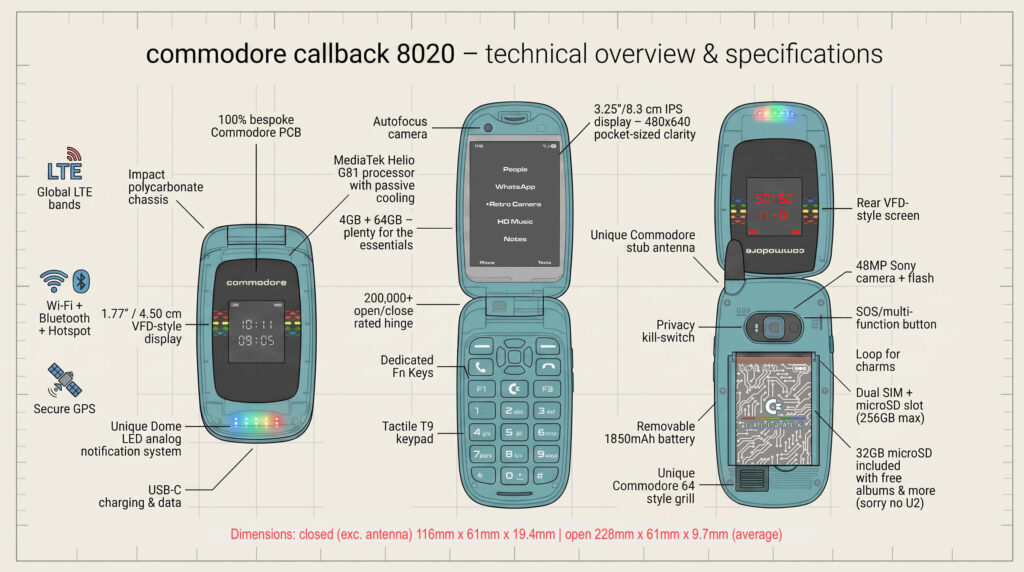
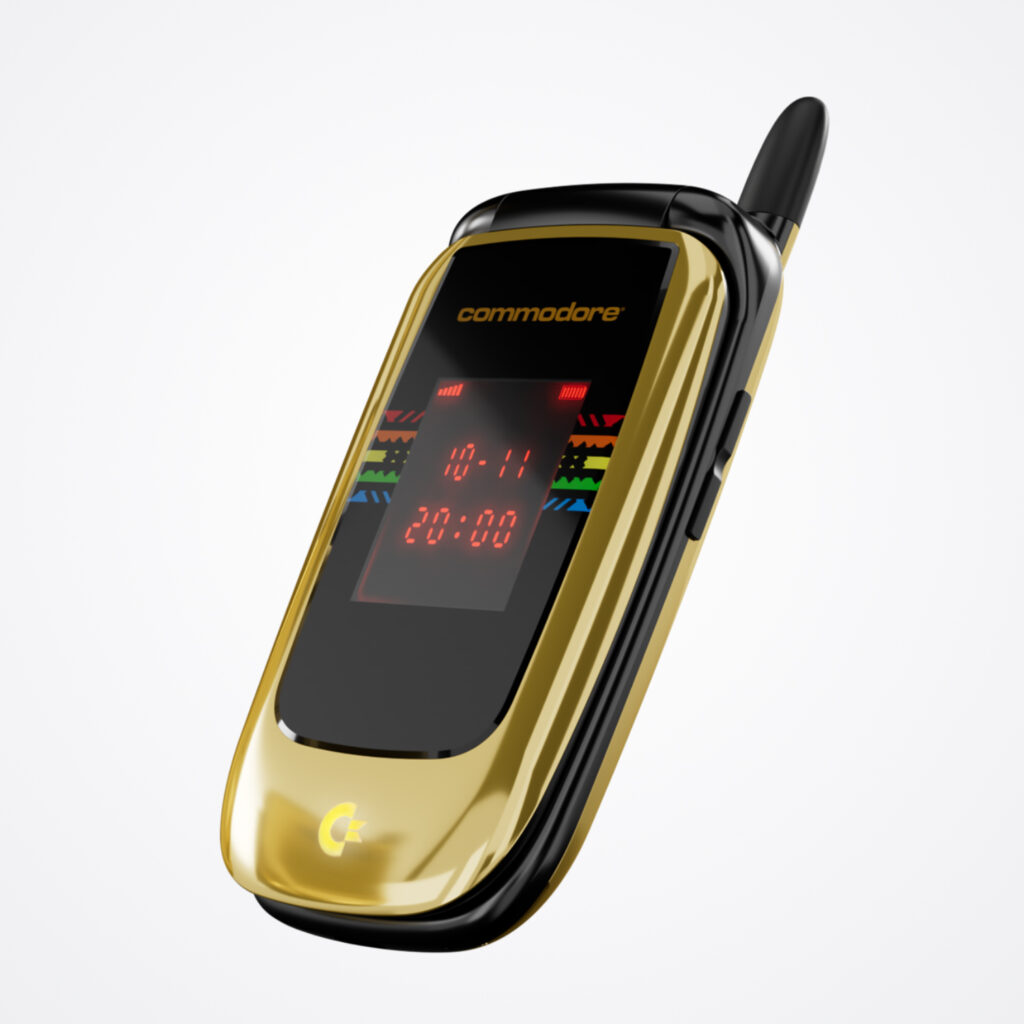
Outside is the party piece: a 1.77-inch VFD-style cover display glowing red like a 1970s Commodore calculator, showing time, date, battery and signal, flanked by five coloured dome LEDs that hint at notifications without naming them. The 48MP Sony camera sits in the lower half, so the closed phone previews selfies on that little red screen; there’s an autofocus front camera for video calls too. The battery is removable and quick-swappable — 1,850 mAh in final form, up from the 1,550 mAh quoted at announcement — and the hinge is rated for 200,000 flips.
The omissions are deliberate and listed proudly: 4G only (no 5G), no NFC, no eSIM — two physical SIM slots instead — and no RCS. There’s a physical privacy kill-switch on the back, a stub antenna, an IP44 splash-proof polycarbonate shell and swappable Snapback covers. Closed, it measures 116 × 61 × 19.4mm. By 2026 standards it is a brick. It knows.
The Commodore Bit Is Not a Skin
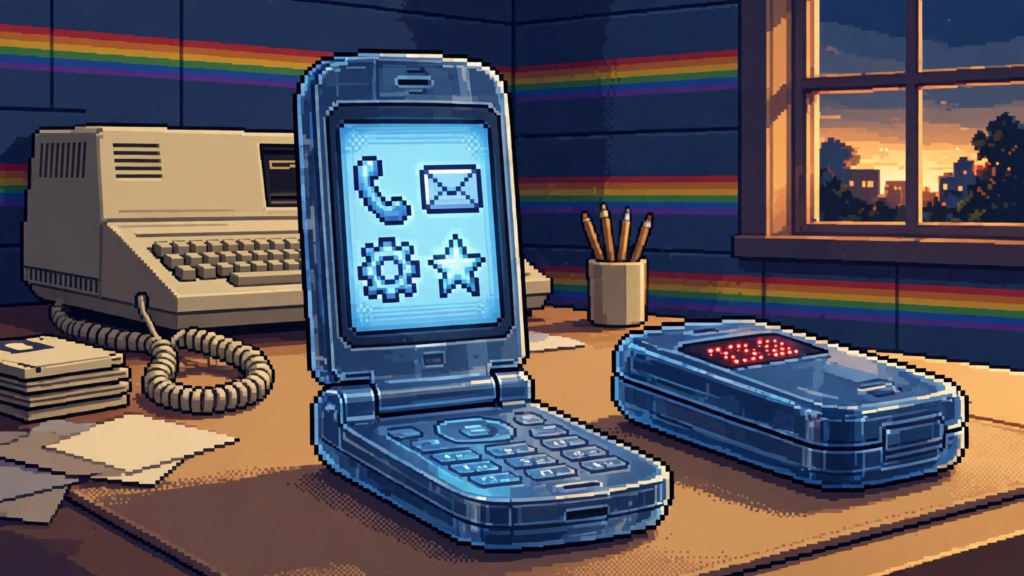
What separates this from the other minimal phones is that the retro layer is functional, not cosmetic. There’s a full SID music player running officially licensed chiptunes, SID ringtones, and an audiophile-grade DAC from Cirrus Logic — a company Commodore notes has supplied chips for its products since the 1990s — plus FM radio and HD albums preloaded on the bundled card. BASIC ships on the phone. So do curated Commodore 64 games — the new app guide names Jupiter Fracture — and Snake, which the press release insists is legally mandatory: “with Nokia heritage, it has to have Snake. It’s the law.”
The best trick needs a second Commodore product on your desk: the C64 Ultimate Remote app talks to a Commodore 64 Ultimate over Wi-Fi and can change its LED colours, load programs, open settings, and hit Turbo Boost to change the processor speed mid-game. Your phone, remote-controlling your other Commodore. The 8020 name is a deep cut in itself — Commodore says it’s the successor to the 8010, the highest-numbered modem the original company ever made, with a nod to both the 80s and the Y2K flip-phone era. The spiral-bound paper manual in the box makes the same point. Commodore has form here, too: it sold a branded rotary phone in Canada in 1983.
Prices, Editions and One Honest Caveat
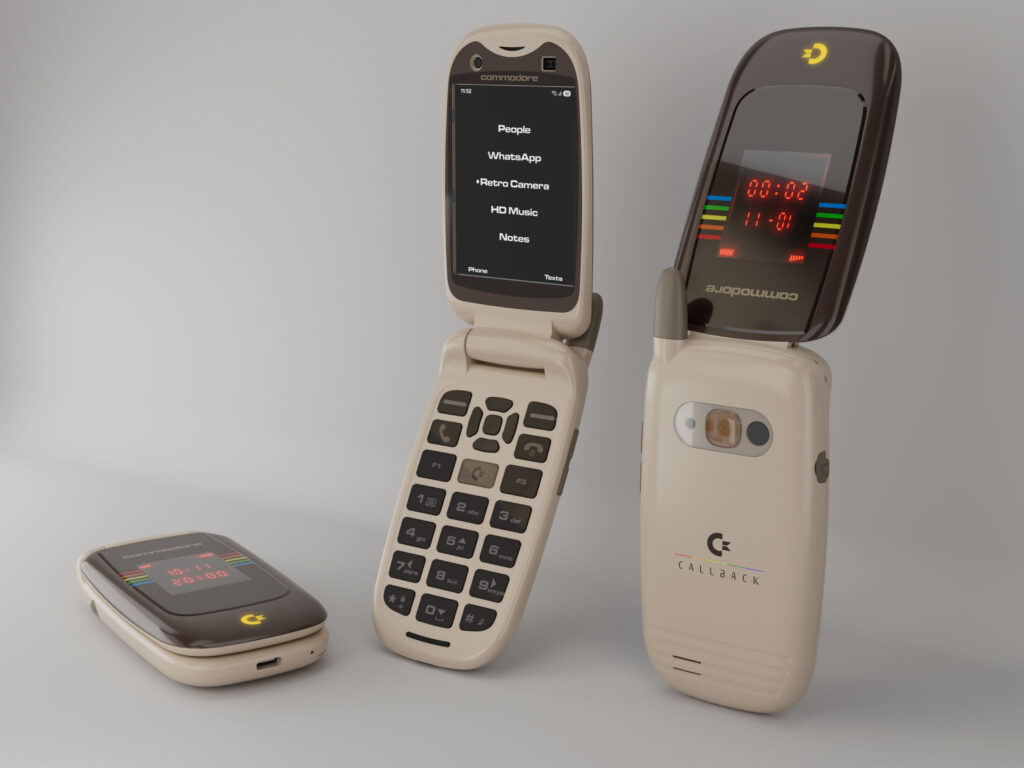
Four standard editions — BASIC Beige, ProtoPET White, SX Silver and the translucent Starlight — all cost $399 with Commodore’s “Zero Waste Eco-Validated” remanufactured memory, or $449 built with brand-new memory. That’s a $100 cut from the announced prices, made before pre-orders even opened by unbundling the premium headphones and switching to recycled memory chips. The Founders Edition is $640: PVD gold coating, a presentation ring box, a clear hard case, the audiophile earphones, and a 24k gold-plated C= key on the phone itself. Pre-orders are charged up front, can be cancelled any time before shipping for a full refund, and shipping is free worldwide at launch.
Commodore published its own comparison on November 5, and it’s not wrong about the gap: the Light Phone III costs $899 with no WhatsApp; the Mudita Kompakt matches the $399 but answers with an E Ink screen and an 8MP camera; the Punkt MP02 is calls, texts and not much else. The Callback is the only one of the four with WhatsApp, a serious camera and a hi-res music chip — and the only one that treats social media as a hardware defect.
Demand, at least, appears real. Commodore posted that the Callback matched the C64 Ultimate’s entire first month of sales in three days — “our biggest launch” — and enthusiast site GenerationAmiga puts pre-orders at an estimated 8,000 to 10,000 units. That figure is an estimate, not an official count, but the direction isn’t in doubt.
Now the caveat, from Commodore’s own fine print: the Callback “has not yet completed the FCC equipment authorization/certification process,” and US pre-orders are a conditional sale — the phone “will not be shipped or delivered to you until that authorization has been granted.” So the late-November forecast carries an asterisk for American buyers, and Commodore is upfront that its delivery dates are estimates, not promises.
None of which dulls the basic fact: the factory is running, the app list is published, and a Commodore you can make calls on is weeks from real pockets. We’ll believe the ship date when the first boxes land — but for a retro revival, “in production” already puts it ahead of most.
— Hank