
At a glance: Demon’s Souls · PlayStation 3 · FromSoftware / Sony Computer Entertainment, 2009 · Action role-playing game · Score: 9.0/10
Nothing about Demon’s Souls was supposed to matter. It was a troubled project inside FromSoftware, a dark fantasy action game that Sony’s own executives reportedly did not understand, launched in Japan in February 2009 to modest reviews and the expectation of a quiet death. Instead it became the most influential game of its generation. Word of mouth carried it across the Pacific in imported copies, Atlus took a chance on a North American release that October, and by the time players understood what had happened, the rules of action games had been rewritten underneath them. Every stamina bar, every corpse run, every boss fog gate and every deliberately cryptic item description in a modern game traces back to this strange, bleak, magnificent PS3 exclusive.
Playing it today, in its original form, is a sharper experience than the polished 2020 remake might suggest. The PS3 version is rougher, murkier and in places plainly threadbare — and it is also the purest statement of the design. The Nexus hums with that strange choral music, the Maiden in Black murmurs her liturgy, and five archstones lead out into a kingdom that hates you with total sincerity.
A kingdom built like a trap
Boletaria is arranged as five worlds, each split into sections gated by bosses, and the structure is the game’s first act of genius. There is no open world and no map screen telling you where the content is. There is a hub, a handful of brutal neighbourhoods, and your own growing knowledge of how they fit together. The first world, the Boletarian Palace, teaches the grammar: shield up, stamina watched, corners checked, shortcuts earned. Then the game scatters you — to the tunnelling heat of Stonefang, the plague swamps of the Valley of Defilement, the vertiginous prisons of Latria — and trusts that grammar to hold.

It holds because the level design is doing quiet, brilliant work. Every area is a loop folded over itself, with doors and elevators that open from the far side and turn a forty-minute ordeal into a two-minute run once you have earned it. Death in Demon’s Souls is rarely about distance. The game is not especially long, and its areas are not especially large. It is about density — of enemies placed like punctuation, of ambushes you can see coming the second time, of lessons administered exactly once, at swordpoint.
Combat with consequences
The fighting looks simple: light attack, heavy attack, block, parry, roll, all metered by a stamina bar that governs everything including your sprint. What makes it sing is commitment. Animations cannot be cancelled on a whim. Swinging a greatsword is a decision you live with for a full second, in a game where a hollowed soldier with a crossbow can end you in two. Weapons have weight classes, movesets that change with one hand or two, and upgrade paths built from stones you will learn to farm in specific, miserable places.
Demon’s Souls does not hate the player. It simply refuses, on principle, to pretend the player is special — and that refusal feels like respect.
Death strips you of your carried souls — the currency for levels, repairs and everything else — and leaves them in a bloodstain where you fell. Die again before reclaiming them and they are gone permanently. It is the most copied mechanic of the last fifteen years, and here it still has a particular sting, because the PS3 game layers World Tendency on top of it: die in body form and the world literally darkens, enemies harden, and new horrors and treasures surface at the extremes of black and white. No sequel ever brought Tendency back. It was too opaque, too easy to ruin a playthrough with — and that perversity is exactly what makes this version feel dangerous in a way its descendants sanded down.
The bosses that became folklore
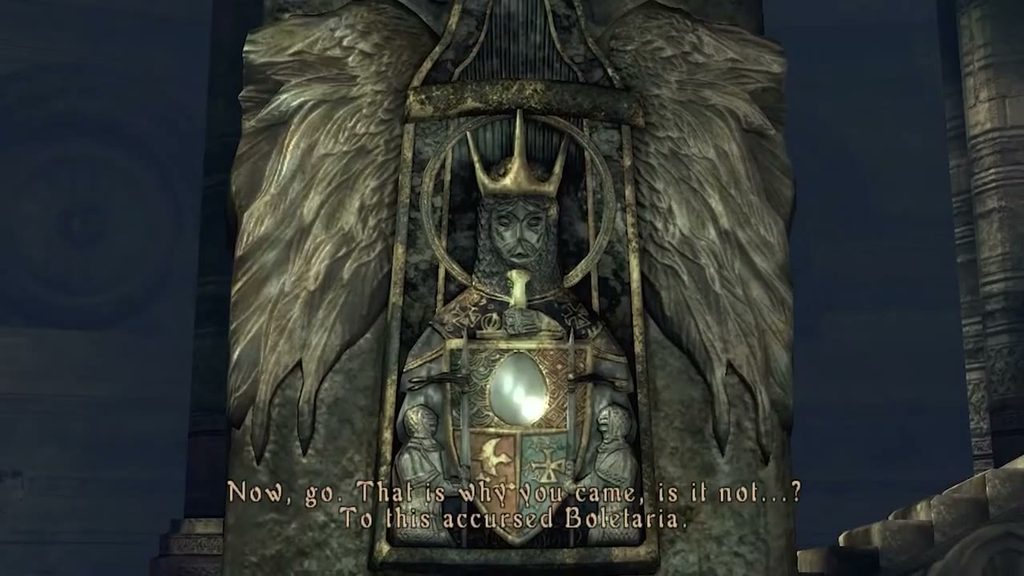
Some of the encounters are straight duels — the Penetrator, Flamelurker, the false king waiting at the end of the first world — and they remain superb tests of everything the game has taught. But Demon’s Souls is at its most distinctive when it cheats the boss template entirely. The Old Monk summons another player to be your boss. The Maiden Astraea barely fights at all, and winning feels like a crime. The Storm King is a spectacle fought across a ruined shrine with a sword pulled from the earth. Tower Knight, the game’s early wall, teaches you to attack ankles and ignore the shield the size of a house. Almost every one of these ideas would be recycled, refined and re-fought for a decade afterwards. Here they arrive raw, strange and unrepeatable.
Alone, together, invaded
The asynchronous multiplayer was the other revolution. Messages scrawled on the ground in a fixed vocabulary — warnings, lies, jokes about treasure ahead that is not there. Bloodstains that replay the last seconds of strangers’ deaths. Phantoms drifting through your world mid-fight. And invasions, in which a real human arrives in your game with the single job of killing you. The original servers closed in 2018, which means the PS3 version today is a lonelier and slightly diminished thing; community-run private servers have restored much of it for those willing to change a network setting, and the game is absolutely worth playing either way. But it is worth saying plainly: a piece of this game’s soul lived on those servers, and its loss is the strongest argument for the remake — or for keeping a PS3 plugged in and hoping.
Running it on the original hardware
There is an honesty to the PS3 version’s presentation that later ports polished away. The game targets thirty frames per second and does not always hold it — Stonefang’s forges and the Shrine of Storms in the rain can drag it into the low twenties — but the instability is woven into the atmosphere rather than fighting it. The fog is real fog, the draw distance is a design tool, and the whole kingdom sits under a gloom that the hardware’s limited memory accidentally perfected. Load times between the Nexus and the archstones are long enough to read the item descriptions the game offers as its only lore delivery system, which generations of players have since agreed was secretly a feature. Character creation is rudimentary, the sixth archstone — the broken one, leading to a land of giants that was cut before release — still sits shattered in the Nexus as a monument to ambition, and the voice acting, recorded in English for a Japanese game, has that wonderful slightly-detached quality that became a series signature. None of these are flaws to apologise for. They are the texture of a game made by a team figuring out a masterpiece as they went, and they are precisely what a remake, however beautiful, cannot reproduce.
The verdict
Demon’s Souls on PS3 is not a museum piece you admire from a distance. It is a game that still works — still frightens, still frustrates, still delivers that flood of relief when a shortcut gate creaks open. Its frame rate wobbles, its camera occasionally betrays you, and its upgrade systems require either a guide or a monk’s patience. None of it matters much. This is the source code of modern action design, running on the machine it was built for, and a PS3 collection without it is a library missing its first book.
Score: 9.0/10 — The difficult, murky, utterly singular origin of the Souls era. Play the remake for comfort; play this one for truth.