At a glance: Dimo’s Quest · Philips CD-i · SPC Vision / Philips Interactive Media, 1994 · Action-puzzle · Score: 7.0/10
Dimo’s Quest is the CD-i game that marketing nearly ruined and design quietly saved. The original, developed from an Amiga game by Infernal Byte Systems and brought to CD-i by SPC Vision (the Vision Factory), starred a lovable frog collecting candy to win a princess. For the CD-i release, someone in a 1994 marketing meeting decided the frog was not cool enough, and Dimo was reborn as a backwards-cap-wearing, shades-sporting skateboard kid who says “dude” and “cowabunga” — a committee’s idea of what Bart Simpson, the Ninja Turtles and a beach catalogue had in common. The skateboard never appears in gameplay. The catchphrases curdle within an hour. And underneath the makeover sits one of the most solid action-puzzlers on the entire platform: fifty-one levels of tile-based, key-and-box, Chip’s Challenge-descended design that respects the player’s intelligence start to finish.
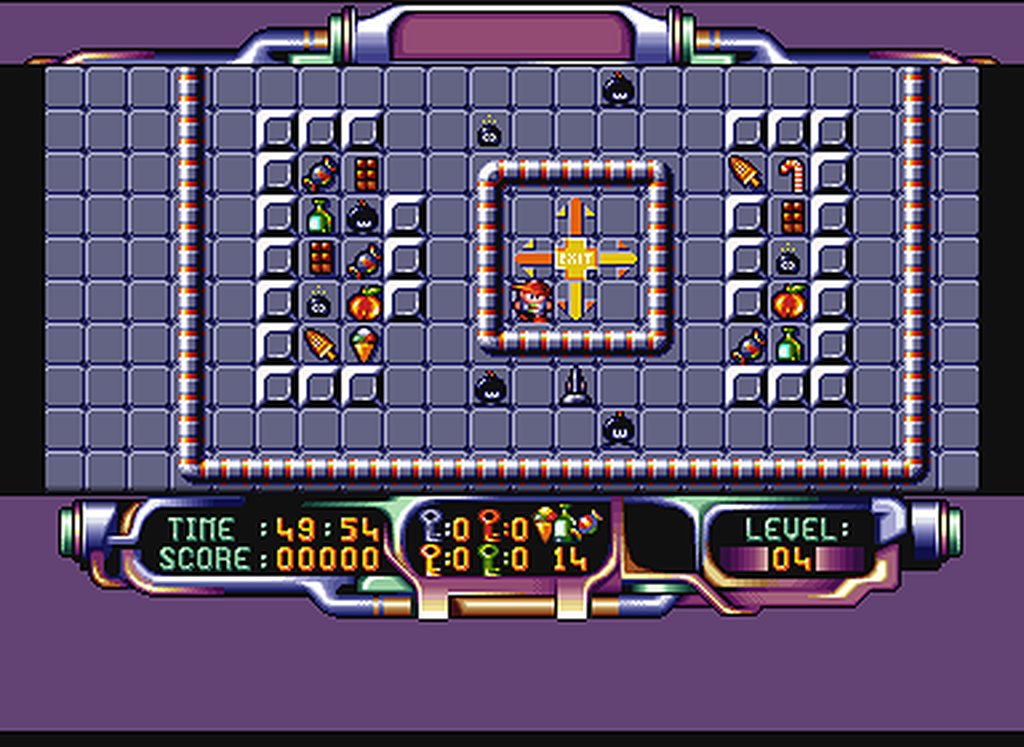
The premise, such as the manual bothers to give, is that Dimo has a sweet tooth and a problem: he must collect every piece of candy on each level and reach the exit. The levels are single-screen or scrolling tile mazes viewed from above at an angle, and their grammar is the classic one: coloured keys for coloured doors, boxes to push (Sokoban rules — push one into a corner and the level is quietly unwinnable, so the reset button becomes a friend), crumbling floors that vanish behind you, ice, water, one-way hazards, enemies on patrol routes, and a remote-controlled vacuum cleaner that remains the game’s most original toy. Every level is a small logic machine, and the pleasure is the purest in puzzle games: reading the machine, seeing the sequence, executing it.
Fifty-one levels of honest design
What elevates Dimo’s Quest above the CD-i puzzle pack is its curve. The early levels teach without text — a key, a door, a box, a lesson — and the middle game starts combining its elements into genuine brain-burners, levels where the solution requires presenting boxes as bridges, sacrificing a route to save another, or threading Dimo past a patrol with the candy count one short and the exit in sight. The design language is indebted to Chip’s Challenge and Sokoban, openly, but the level authorship is its own: tight, fair, and almost entirely free of the cheap deaths that pad lesser puzzlers. Failure in Dimo’s Quest is information, not punishment, because the password system — an eight-letter code per level — lets you resume exactly where your brain left off.

The presentation is bright, colourful and clean in a way that flatters the CD-i: the tile art reads instantly, the levels are legible at television distance — a sentence this build-up has rarely been able to write — and the soundtrack bounces along without outstaying its welcome. Against that, the CD-i’s controller does the game few favours in its twitchier moments: a handful of levels mix timing with logic, and diagonal intentions on a thumbstick-disc are a negotiation. It is a smaller tax than the platform usually levies, because the game is turn-based at heart — think first, move second — but it is present.
The Dimo problem
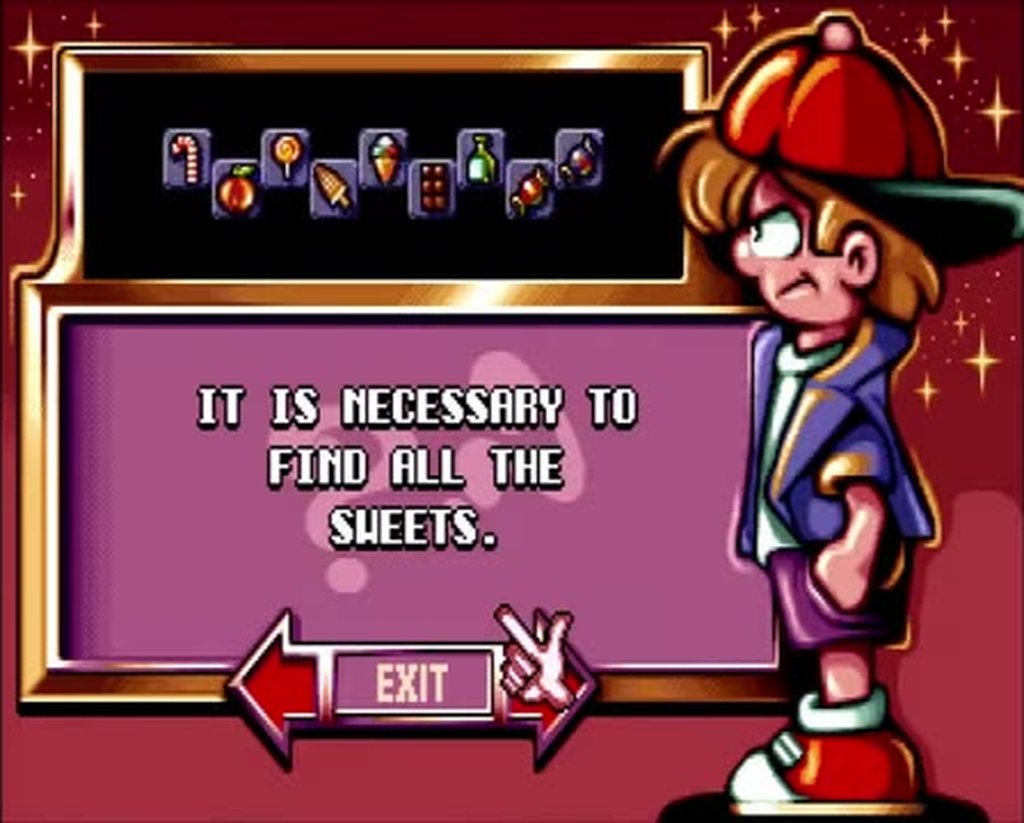
We cannot let the character pass without a verdict, because the game won’t either: he talks. Constantly. Sampled catchphrases punctuate play, and what might have been charming in a thirty-second advert becomes, across fifty-one levels, the single most dated element of the package. The original frog — silent, expressive, on a legible quest with a princess at the end of it — would have aged gracefully. The 1994 dude has aged like a mood ring. There is also the matter of the between-world rewards: every ten boards, the game presents a swimsuit photograph, a piece of era-specific pandering so out of step with the game’s all-ages design that modern players will simply blink at it. A period artefact, noted for the record.
Dimo’s Quest is the rare CD-i game whose design is better than its packaging. Ignore the kid on the box and the voice in your ear, and there is a first-rate puzzler here — fifty-one levels deep, and honest in every one.
Longevity deserves its sentence: fifty-one levels is a substantial campaign for a puzzle game of this density, and the back third will occupy experienced players for evenings, not minutes. There is no filler in the set — a claim almost no CD-i title in this series can make — and the password system means the campaign can be lived with, a few levels a night, the way it was designed to be.
The Amiga in the room
The comparison that follows Dimo’s Quest everywhere is its Amiga original, where Dimo was a frog in a fantasy kingdom and the game an early-nineties European puzzler of modest profile. The CD-i conversion is, under the makeover, remarkably faithful: the same fifty-one levels, the same design intelligence, presented with the bigger palette and soundtrack budget the disc allowed. That fidelity cuts both ways in the scoring. It means the CD-i version inherits a design built by people who understood the genre’s fundamentals at a time when much CD software was being built by people learning them. It also means the game’s ambitions are those of a good Amiga puzzler rather than a CD showcase — and judged as a puzzler rather than a showcase, which is how this review has judged it, that ancestry is a strength wearing a disguise.
Longevity, one more time, because it is the game’s quiet headline: the back fifteen levels are the stiffest test this format’s puzzle shelf offers, and they are stiff in the right way — solvable by thought, repeatable by password, and free of the reflex demands that would have made the CD-i’s controller a scapegoat. A puzzle game lives on its endgame. Dimo’s Quest has one.
Two practical notes for the modern player, offered in the review’s spirit of precision. First, the password is per-level and forgiving — screenshot the codes and the campaign becomes a modern, resumable puzzle game in everything but name. Second, play on the gamepad if you possibly can: the puzzle core is controller-agnostic, but the handful of timing rooms were plainly tuned by people imagining quicker thumbs than the remote provides. Equipped properly, the game’s remaining frictions are the character’s voice samples and the difficulty’s honest steepness — and the second of those is not a flaw at all, whatever the first might be.
It also, not incidentally, contains the format’s most honest difficulty promise: what you see in the first five levels — keys, boxes, floors that fall — is the whole vocabulary, and everything after is composition. Puzzle design as music, themes combined rather than replaced. That is why the game survives its mascot: compositions outlive costumes.
Verdict
Dimo’s Quest earns 7.0/10: a genuinely well-made action-puzzler, docked for a host character engineered by a marketing department and a controller fit that is merely adequate. In a catalogue full of famous names disgraced, this is the reverse story — an unknown name that delivers. If you own a CD-i and like puzzle games, this is one of the first discs to hunt down, whatever the kid on the cover is wearing.
