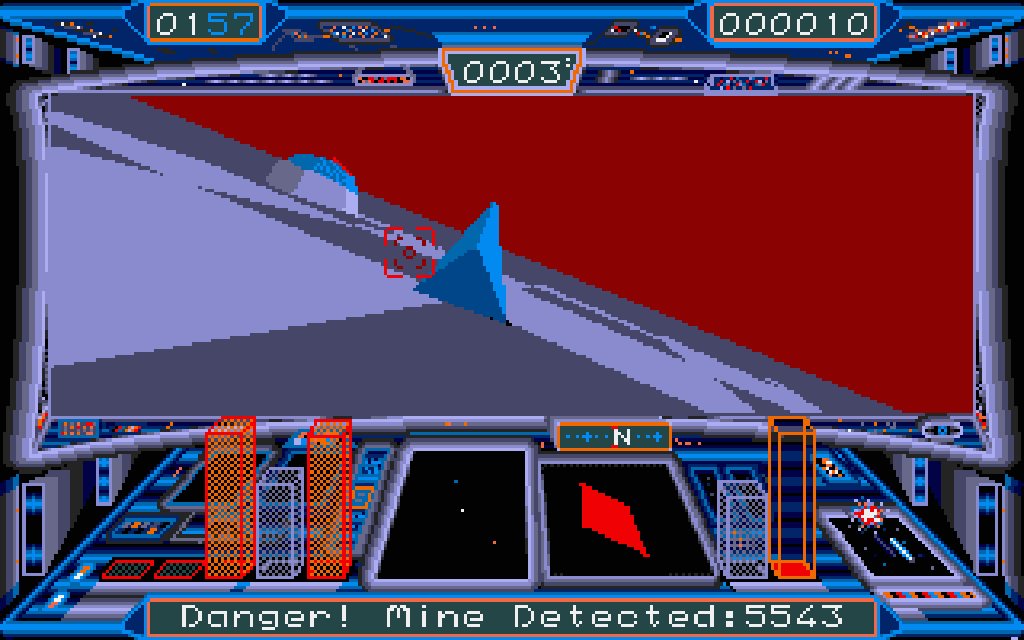
At a glance: Starglider 2 · Atari ST · Argonaut / Rainbird, 1988 · Space combat simulator · Score: 8.5/10
The original Starglider was a wireframe wonder; the sequel threw the wireframe away and built a solar system. Starglider 2, Jez San and Argonaut’s 1988 follow-up, renders its world in solid, flat-shaded 3D at a pace the ST had no business sustaining — then lets you fly from a planet’s surface, through its atmosphere, into orbit and out to other worlds without a single loading screen or cut. In 1988, on a home computer, that seamlessness felt like a magic trick. What keeps the game on essential lists is that the trick turns out to be a genuinely good space game underneath: trading, tunnelling, bounty hunting and a war to win, all inside one continuous volume of space.
You fly the Icarus, a small ship with an outsized job: the Egron empire is building a beam platform to destroy your homeworld of Novenia, and you must assemble a neutron bomb from components scattered across the Solice system — parts that must be traded for, mined, salvaged or stolen. The structure is open in a way few 1988 games dared. Five planets and their moons, asteroid belts, space stations and a sun you can skim for fuel: everything is there from the start, and the order of your campaign is yours. Fly into a planet’s tunnels to raid Egron depots. Scoop stardust. Bounty-hunt pirates for cash. The mission gives direction; the system gives freedom.

Speed you can feel
The technical story is the headline the ST press wrote at the time, and it holds up: solid 3D with colour, speed and scale that made rival machines look a generation behind in this one genre. Where the Amiga version leaned on its custom chips elsewhere, Argonaut’s engine here is a love letter to the 68000’s raw clock advantage — the ST’s processor ran a touch faster, and in polygon games that touch showed. The Icarus handles with a weight that sells the fantasy: banking over a planetary surface as installations scroll beneath, dipping into a tunnel mouth at speed, feeling the ship wallow when the cargo hold is full of ore. Mouse or joystick both work; the mouse, unusually for a flight game of the era, works well.
One unbroken flight from a tunnel raid to open orbit, in 1988, on a home micro: Starglider 2 did not show the future in a trailer. It let you fly there.
Combat is frequent and legible. Egron walkers stalk the surfaces, fighters swarm in space, and your lasers, missiles and the ship’s shields make dogfights brief and punchy rather than simulated to death. The economy loop — trade goods between worlds, watch prices, fund your repairs — gives the shooting a skeleton. So does the bomb quest itself: components like a cluster of asteroids’ worth of minerals, a crate of Vistan wine for a thirsty engineer, each fetch a small story. The game trusts you with a map, a list and your own curiosity, a design confidence that flatters the player even now.

Where it strains
The openness cuts both ways. With so little signposting, a first campaign can wander: the bomb components are findable but the game is in no hurry to confirm you are warm, and the tunnels — spectacular the first time — become the grind at the quest’s heart, since so much of value hides underground. The flat-shaded worlds, for all their speed, are sparsely dressed; surfaces can blur together at distance, and the sound is functional YM2149 fare: solid engine hum and laser cracks rather than a score to remember. Argonaut’s own later work, and the genre’s giants of the next decade, would add the mission variety and character this framework begs for. What they could not add was novelty — this had it first.
Judged as an ST game specifically, Starglider 2 is the platform showing its favourite party trick: a fast processor, a clean display and a developer who treated both with ambition. It made the ST the connoisseur’s choice for 3D in 1988, a reputation the machine’s flight-simulation shelf would keep for years. Owners who bought the machine for MIDI and desktop publishing found a space epic in the same beige box, and the double life suited it.
The Argonaut signature
Context sharpens the achievement. Argonaut was a young British team working at the frontier of what home hardware could draw, and Starglider 2 reads now like a manifesto for the 3D future they would help build — the studio that later worked on the Super FX chip and Star Fox learned its trade making the ST draw a solar system. The game’s seamlessness was its boldest claim: no tape-style loading between surface and space, the planet’s curve giving way to stars in one motion. That continuity changes how a world feels. Novenia’s system is not a menu of levels but a place, and the player’s memory of it is geographical — trade routes, tunnel mouths, the station where the engineer waits — rather than a list of stages completed.
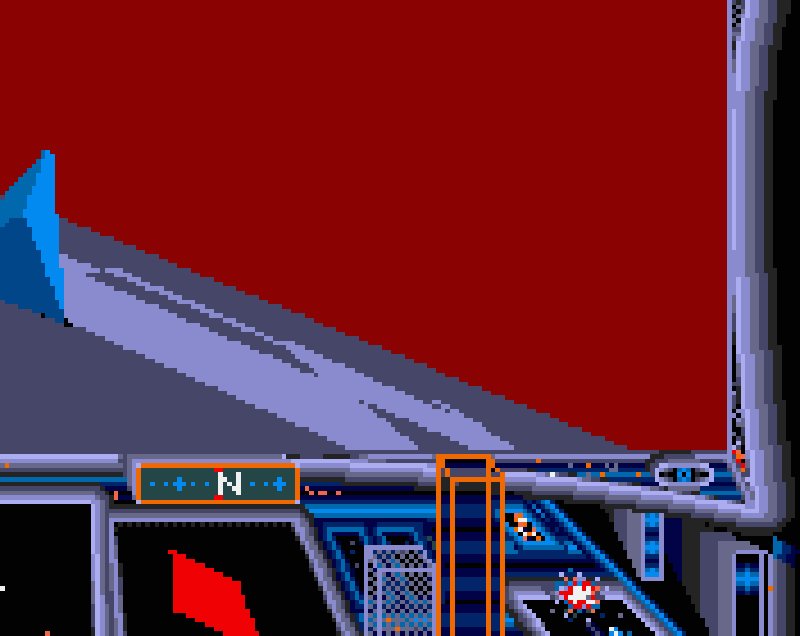
It is worth pausing on the tunnels, the game’s signature set-piece. Diving from orbit into a planetary shaft, walls rushing past in flat-shaded bands, emerging into caverns where Egron machinery hums — these sequences sold the game in every screenshot and still deliver its purest thrill. They are also where the ST’s clarity counts: the low resolution is offset by bold shapes and honest speed, and the Icarus answers the mouse with a precision that makes threading a tunnel at full burn a skill rather than a lottery. Many 3D games of the era are impressive as demonstrations. Starglider 2’s best sequences are impressive as experiences, which is why the game is replayed rather than merely cited. The demo that learned to be a campaign: that is the whole Argonaut story in one disc.
It is also a game that rewards a particular kind of housekeeping. The Icarus is a working ship: fuel scooped from suns and surfaces, cargo space that forces choices between ore and armament, repairs that cost the credits your trading earned. None of it is deep enough to be called a simulation of an economy, and all of it is present enough to make the pilot’s life feel continuous — you are not teleporting between action scenes but living between them, at sublight, with a hold full of decisions. That continuity is the seed from which the whole later genre of open space games grew, and it is fully formed here, in 1988, between the tunnels and the trade runs. The ST version carries it at a pace that never breaks the spell.
Verdict
Starglider 2 is a landmark of engineering that remembered to be a game: a whole solar system, seamlessly flown, with a war economy and a bomb to build inside it. Its sparseness and its wandering middle hours are real, but the central sensation — lifting off a world you were just raiding and watching it shrink beneath you, unbroken, in 1988 — has lost none of its power. The ST version is a definitive text of early British 3D, and one of the strongest arguments ever made for the machine’s quietly excellent processor. Take the Icarus up once and try to land unimpressed.