At a glance: Electrocop · Atari Lynx · Epyx, 1989 · Action adventure · Score: 7.5/10
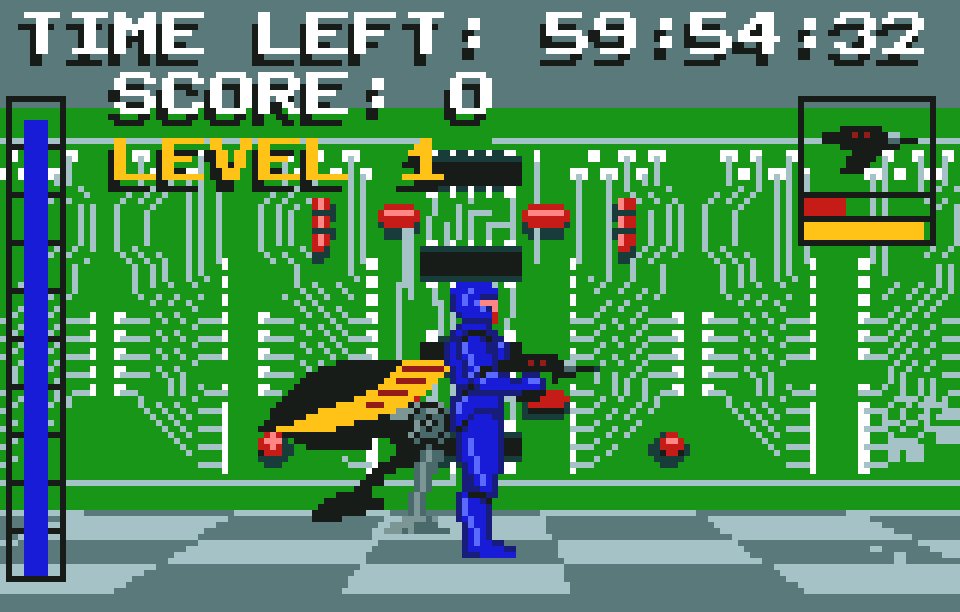
Of all the Lynx launch titles, Electrocop is the one that feels like a dispatch from a future that hadn’t happened yet. It is 2069 — or thereabouts; the game wears its future lightly — and you are a robot policeman sent into a fortified complex to rescue a kidnapped dignitary’s daughter before a real-time clock runs out and the building’s captors make good on their threat. Between you and her: locked doors, patrolling robots, computer terminals to interrogate, and corridors rendered with the zooming, scaling trickery that Epyx built the Handy hardware to perform. In September 1989, nothing else in a handheld looked like this. Some of it still looks like nothing else anywhere.
A rescue against the clock
The structure is a small masterpiece of tension. The countdown runs in real time, displayed like a threat, and it converts what could have been a leisurely maze-crawl into a heist: every door code you hunt, every terminal you stop to interrogate, every wrong corridor you clear is paid for in minutes of her life. Your Electrocop explores a multi-level complex of doors, lifts and security systems, blasting hostile robots and collecting the information — door codes, weapon upgrades, the layout of the trap ahead — that makes the next floor survivable. Death is handled with a fiction the game commits to: you are a machine, and the agency simply uploads you into a fresh chassis, at the cost of the one resource you cannot replace. Time.

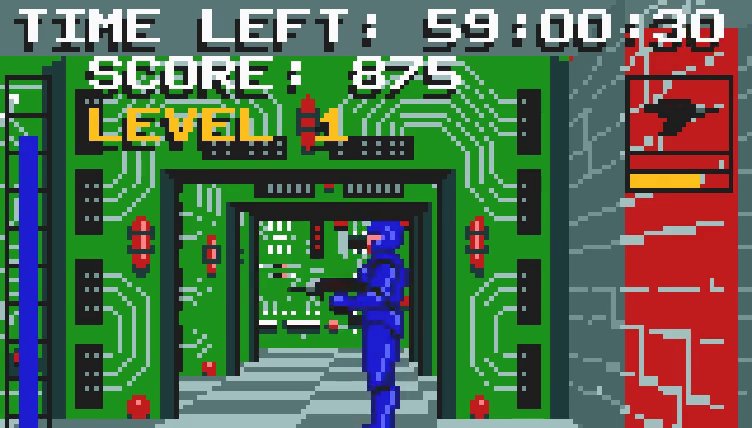
The corridor rendering is the famous part. Electrocop’s world is built from scaling sprites arranged into pseudo-3D hallways, and doors rush toward you with a smoothness that was pure showmanship in 1989 — the Suzy chip stretching and shrinking bitmaps to fake depth, years before textured polygons made the trick obsolete. Shoehorned into a lesser game it would be a gimmick. Here it serves the fiction: the complex feels like a place, with approach and arrival, rather than a grid of rooms, and the approach to a sealed door — code known or code unknown — becomes the game’s recurring moment of dread.
Electrocop’s corridors were the Lynx’s promise made visible: this machine did not do small versions of other people’s games. It did its own, at full size, in your hands.
Terminals, codes and robot police work
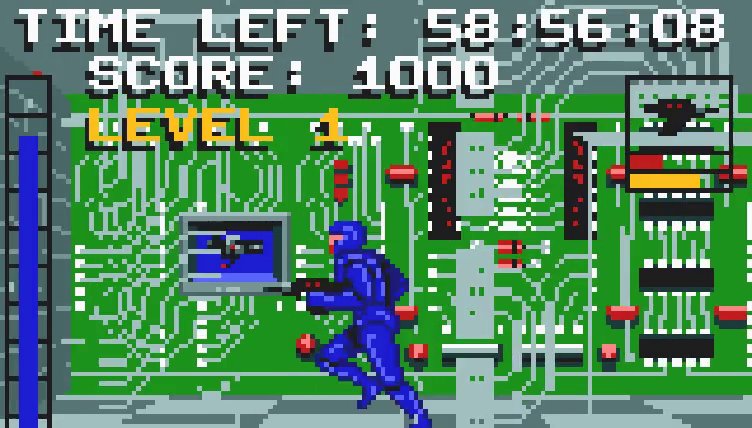
What saves Electrocop from tech-demo status is the adventure skeleton under the action. The terminals are not decoration. They are how the game is solved: interrogate them for door codes, security states and hints, and the complex gradually becomes legible. Combat is deliberately secondary — your weapons are tools for clearing a path, ammunition and energy are resources, and the robots you destroy are obstacles between you and information. The result plays like a first-person adventure wearing a shooter’s coat, a genre blend the home computers of the era attempted often and handhelds almost never. Players who wanted pure action found it methodical. Players who wanted to think inside an action game found one of the Lynx’s most original cartridges.
The clock is the game
It is worth dwelling on that countdown, because Electrocop was doing in 1989 what games would later congratulate themselves for inventing: a systemic pressure that turns exploration into triage. Knowing a door code is worthless if you learned it too slowly. A wrong turn is not a loading screen’s embarrassment; it is a deduction from a stranger’s remaining minutes. The game even frames your retries honestly — a new robot body costs nothing but time, which is the only currency the fiction respects. Modern time-loop and deadline games write essays about this design. Electrocop simply shipped it, on a handheld, in the Lynx’s first month, and let the clock make its own argument.
The complex rewards the methodical player across runs. Codes, once learned, stay learned — in the player’s notebook, in the great handheld tradition — and a second attempt at the rescue is a different game from the first: bolder, faster, routed. Electrocop is quietly a speedrunner’s game twenty years before the category, and its small community of devotees treats the rescue time the way other communities treat high scores.
Where the future creaks
The flaws are the design’s honest price. The real-time clock is a magnificent pressure device and an occasional tyrant: a first-time player learning the terminal system can burn the rescue window on education, and the game offers no mercy difficulty. The corridors, for all their rendering magic, recycle their layouts enough that navigation by landmark is harder than it should be in a game about navigation. Combat, when it comes, is functional rather than thrilling — the robots are roadblocks, not duels — and the sound design is more hum and zap than score. As an action game it is a 7; as an adventure it is an 8.5; the cartridge’s identity crisis is the review’s dilemma too.
The Epyx design philosophy, on one cartridge
Electrocop matters beyond its score because it shows what Epyx thought the Handy was for. This was a company that designed the hardware and then wrote games as arguments for it: Chip’s Challenge argued for depth, Blue Lightning for spectacle, Electrocop for immersion — a game that tried to put the player inside a place, with a clock, a mission and a robot’s-eye view. That the argument was made at launch, on a handheld, against a monochrome rival, explains the loyalty the Lynx still commands. No other 1989 portable game reaches for this much atmosphere.
For the modern collector it is also a bargain with a story attached: a launch title from the hardware’s own designers, attempting things the industry would take a decade to standardise. Play it with a notebook beside the machine, the way its first players did, and the future it imagined feels closer than the one we got.
One last thing in its favour: Electrocop has no substitute. The Lynx library contains faster games, prettier games and longer games, but nothing else that plays like this — the timed infiltration of a machine-run building by a machine with a conscience. Emulation preserves it adequately; original hardware, screen glow and all, preserves it best. Either way it demands an evening of any serious Lynx owner’s time, notebook open, clock running.
And when the rescue succeeds with seconds on the clock — and it will, eventually, if you keep the faith — the feeling is one the launch window rarely delivered: not a high score, but a job done.
Rating it requires choosing which half of its split personality to judge, and the fair answer is both: an adventure of genuine originality carrying an action game of merely decent manners, fused by a clock into something greater than either.
File it, then, under essential Lynx strangeness: the launch game that trusted a handheld to hold a clock, a building and a hostage in your head all at once, and was right to.
Verdict
A flawed, fascinating original: part shooter, part adventure, all atmosphere, racing a clock that never stops being scary. 7.5/10 — and one of the most historically interesting cartridges Atari ever shipped.