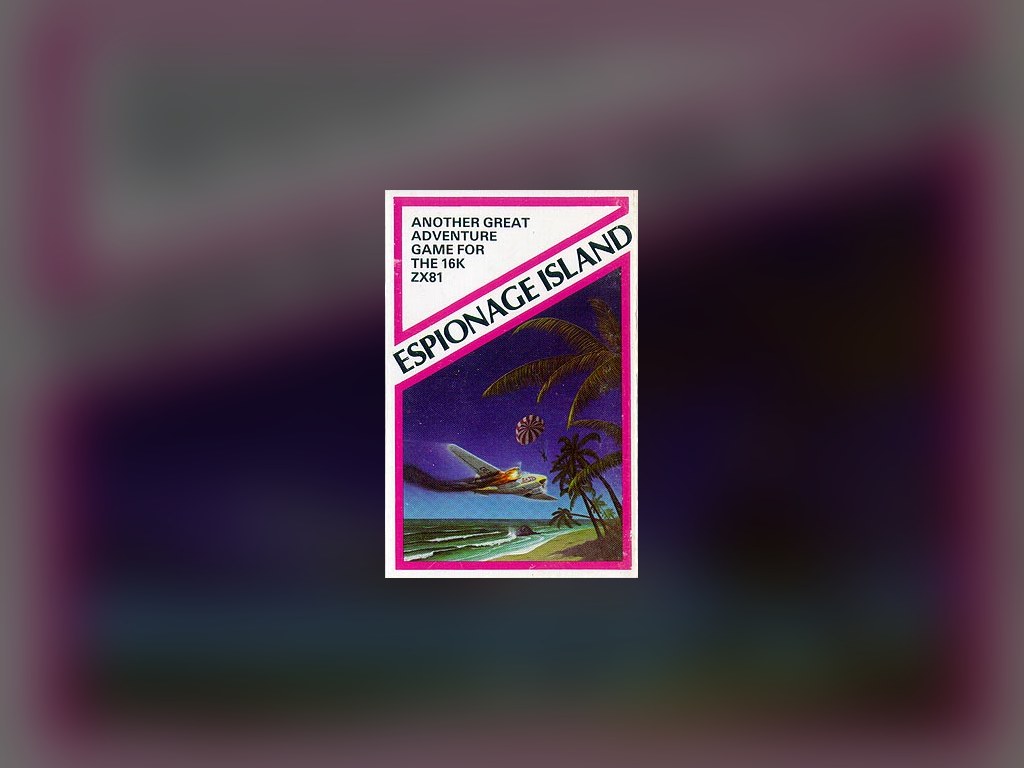
At a glance: Adventure D: Espionage Island · ZX81 · Artic Computing, 1982 · Text adventure · Score: 7.0/10
Four letters in, Artic Computing’s alphabet reached the spy thriller. Adventure D: Espionage Island, written by Charles Cecil and published for the ZX81 in 1982, trades alien planets, Inca temples and brain-harvesting cruisers for the Cold War’s favourite fictional furniture: a secret island, enemy agents, and a mission that depends on the player being cleverer than the security around them. It completes the original ZX81 sequence — the run of adventures, A through D, that Artic wrote for the little Sinclair before porting the set to the Spectrum — and it shows the series at its most confident about premise. The first three adventures are escape stories and treasure hunts. Espionage Island is a caper, and capers need a different kind of writing: objectives, cover, and the pleasures of a plan.
The sequence’s importance is easy to state and hard to exaggerate. Artic was founded in Brandesburton by Richard Turner and Chris Thornton; Cecil joined shortly afterwards and wrote B, C and D, making this compact run of ZX81 cassettes the foundation course of one of British gaming’s most significant careers — the designer of Beneath a Steel Sky and Broken Sword learned adventure design by writing four of them, in capitals, for a machine with a membrane keyboard. Espionage Island is the last of his ZX81 letters, and the one that points furthest forward: espionage fiction is about information, misdirection and identity, which is to say it is about the things text adventures do better than any other genre of the era.

The alphabet goes undercover
The engine, by now, is a known quantity — the two-word verb-noun parser, the limited vocabulary, the terse location descriptions, no graphics — and by the fourth game its limitations and its disciplines were equally familiar to its audience. Retrospectives of the series are consistent about both sides: simple parser, terse prose, puzzles that could be illogical; and, against that, genuine structure, completable quests, and premises that kept widening. Espionage Island benefits from the widening most. A spy scenario gives the terse style something to bite on: checkpoints and cover stories are naturally told in short exchanges, and an island is the adventure map at its most classical — a bounded world with a hostile administration, the size of Planet of Death’s rock but populated by people with guns and filing cabinets.
It is also the series’ farewell to its first machine in spirit, whatever the exact order of releases and ports. The Spectrum arrived in April 1982 with colour, sound and 48K in its fuller form, and Artic — like everyone — followed the gravity. Adventures A through D were ported across, began appearing in Spectrum listings alongside their ZX81 originals, and later reached the Commodore 64 and Amstrad CPC. The series continued on the bigger machines, but the original quartet belongs to the ZX81: conceived for it, constrained by it, and complete on it in a way the later, larger letters are not. D closes the set the way a good final episode should, by being the most assured version of the formula rather than a departure from it.
A, B, C, D: a stranded pilot, a robbed temple, a doomed ship, a spy island. Four cassettes that taught Charles Cecil — and Britain — how adventure games worked.
Playing the sequence’s finale
Modern players coming to Espionage Island should come to it as the fourth evening of four. The Artic adventures reward sequence play: the parser’s habits become fluent, the terse style becomes a voice, and the growing ambition across the letters becomes the story. Judged alone, D is a compact spy adventure on a proven engine — the most premise-driven of the four, the least dependent on the novelty that carried A. Judged in sequence, it is a graduation. What Cecil does next, historically, is leave for bigger canvases; what the player does next is understand how much of the later British adventure tradition — the wit, the structure, the faith in the player’s intelligence — was already present in a 16K cassette about an island full of secrets.

A note for collectors and the curious: the whole A–D run exists in both Artic’s own packaging and Sinclair Research re-release dress, a small marker of how central these tapes were to the ZX81’s official software story. The Sinclair editions put Yorkshire’s alphabet on shop shelves next to Psion’s polish — the two poles of the machine’s catalogue, the suite and the series, and both of them British to the bone.
After the alphabet
The sequence did not stop at D — the Planet of Death’s own record notes the line continued through Adventures E, F, G and H — but it changed its centre of gravity. The later letters belong to the Spectrum’s world of colour and capacity, where the Artic formula competed with a maturing industry rather than founding one, and where Cecil’s own trajectory bent toward the work that would define him. Read against that afterlife, the ZX81 quartet’s completeness is its charm: A through D are the foundation course, four premises — escape, loot, rescue, infiltrate — that between them cover most of what adventure games would do for the next decade, each executed in the same terse engine, each a few evenings long, the whole set fittable on one shelf of cassettes in two publishers’ dress, Artic’s own and Sinclair Research’s re-release livery.
Espionage Island’s particular place in the foundation is the one this review has argued throughout: it is the letter where the adventure stops being about a place and starts being about a system of people. Temples and cruisers are geography; an island of agents is society, and a spy game must simulate society’s rules — who may go where, what may be carried, which story will be believed. The two-word parser, so crude against a temple door, is oddly apt against a checkpoint, where conversation really is verb, noun, and consequence. If Planet of Death is the genre’s first word, Espionage Island is its first sentence about other people — and the genre has been writing about other people ever since.
Playing it in 2026
The final letter is preserved in both Artic and Sinclair Research editions, and it closes the sequence best in sequence: the parser fluent by now, the style familiar, the island’s secrets the reward for three evenings of training. New agents should map the island, interrogate the two-word engine patiently, and expect the occasional illogical lock that the retrospectives warned of — the series’ ceiling, worn honestly. What survives intact is the premise’s freshness. Spy fiction in a text adventure still feels like a genre discovering its natural home.
Verdict
Adventure D: Espionage Island completes the founding quartet of British text adventures with the series’ most grown-up premise: a spy caper on a hostile island, played through the same honest two-word engine. It is not the biggest of the four, but it may be the most forward-looking — a designer and a genre both discovering that secrets make better adventures than monsters. Classified, in capitals, since 1982.

Score: 7.0/10 — The alphabet’s finale goes undercover: Artic’s ZX81 sequence signs off in style.