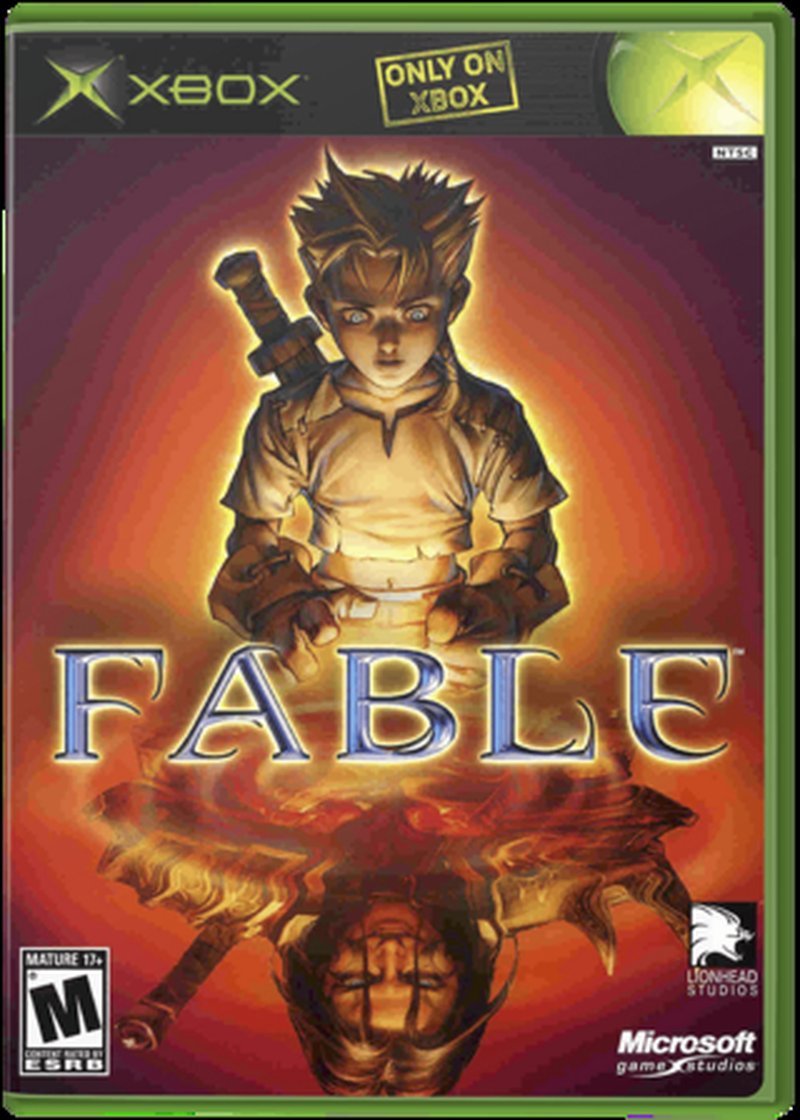
At a glance: Fable · Xbox · Lionhead Studios / Microsoft Game Studios, 2004 · Action role-playing game · Score: 8.5/10
Fable is the most argued-about great game on the Xbox, because the argument started before it shipped. Peter Molyneux promised a world where every acorn grew into a tree and every choice rewrote the story; the game that arrived in 2004 is smaller, shorter and more linear than the legend. Strip the hype away — as a review two decades on fairly can — and what remains is a charming, funny, deeply British action RPG with a morality system that genuinely changes how the world treats you, a combat model built for a controller, and more personality per hour than RPGs three times its length. It is not the revolution that was promised. It is something better than a failed revolution: it is a lovely game.
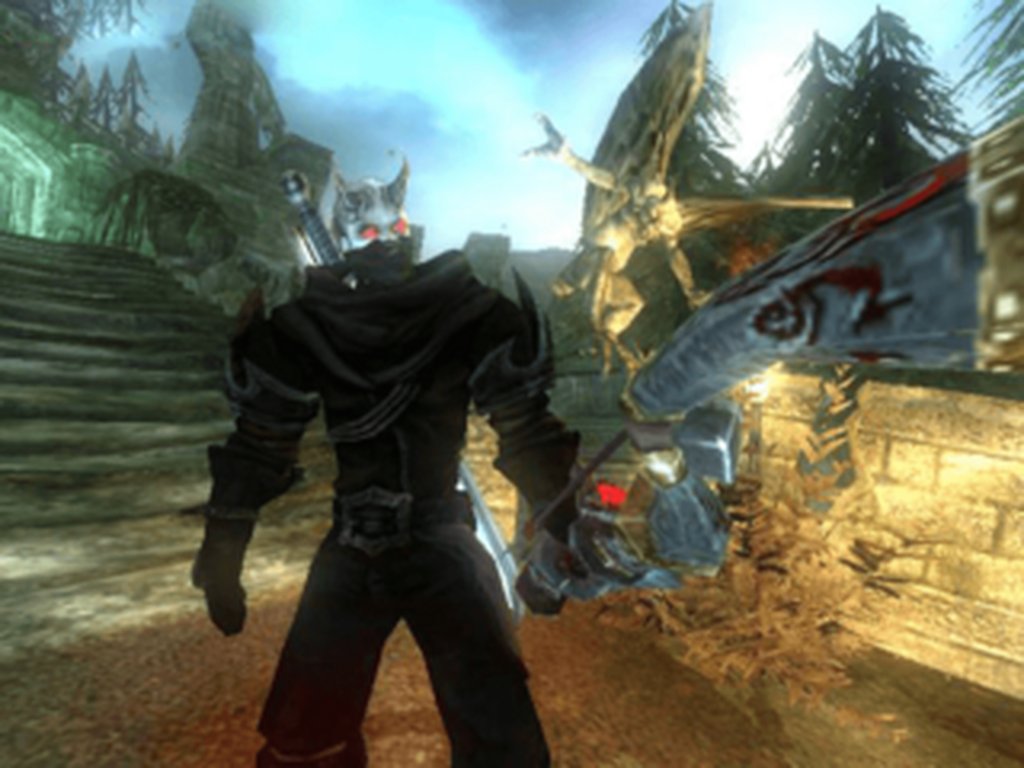
You play an orphan raised by the Heroes’ Guild, and the arc from skinny apprentice to scarred legend is told in years, not levels. Your hero ages across the campaign, and the world reads your deeds off your body: fight with a sword and you bulk up; cast magic and arcane lines etch your skin; eat pies and, yes, you get fat. Good deeds grow a halo and butterflies; evil grows horns, red eyes and a trail of flies, while villagers either cheer your name or run screaming from it. Alignment systems were not new, but nobody had made them this visible, this physical, this funny. Renown matters as much as morality — complete quests with boasts (“I will do this naked, untouched, in record time”) and the Guild’s crowds grow with your fame. Albion responds to who you are being, which is Fable’s real subject.
Combat is a clean three-part kit: melee on one button family, archery with a proper first-person aim, and Will magic — lightning, fireballs, time-slow, the beloved force-push — drawing from a mana bar. Everything feeds experience into four pools you spend as you please, so builds genuinely diverge: the hulking swordsman, the willow archer, the glowing spellsword. Enemies are readable and characterful — hobbes giggling in caves, balverines leaping from treelines, bandits who surrender when beaten — and boss fights lean on pattern and spectacle rather than stat walls. On Xbox the controls are the revelation: this was a PC-genre repertory company performing flawlessly on a joypad, lock-on, expressions and all.
Albion, the real star
The world is a string of hand-built regions rather than an open map, and honesty requires saying so: Fable’s Albion is a corridor with excellent scenery. But what scenery, and what life inside it. Towns run on routines — shops open and close, guards patrol, bards sing your deeds badly — and the social systems invite pleasant mischief: marry, buy houses, rent them out, get drunk, get divorced, kick chickens. The chicken-kicking is not a joke at the game’s expense; it is the tone in one image. Fable is a fairytale with mud on its boots, narrated like a bedtime story and scored by Russell Shaw (with a Danny Elfman theme) like a film. The main quest, involving the villain Jack of Blades, is a solid ten-to-fifteen-hour spine; the side content, demon doors and legendary weapons stretch it for players who want to live there longer.
Fable does not simulate a world. It performs one — and the performance is so warm, witty and responsive that you forgive the stage its edges.
The honest debits: length, first. A focused player finishes the story while grander RPGs are still in their second act. The morality, for all its visibility, is binary — saint or monster, with little reward for the interesting middle — and late-game difficulty collapses once your build matures, removing tension from the finale. The Xbox original also predates The Lost Chapters expansion content, so this disc is the leanest version of Fable that exists; collectors should know the difference and prize this one as the artefact, not the complete text. Loading between regions, frequent and slow, is the period tax every Xbox RPG charges.
Technically, Lionhead squeezed the Xbox fondly: soft golden lighting, heavy bloom before bloom was fashionable, expressive caricature faces, and villages that glow at dusk. Frame rates wobble in the busiest towns, forgivably. The voice cast is a British treasure chest, and the Guildmaster’s dry commentary — your health is low, hero — has passed into folklore. Danny Elfman’s main theme over Shaw’s score gives Albion a storybook grandeur the visuals occasionally only sketch.
The systems under the charm
Look closer and Fable’s smaller systems are doing sophisticated work. The expression system — laugh, sneer, swear, flirt, fart, all mapped to the D-pad — is a social interface years ahead of the dialogue-wheel era, letting you perform a personality in public spaces and watch crowds recalculate you in real time. Property ownership creates a gentle economic loop rarely seen in action RPGs: buy low in a frightened town, rent to tenants, sell high when your fame makes the district desirable. The boast system turns quest selection into a difficulty-and-reward negotiation with the audience built in. Even the much-joked-about chicken kicking is a physics toy the game tracks, titles and rewards. Lionhead’s simulation instincts are everywhere; they are simply aimed at people and reputation rather than ecosystems, and on those targets they mostly hit.
For today’s player, the practical picture is kind: the Xbox original is common, inexpensive and complete on the disc, its save system is generous, and its fifteen-hour scale — the very thing held against it in 2004 — reads in 2026 like a courtesy. This is the RPG you can actually finish between bigger commitments, and finishing it feels like closing a storybook rather than surviving an obligation. Completionists can chase the legendary weapons, the demon doors’ riddles and a full set of hero titles for many hours more. Albion’s gates are narrow, its heart is large, and its welcome has not faded.
One more lap of Albion
Stay a while after the credits, because Fable’s endgame quietly makes its best argument: the world keeps applauding, fearing and gossiping about you, your titles accumulate (the game bestows nicknames from your habits — buy the right one or earn the wrong one), and the legendary weapons, demon doors and silver-key chests give the map a second pass of secrets. The Xbox original’s smaller Albion makes that completionist lap feel attainable rather than endless, which in 2026 reads as mercy. Many modern RPGs could stand to be this size, this dense and this sure of their tone.
If you come to Fable from its sequels, expect a smaller, stranger, more hand-made Albion — and expect to prefer it. The original’s focus is its flavour: every region earns its place, every system serves the central performance of a life, and the whole thing can be lived, fully, in a week of evenings. Few cult classics justify their cult this comfortably.
Verdict
Judged as the game it is rather than the game that was promised, Fable is an 8.5 with its head high: a compact, funny, heartfelt action RPG whose morality is worn on the body, whose world applauds and fears you in equal theatrical measure, and whose Albion remains one of gaming’s most likeable places. It is short, it is linear, and it does not care, because charm this deliberate is a design achievement too. Every Xbox collection needs it — ideally next to the bigger RPGs it never tried to be.