At a glance: Star Wars: Knights of the Old Republic · Xbox · BioWare / LucasArts, 2003 · Role-playing game · Score: 9.5/10
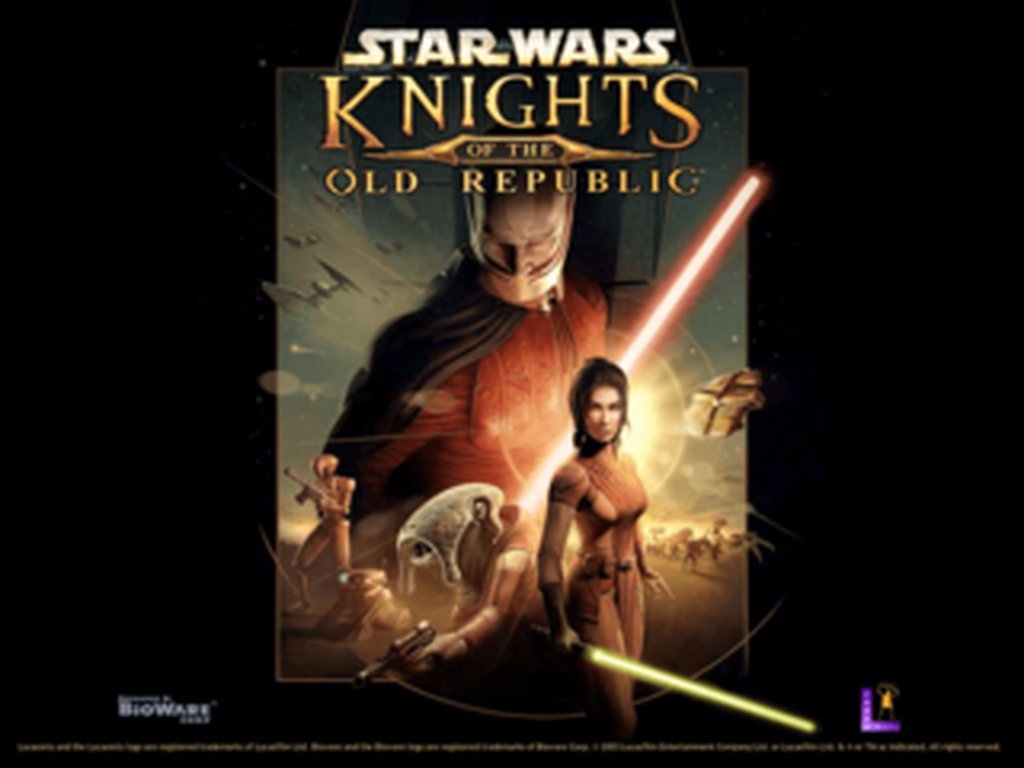
Four thousand years before the films, in a corner of Star Wars nobody had filmed, BioWare built the best Star Wars story told in any medium outside the original trilogy — and on the Xbox, of all places, a machine with a controller where mice were supposed to be. Knights of the Old Republic is a full, systems-deep role-playing game in the Dungeons & Dragons tradition, translated so gracefully to a joypad that it never feels like a port of anything. It feels native. It also contains a plot twist so good that two decades of spoiler discipline still surrounds it, and this review will honour that discipline while telling you plainly: this is one of the finest RPGs ever made, on any system.
You begin as a Republic soldier with amnesia, washed up on Taris as the Sith hunt your commander, the Jedi Bastila Shan. The structure that unfolds is classic in the best sense: gather a party, earn a ship — the Ebon Hawk, a freighter with the Millennium Falcon’s silhouette and its own personality — and hop between worlds hunting the Star Maps that lead to the enemy’s secret weapon. Taris, Tatooine, Kashyyyk, Manaan, Korriban: each planet is a hub of quests with multiple solutions, factions to play against each other, and moral choices that are genuinely choices. The Light Side and Dark Side paths are not a good ending and a bad ending; they are two full playthroughs, with different powers, different party reactions and a finale that diverges hard.
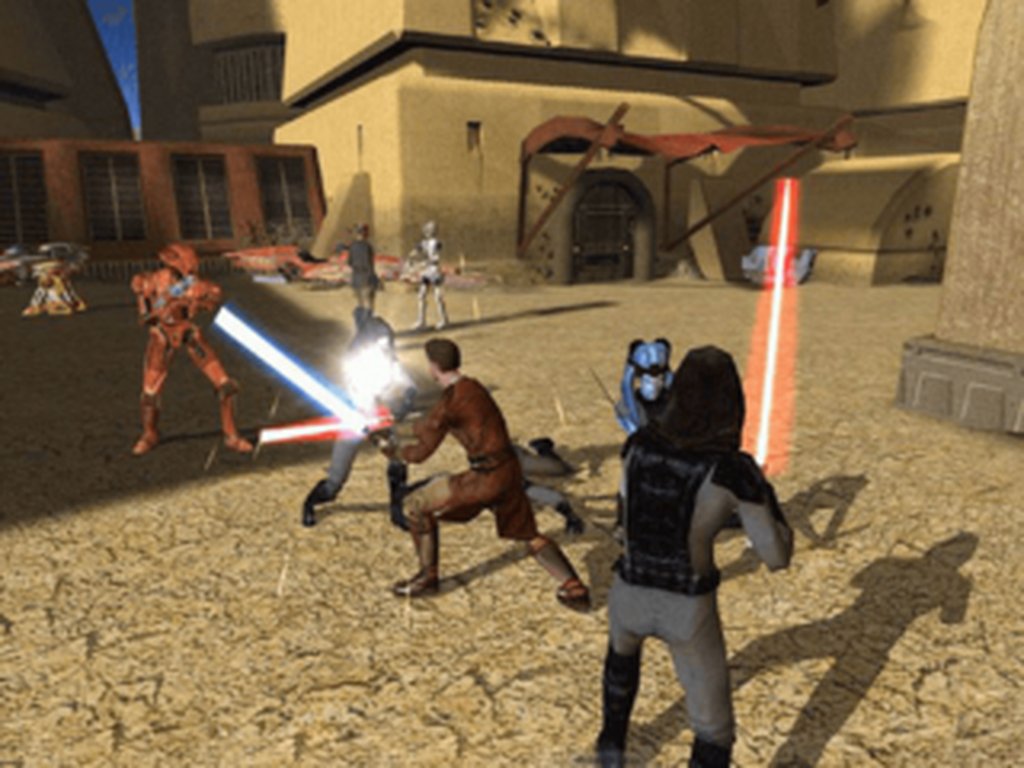
Combat runs on a real-time-with-pause system derived from the d20 rules: behind the lightsaber swings, dice are rolling, and the Xbox interface makes that complexity friendly. You queue commands for three party members, pause mid-fight to redirect a grenade or a Force power, and watch it play out cinematically. It is a compromise between PC tactics and console flow that lands exactly right. Character building is deep — three classes, then Jedi prestige paths, feats, skills from computer slicing to persuasion, and armour and weapon upgrades — yet a newcomer who simply picks what sounds fun will still finish the game happy. That accessibility-with-depth balance is the game’s quiet miracle.
A party worth travelling with
The companions carry the storytelling. HK-47, the assassination droid who calls humans “meatbags” and means it fondly, remains the funniest character BioWare has ever written — and his comedy has teeth, because the game keeps letting you ask what he is for. Carth’s suspicion, Bastila’s brittle pride, Mission’s loyalty, Jolee Bindo’s weary neutrality: the party argues with your choices, remembers them, and in several cases can be lost entirely through them. Dialogue is fully voiced, thousands of lines of it, and the writing treats Star Wars with a scholar’s love and a critic’s eye — the Jedi Code gets examined here more honestly than any film has managed.
KOTOR’s real subject is not the Force. It is identity: who you were, who you choose to be, and whether the galaxy gets a vote.
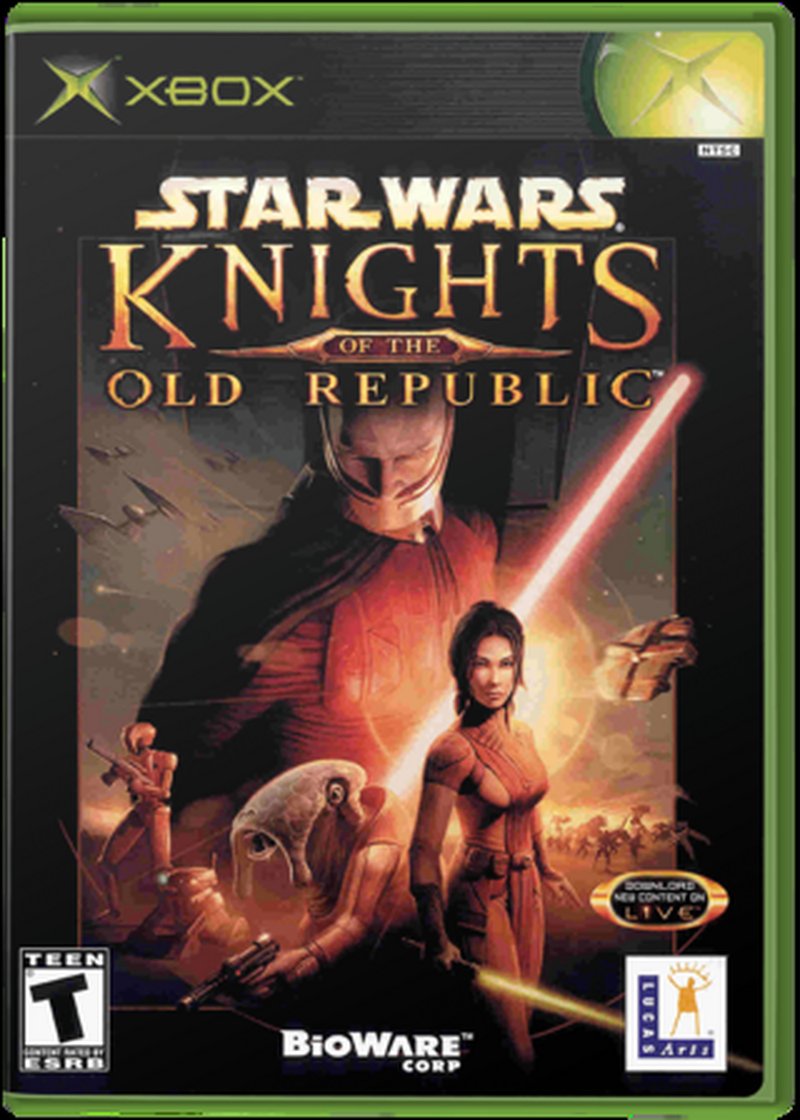
Xbox-specific notes matter in this review. This version was the lead console release, arriving months before the PC edition, and it shows: the interface, radial menus and combat pacing are designed around the controller first. The trade-offs are loading times between areas that ask patience, some texture muddiness beside the later PC build, and occasional frame-rate sag in the busiest Taris streets. Against that, the Xbox got exclusive downloadable content in its day via Xbox Live — the Yavin space station, with high-end gear and a merchant — a genuine novelty for a console RPG in 2004, and the game’s Swoop racing and Pazaak card minigames feel made for the couch. Playing on original hardware today, the load screens are the only real tax.
Presentation holds up through art direction rather than raw power. The Old Republic era let BioWare design a Star Wars that is recognisably itself but not a film copy — sleeker ships, older armour, temples that predate everything you know — and the score, by Jeremy Soule, writes new themes in the Williams grammar without quoting it. Voice acting is uniformly strong. If the visuals date anywhere, it is in facial animation during the long conversations, and the writing is good enough that you stop noticing within the first hour.
Depth in the corners
Replay value is built into the design rather than sprayed over it. Two full moral paths, three starting classes with different early games, party compositions that unlock different dialogue and subplots, a workbench economy that rewards salvaging and building your own lightsaber crystals — a second forty-hour run genuinely differs from the first. The side content repays wandering: bounty hunts on Tatooine, a murder investigation conducted like a courtroom drama on Manaan, the Genoharadan assassin’s guild for the dark-hearted, swoop championships with upgradeable bikes. Even the much-mocked tutorial planet, Taris, is doing quiet structural work, teaching every system — combat, stealth, disguise, racing, cards, arena duels — inside a city whose class politics the Sith occupation throws into relief. By the time the Ebon Hawk lifts off, you have a degree in how the whole game thinks.
For the collector, the Xbox disc is the original artefact: the first release, the version that proved a Western RPG could top console charts, complete with the manual-era presentation the platform favoured. It runs from the hard drive kindly, saves anywhere outside combat, and its Platinum Hits reissue is identical in content and usually cheaper. The one caution is the known save-file size quirk late in very long games — rotate a few save slots, as with any RPG of the era, and the issue never bites. What you are buying, beyond the hours, is the foundation stone of everything BioWare and a hundred imitators built afterwards: Mass Effect’s structure, Dragon Age’s party heart and the modern choice-driven RPG all trace their lineage to this ring-side seat on the Old Republic.
One galaxy, honestly priced
A final practical word: KOTOR asks nothing of you but time and attention, and it repays both at an exchange rate modern games rarely match. There is no downloadable dependency, no online component to mourn, no difficulty spike designed to sell you relief — just a complete, self-contained epic whose every system still functions exactly as designed in 2003. In a collection, it is the disc most likely to convert a sceptical friend. Guard it accordingly.
Choose your first class by temperament, not by optimisation guides — KOTOR rewards playing a person over playing a build, and the galaxy is generous to the sincere. The min-maxed second run will still be there, red blades and all, when the story has made you curious about the other road.
Verdict
Knights of the Old Republic is the Xbox’s essential RPG and one of the defining games of its generation: a forty-hour epic with a party you will remember by name, moral choices that cost something, combat that respects both tactics and pace, and a story twist that recontextualises everything before it. Its flaws are period flaws — loads, muddy textures, stiff faces — and none of them touch the design. New players should know that no prior Star Wars knowledge is required beyond the films’ mood; old players already know. It is, simply, the reason many people kept their Xboxes.