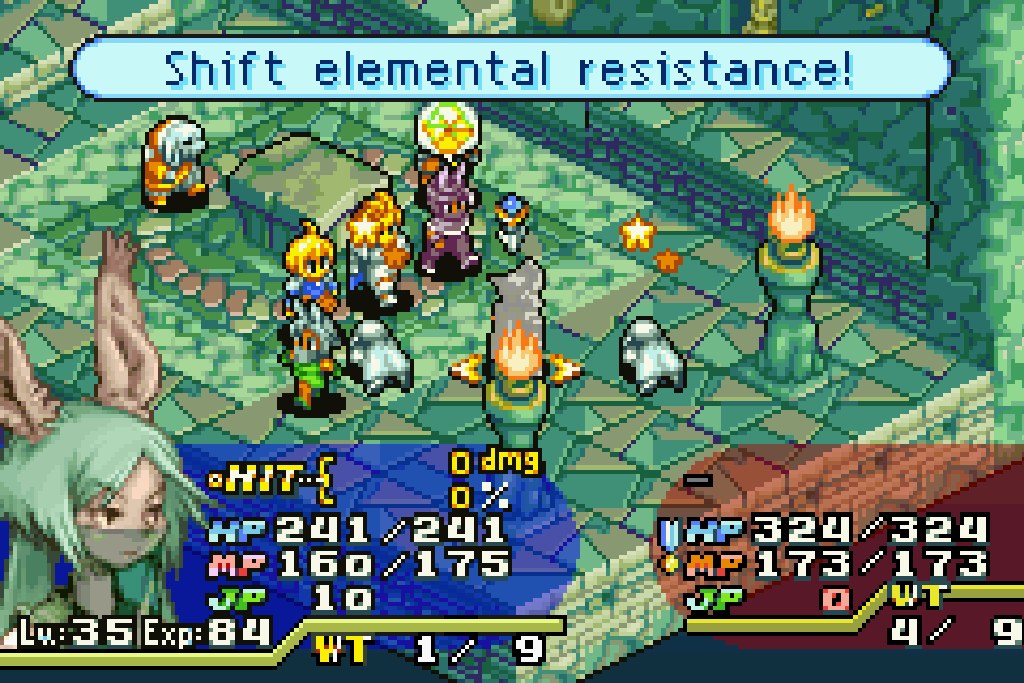
Final Fantasy Tactics Advance, released in 2003, is one of the great deceptions in games — in the nicest way. It looks like a storybook: bright colours, a snowball fight opening, a world literally built from a child’s wishes. Underneath, it is one of the deepest strategy RPGs ever made for a handheld, with hundreds of missions, a job system of enormous flexibility, and one of gaming’s most argued-about stories — a tale about escapism whose ‘hero’ spends the game dismantling his friends’ happiest dreams, and whose villain, depending on who you ask, might be him. Square could have shipped a simple spin-off. Instead it shipped a classic with a splinter in it.

The world Marche tried to leave
Schoolboy Marche and his friends — Mewt, whose mother has died; Ritz, teased for her hair; Doned, Marche’s brother, who uses a wheelchair — find a magical book that remakes their town into Ivalice, a world of clans, crystals and adventure where each of them is remade whole and powerful. Marche alone wants to go home. That premise powers twenty years of debate: is Marche the hero restoring reality, or a boy tearing down a world where his brother can walk and his friend can be happy? The game, to its credit, does not flinch from the discomfort — it gives its arguments to its characters, lets Mewt’s position breathe, and trusts younger players with genuine moral weight. It is not the PlayStation Tactics’ political tragedy; it is a different, more personal kind of serious, and it has aged remarkably well.
Jobs, laws and a clan of your own
Systems are where FFTA becomes a way of life. Your clan recruits from five races — humans, moogles, the lizard-like bangaa, the rabbit-eared viera and the squirrel-ish nu mou — each with its own job tree: soldiers, paladins, ninjas and hunters for humans; dragoons and templars for bangaa; summoners and assassins for viera; time mages and sages for nu mou; gunners and jugglers for moogles, and dozens more. Abilities are learned from equipment — wear the sword, learn the technique, master it, keep it forever — then combined across jobs: a unit carries a primary job, a secondary command set, a reaction ability, a support ability and a combo, producing builds of real personality. Over 300 missions span story battles, clan turf wars, monster hunts and dispatch quests, on maps where you place Ivalice’s locations yourself as rewards, nudging the world’s treasure and encounter tables with every placement.

The Law system is FFTA’s signature friction. Each battle is governed by a rotating law and enforced by an invincible Judge: break it (no swords today; no fire magic; no healing) and offenders are carded — yellow for warnings, red for ejection and prison. Laws irritate players to this day, and deliberately so: they forbid autopilot, forcing you to rotate your clan, respect the day’s rules and build breadth instead of one perfect team. Judged kindly, it is a variety engine; judged unkindly, the harshest laws can feel arbitrary. Both readings are honest, and the system softens as anti-law cards enter play. What is not debatable is the presentation: Yasumi Matsuno’s Ivalice rendered in lush, painterly pixels, Hitoshi Sakimoto’s score doing orchestral warmth through the GBA’s speaker, and battle animations full of character.

Scale and its costs
The game’s generosity is also its caveat. Three hundred missions is a mountain; the story’s critical path is a fraction of it, and players who chase completion face a very long, occasionally repetitive tail of similar battles, with clan management and ability-learning menus that belong to a pre-streamlining era. Difficulty, too, is gentler than the PlayStation original’s — veterans seeking punishment should set personal rules. But as a handheld epic — something to live inside for a season of commutes, building a clan that feels like yours — FFTA has few peers on any system.
The long campaign, and who this Ivalice is for
Expectations are worth setting, because FFTA’s relationship with its famous predecessor has distorted its reputation in both directions. Players arriving from the PlayStation’s Final Fantasy Tactics expecting political tragedy, permadeath and punishing difficulty will find instead a brighter game with gentler stakes — fallen units revive after battle, and the challenge curve is forgiving for long stretches. Players arriving fresh will find something rarer than difficulty: breadth with personality. Five races with real mechanical identities, a clan that feels recruited rather than generated, an economy of missions, auctions for territory in the sequel-minded systems it pioneered, and a world map you literally assemble yourself as location tokens are won — every placement a tiny act of cartography that changes encounter rates and treasure. There is a whole second game in optimising Ivalice’s layout, and the community spent years mapping it.
It is also a game unusually kind to handheld play: missions are bite-sized, suspending mid-battle is painless, and the clan-management loop (equip, learn, dispatch, recruit) suits short sessions while the 300-mission mountain suits long ones. The link-cable clan battles against a friend’s save were a beloved extra in its day. If the laws divide players, the package unites them: this is one of the fullest cartridges on the Game Boy Advance, a season’s worth of strategy in a storybook, and the essential companion piece to Advance Wars in the system’s strategy library — the tactics of grids and jobs to go with the tactics of tanks and COs.
The clan itself deserves a closing word, because FFTA understands something about attachment: your units are not the story’s heroes — they are your people. You name the clan, you recruit the moogle who looked cheerful in the shop, you keep the under-levelled bangaa because he has been there since the beginning, and the game’s systems (dispatch missions that level the bench, laws that force rotation, clan turf that needs defending) keep the whole roster feeling employed and alive. When a red-carded favourite spends a stretch in prison for breaking a law you did not read, or a dispatch team returns with a rare item and a level apiece, the game generates the small management stories that tactics players retell for years. Marche’s story is the one in the cutscenes. Your clan’s story is the one you will actually remember — and a game that makes room for both, on a cartridge this size, has earned its classic status honestly.
For the undecided, the shortest honest pitch is this: if you have ever wished a strategy RPG respected your schedule as much as your intelligence — missions in minutes, mastery in months, a story you will argue about in the group chat — FFTA is that game, and the GBA version is where it lives. Its painterly Ivalice, its five peoples and their dozens of jobs, its judges and their maddening, wonderful laws: all of it coheres into the most distinctive tactics package on the system. Advance Wars will teach you war. Tactics Advance will give you a clan, a country you built tile by tile, and a snowball fight you will think about for twenty years.
Verdict
Final Fantasy Tactics Advance is a storybook with teeth: a vast, flexible, endlessly buildable strategy RPG wrapped around a story brave enough to make its hero arguable. It is not the original Tactics, and it never tries to be — it is Ivalice for the pocket, and one of the Game Boy Advance’s essential RPGs.
Score: 9.0/10