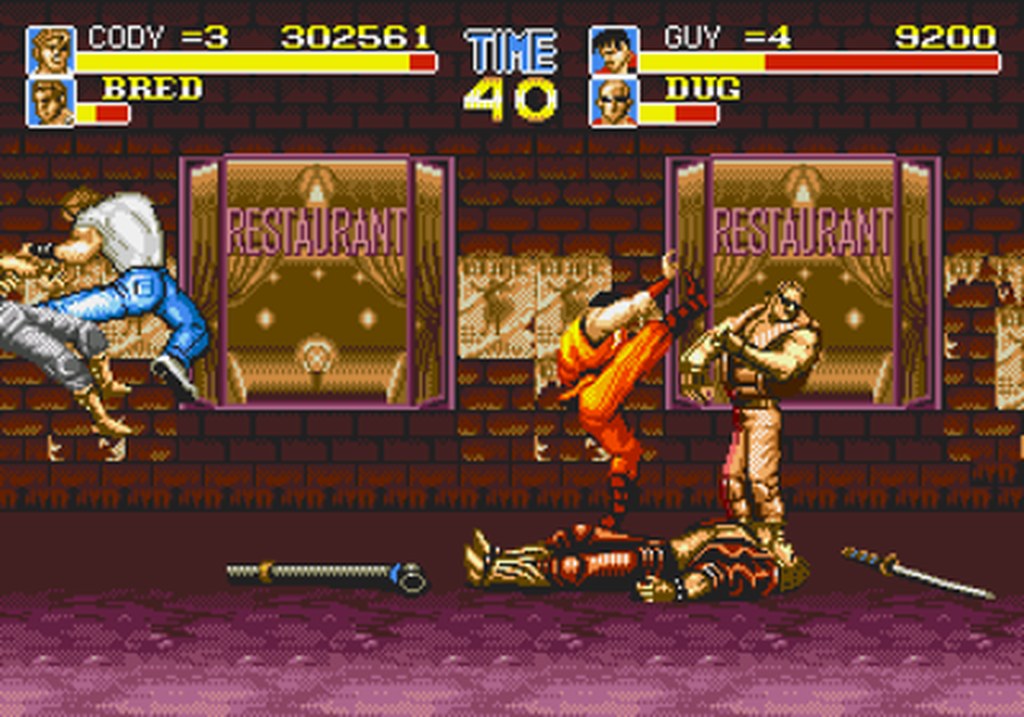
For years, bringing the arcade home meant accepting an apology. Home versions of Capcom’s Final Fight were famous compromises — most notoriously the Super Nintendo port that launched missing a character, missing stages’ worth of content in some regions and, unforgivably for a brawler, missing the second player entirely. Then came Final Fight CD in 1993, and the apology ended. Developed by Sega for its CD add-on, this is the version that finally treated the arcade game as something to reproduce rather than reduce: all three heroes, two-player co-operative play, the full stage count, an arranged CD soundtrack and an animated introduction. “Almost intact” is in our headline out of honesty, and we will get to the “almost” — but first, credit where it is overdue.
Metro City, complete at last
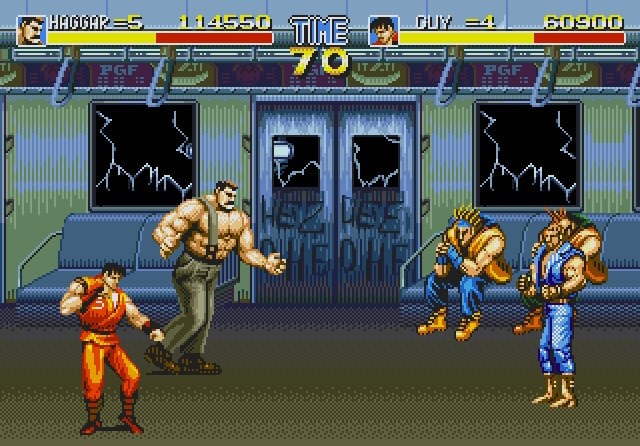
The story remains gloriously simple. The Mad Gear gang has kidnapped Jessica, daughter of Mayor Mike Haggar — a former pro wrestler who responds to this act of political terrorism the way you would hope, by taking his shirt’s sleeves off and going to work personally. He is joined by Jessica’s boyfriend Cody, a brawler with a knife habit, and Guy, a ninjutsu-trained martial artist. On the Sega CD, for the first time at home, all three are selectable — the SNES’s omission of Guy had become a running joke — and each plays distinctly: Haggar is a grappling mountain with a piledriver that clears crowds, Cody is the all-rounder who holds knives instead of throwing them away, and Guy is fast, light and technical, with an off-the-wall kick that rewards aggressive positioning.
Two players, as the genre demands
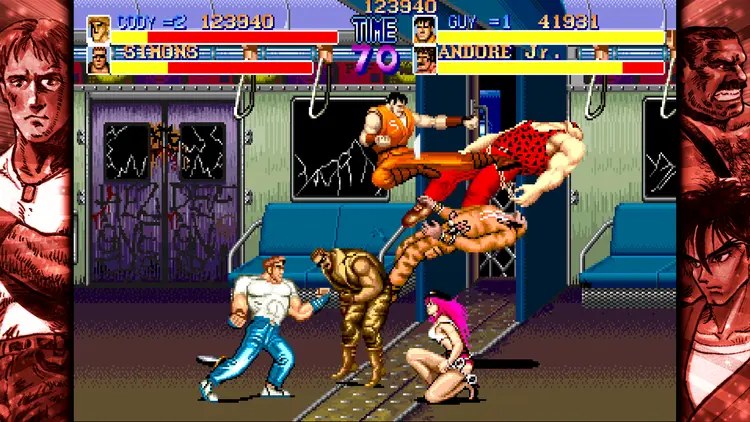
A scrolling beat-’em-up without two-player co-op is a rehearsal. Final Fight CD restores the real performance. Two players share the screen, the enemies and the continues, and the game holds together under the load: the number of thugs it throws at a pair feels like an arcade machine’s answer to having two customers, not a home port trimming itself to fit. Friendly strategy emerges naturally — Haggar holds a crowd in grapples while Cody cleans up with a pipe; Guy keeps the edges honest. It is also, not incidentally, the best way to survive the later stages, where the game’s arcade ancestry shows its teeth.
What the CD bought: sound and ceremony
The most immediately obvious upgrade is the audio. Final Fight CD carries a fully arranged, remixed soundtrack on Red Book audio — the arcade’s tunes rebuilt with the space and fidelity a CD allows — alongside voice samples and an animated opening sequence setting up the kidnapping. In 1993, firing up a home brawler and getting a cartoon introduction and a proper arranged score was a small ceremony that said the format mattered. The remix is excellent, punchy where the original was scrappy, and it does something subtle for the gameplay too: stages feel bigger when their music has room to breathe. Load times between stages exist — this is a single-speed drive — but they are brief pauses, not intermissions.
How it plays, swing by swing
The fundamentals are pure Capcom. Three buttons’ worth of moves stretched across punch combos, throws, jump attacks, a crowd-clearing special that costs a sliver of health, and a wonderful arsenal of pipes, swords and knives lying in oil drums next to the restorative roast chickens of legend. Enemy variety carries the six stages: the basic punks escalate into knife men, fire-breathers, fat chargers, and the dreaded Andore family, whose grapples can delete a health bar’s optimism in seconds. Bosses are pattern puzzles in the arcade tradition — learn Damnd’s windows, respect Rolento’s speed, fear Belger’s crossbow endgame — and the difficulty curve peaks hard in the final industrial stages.
Extras round out the package: a time-attack mode gives score-chasers a reason to keep the disc in after the credits, and options let you soften the arcade’s continue economy for a home evening’s purposes.
The “almost”: an honest accounting
Why not “intact” without qualification? Because a careful eye finds the seams. The colour palette, drawn from the Genesis’s 64-colour ceiling, is a step down from the arcade’s richer tones, and the sprites, while close, are not arcade-identical. There is sprite flicker when the screen gets truly crowded, and the maximum number of enemies on screen at once is trimmed compared with the coin-op at its most generous. Censorship in the Western release touched a few character sprites and names, in the manner of the times. None of these change what the game is; all of them are the sort of thing a collector comparing versions side by side will notice, and this review’s job is to notice them for you.
The stages: a tour worth taking slowly
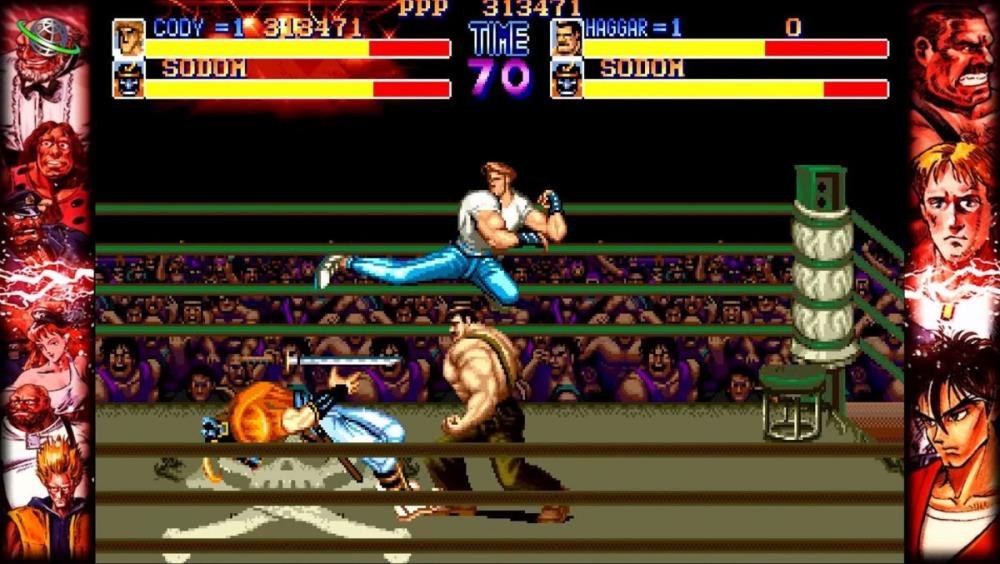
Six stages carry you across Metro City, and they hold up as a level-design tour of what the genre did best. The opening Slum throws the basic mob at you in forgiving numbers while the arranged soundtrack announces itself; the Subway introduces verticality, a moving train and the first real crowd-control problems; the West Side raises the stakes with the wrestling-ring boss encounter that remains the game’s most quoted set-piece; and the Bay Area finale is a long, scenic brawl along the waterfront that tests everything before the Industrial Area’s gauntlet and the final climb to Belger’s penthouse. Bonus stages — smashing a car to pieces on a timer, breaking glass panels — punctuate the campaign with the arcade’s own comic relief, and they are all here. What the CD version quietly improves is pacing at home: stage loads are short, continues are configurable, and the whole campaign sits at a length — comfortably under an hour for a practised pair — that suits an evening’s co-op session perfectly. It is a complete night out, on one disc, with no quarters harmed.
The genre context it deserves
Context sharpens the achievement. By 1993 the home brawler field was crowded — Streets of Rage 2 had set a console-native standard with bigger sprites and four-player ambitions of its own school, and Capcom’s own SNES sequels were respectable original works rather than ports. Final Fight CD wins its place not by out-designing the console natives but by being the arcade, faithfully, in a living room — the thing the coin-op’s fans had actually been asking for since 1990. Its arranged soundtrack alone made it the version importers and reviewers reached for when demonstrating the add-on to sceptics: put the disc on, hand over pad two, and the argument about whether the Sega CD was a real games machine ended at the first stage clear. Machines need their demonstrators. This was the brawler division’s.
A note on playing it today
On original hardware the experience remains the one described above, with load pauses that modern patience barely registers. However you reach it, give the arranged soundtrack a proper pair of speakers once: half this version’s legend lives in its low end, and laptop speakers have been underselling it for thirty years.
Verdict
Measured against its own era, Final Fight CD is the definitive home version: complete roster, complete stages, two players, superior sound, and the full arcade campaign. Measured against today, it remains a top-tier brawler whose only serious rivals are its own arcade original and the genre’s later evolutions. The Sega CD is remembered for many strange experiments; it should be remembered for this one first — the moment a home port stopped apologising.
Score: 8.5/10