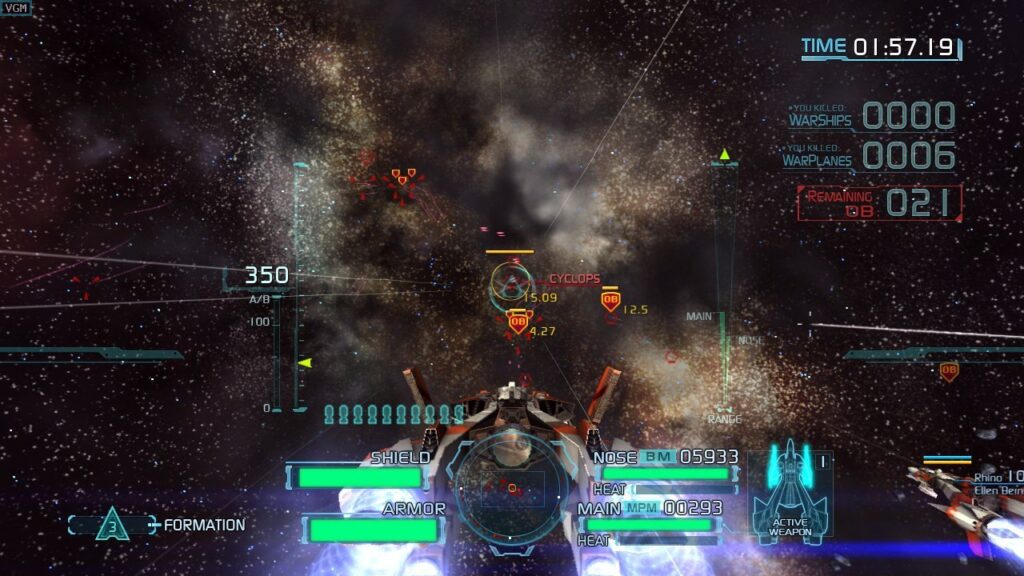
Silpheed is the most Sega CD game imaginable, in both the flattering and the unflattering senses of that phrase. Game Arts’ 1993 shooter is built on a technical trick that still makes people sit up: full-motion video backgrounds — pre-rendered polygon worlds streaming off the disc — with your polygonal fighter weaving through them in real time. In an era when the add-on’s showrooms needed a spectacle, Silpheed was the spectacle. The honest question, thirty years on, is what is left when the wow fades. The answer is a good, occasionally great, slightly strange shooter wrapped inside a piece of technical theatre that has aged far better than its critics predicted.
The trick, explained fairly
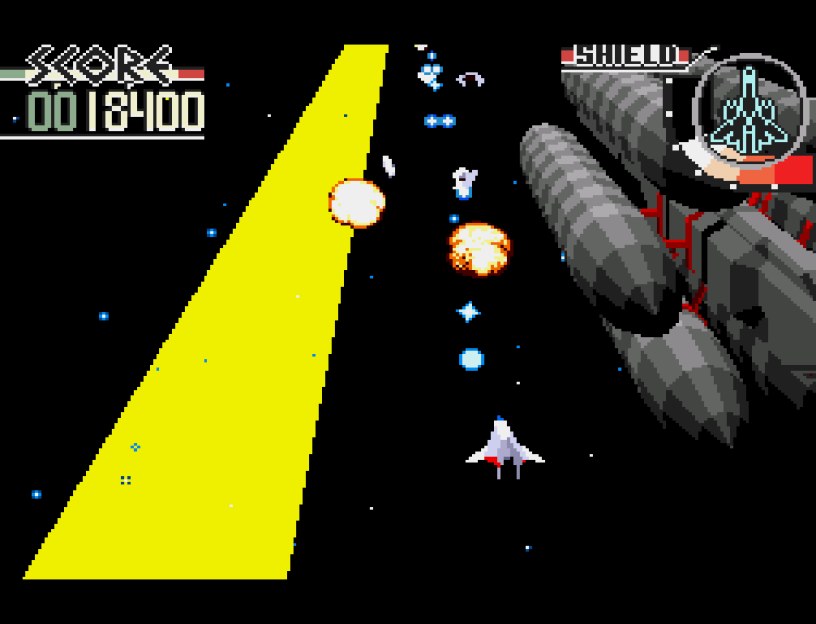
Your ship, the SA-77 Silpheed, flies into the screen over backgrounds that are not being drawn by the Genesis hardware at all — they are pre-rendered polygon sequences played back from the CD while the game overlays your ship, enemy craft, shots and explosions as sprites and polygons in the foreground. The result, in 1993, looked like witchcraft: sweeping asteroid fields, capital-ship flybys and planetary dives of a scale no cartridge shooter could approach, running on a machine whose base unit was designed in 1988. The seams are visible if you know them — your ship cannot truly interact with that gorgeous terrain, and foreground enemies enter on rails laid over the film — but the illusion’s direction is excellent. Stages are staged: the camera dives, banks and charges in ways that make you feel piloted through a battle rather than pasted over one.
How the shooting holds up
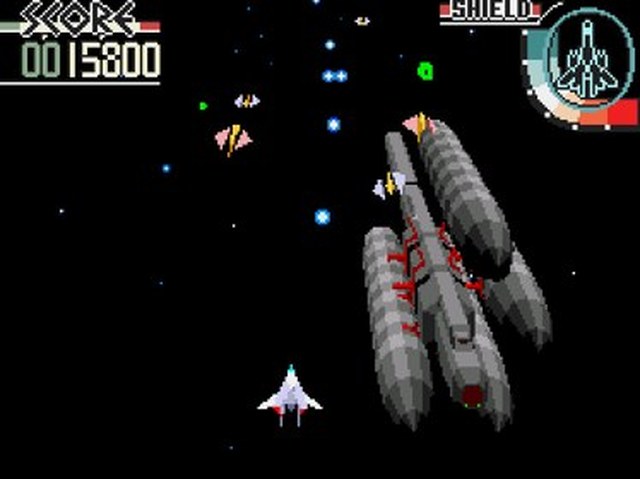
Strip the backdrop away and Silpheed is a disciplined vertical shooter viewed from a chasing, tilted perspective. Enemies arrive in formation waves, gun emplacements track you, and larger craft demand concentrated fire while the screen fills with honest bullet patterns — nothing like the later bullet-hell standard, but busy enough to punish autopilot. Your arsenal builds between stages from earned credits: forward vulcans, wide shots, homing options and shields that you select and position, giving the game a light loadout strategy absent from most of its peers. Taking a hit costs you a weapon’s power rather than a life at first, a forgiving structure that keeps runs alive and tension high — you are always one sloppy weave away from finishing a stage with a peashooter and strong opinions.
The controls deserve praise. The tilted perspective could have made aiming mushy; instead, movement is tight, your hitbox feels fair, and the game teaches its depth grammar quickly — enemies that look close but pass beneath you stop fooling you within a stage or two. Bosses are the foreground’s big exam: large multi-part craft fought over the streaming scenery, where the theatre and the game finally occupy the same space.
The substance question, answered honestly
Silpheed’s critics, then and now, make one fair point: parts of the experience are a film you are allowed to lose at. Background events happen on rails regardless of your performance; collision with the world is an illusion; and a player who has memorised the waves is partly memorising a movie’s timing. All true — and less damning than it sounds. Plenty of revered shooters are memorisation exercises; Silpheed is simply honest about being choreographed. Where the criticism does land is variety: across its dozen stages, the foreground game changes less than the scenery does, and the middle act sags slightly, with waves that remix rather than reinvent. The difficulty, meanwhile, spikes honestly at the end, as if the game suddenly remembers it is an arcade-bred shooter and bills you for the spectacle.
The presentation around the shooting is all class. The soundtrack uses the CD properly — driving, orchestral-flavoured compositions that treat stages like film sequences — and the voice work from your command crew gives missions a Saturday-morning space-opera warmth without drowning the action. Continue screens, briefings and hangar sequences build a world around what is, mechanically, a fairly lean game, and they build it well.
Sixty-four colours, unlimited nerve
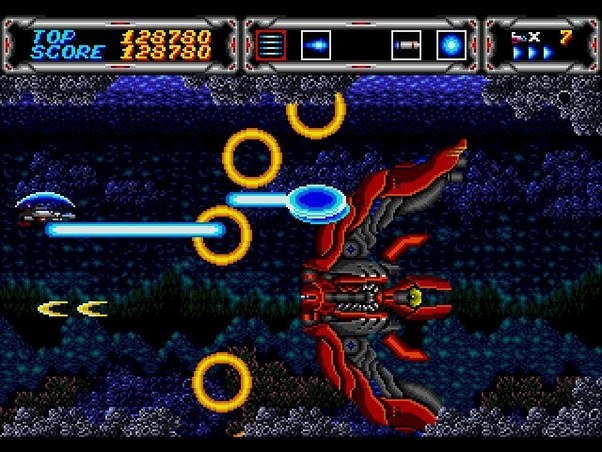
Our headline mentions the palette because Silpheed’s art direction turns the Genesis’s 64-colour limit into a style rather than an apology. The pre-rendered backgrounds are graded in moody blues, gunmetal and flare-orange; the foreground sprites are kept bold and readable against them. Yes, you can spot dithering. Yes, modern eyes see the video compression of a 1993 disc working at single speed. But as a piece of direction — a team deciding what their constraints looked like and leaning in — Silpheed remains a small masterclass, and its surface-fleet and deep-space stages still photograph beautifully.
A lineage worth knowing
Silpheed did not begin on the Sega CD. Game Arts’ series started on Japanese home computers in the 1980s, where the original Silpheed was already a polygon-flavoured showpiece for hardware that had no business attempting it — showing off was in the series’ blood from birth. The Sega CD game is best understood as that instinct meeting a disc: the computer originals dreamed of cinematic scale and the technology of 1993 finally let the dream be filmed rather than described. Knowing the lineage also explains the game’s structure — the between-stage armament, the command-crew framing, the mission-serial pacing all descend from the home-computer games, translated for a console audience. It is a sequel in spirit and a remake in ambition, and it stands as Game Arts polishing two of the system’s defining releases, this and Lunar, in entirely different genres at the same moment in history — a studio résumé few could match on the format.
Who should play it now
Three audiences, honestly assessed. Shooter historians should play it as a primary document — the moment the genre flirted with cinema and learned which parts of the flirtation it wanted to keep. Score-attack players will find a fair, learnable, genuinely tense game whose weapon-degradation system creates comeback stories in miniature on every stage. And Sega CD owners building a shelf should treat it as core stock: it is one of the half-dozen discs that demonstrate the hardware’s personality at a glance, the one you put on when someone asks what the machine could do that a cartridge could not. Play it on a decent display, turn the soundtrack up, and forgive the middle act its remixes. The finale earns the forgiveness back with interest.
The sound of the future, 1993 edition
One element has escaped the theatre-versus-substance debate entirely, because both camps agree on it: the audio. Between the soundtrack’s full-orchestra ambitions and the constant, characterful radio chatter of your support crew — warnings, confirmations, alarm — Silpheed sounds like the CD future the advertisements promised, the rare launch-window disc whose audio design alone justified the format to a sceptical friend in one sitting. Many Sega CD games used the disc. This one broadcasts from it.
Verdict
Silpheed is technical theatre with a real game inside it: not the deepest shooter on the Sega CD, but a tight, well-armed, beautifully presented one whose central trick still impresses. Come for the spectacle the magazines promised in 1993; stay for the loadout decisions, the fair controls and the score attack. The film may be pre-rendered, but the fun is live.
File it beside the system’s other great demonstrations — the ones where the disc, the design and the nerve all arrived at the same time — and play it loud.
Score: 8.0/10