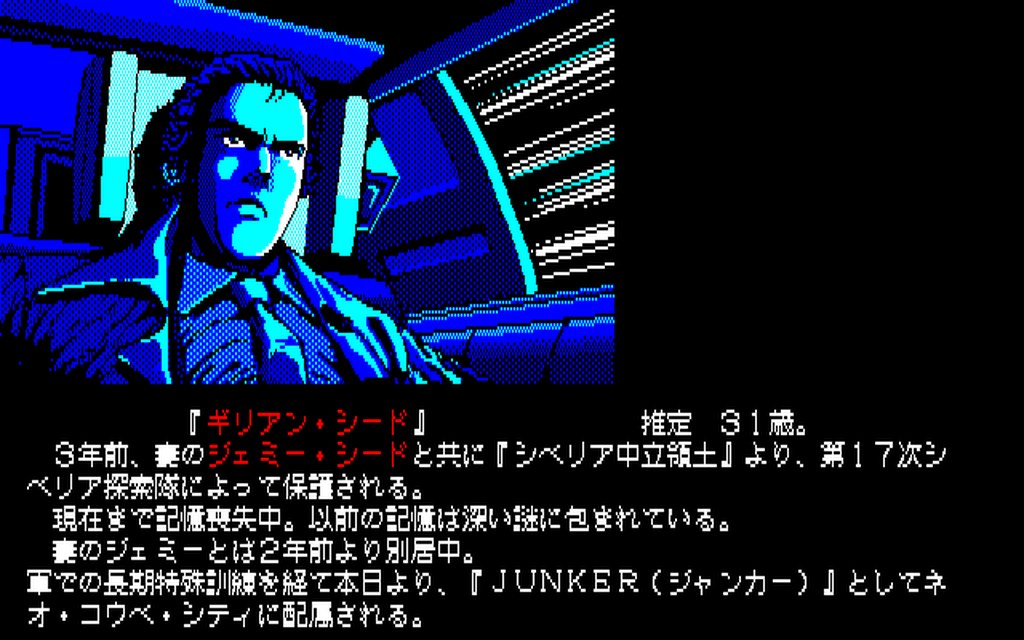
There is a short list of games that make an entire add-on worth owning, and Snatcher sits near the top of it for a reason that has nothing to do with hardware specs. Hideo Kojima’s cyberpunk adventure — part detective story, part horror film, part love letter to the science-fiction cinema of the 1980s — reached English-speaking players officially on exactly one platform: the Sega CD, in Konami’s 1994 version. Everything about that sentence is unlikely, and everything about the game itself explains why people still hunt it down. This is the Sega CD at its most adult, most ambitious and most confident.
Neo Kobe, 2047: the setup
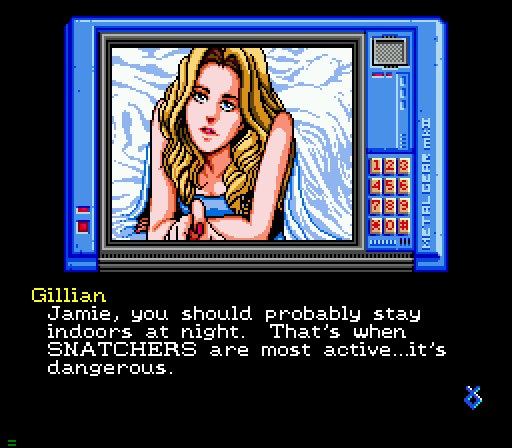
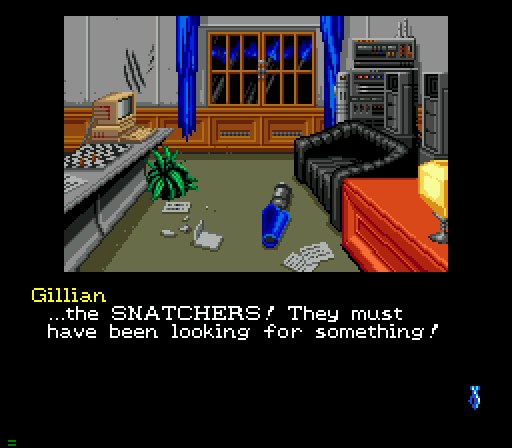
Fifty years after a catastrophe in Moscow released a biological weapon that devastated half the world’s population, the island city of Neo Kobe is being infiltrated by Snatchers — artificial life forms that kill their victims and take their places, wearing their skin. You are Gillian Seed, an amnesiac recruited into JUNKER, the task force that hunts them. Gillian remembers nothing before three years ago, his estranged wife Jamie remembers nothing either, and the one thing they share is a past connected, somehow, to the Snatchers themselves. It is a superb noir hook: a detective whose own identity is the coldest case in the file.
The influences are worn openly — the replicant hunts of Blade Runner, the pod-person paranoia of Invasion of the Body Snatchers, the chrome-and-smoke of The Terminator — but Snatcher is a synthesis, not a collage. Kojima assembles the borrowed pieces into a world with its own rules, slang and dread, then writes characters who live in it rather than posing in it. Gillian is lecherous, frightened, funny and brave in rotation, sometimes within one scene, and his navigator — a small robot named Metal Gear Mk. II, in one of gaming’s great in-jokes — plays straight man, database and conscience in one metal shell.
An adventure game that trusts conversation
Snatcher plays as a menu-driven adventure: look, investigate, ask, move, call. The interface is the genre’s standard furniture, but the writing elevates it. Interrogating suspects, phoning contacts on the videophone, and badgering witnesses through repeated questions gradually opens new options, and the game rewards curiosity with character detail rather than punishment. The famous moments are investigative, not action-based — examining a shower scene for evidence plays out as genuine detective work wrapped in Gillian’s hopeless commentary, and a trip to an underground black-market district builds more atmosphere through dialogue than most games build with a level.
The voice acting deserves special emphasis, because this was 1994, on a console add-on, in English. Konami’s localisation cast the game properly and recorded extensive voiced dialogue for its key scenes at a time when most CD games were dubbing kung-fu footage. The performances hold up because the direction does: scenes are allowed to breathe, jokes are allowed to land, and the horror — and there is real horror, including one discovery involving a hospital that remains genuinely upsetting — is allowed to be quiet before it is loud.
The Justifier moments
Periodically, the investigation erupts. Snatcher’s shooting sequences drop into a first-person grid where you blast attacking Snatchers and bioroids, and on the Sega CD they support Konami’s Justifier light gun — the pink-revolver peripheral from Lethal Enforcers. These segments are short, sharp punctuation: aimed well, over quickly, and tuned so that a controller works perfectly well if you do not own the gun. That restraint is typical of the game’s judgement. Action exists to raise your pulse between deductions, never to replace them, and the final act’s escalating set-pieces feel earned precisely because the game made you do the detective work first.
Why the Sega CD version is the one
Snatcher existed in Japan in earlier computer and PC Engine CD forms, but the Sega CD release is the only official English version ever made — and it is not a bare translation. The Sega CD version carries the story through its concluding act with material adapted and expanded for this release, the full English voice production, redrawn art touches, and the light-gun support. For an English-speaking player, the question “which Snatcher should I play?” has had exactly one answer for thirty years. It also means this version carries the weight of the game’s whole Western reputation: every retrospective, every “greatest adventure game” list, every Kojima career history that English readers know runs through this disc.
Honesty corner: the game is not flawless. Menu-hunting can stall progress when the required action is the third repetition of a command you already tried, a classic adventure-game sin this game commits a handful of times. Some of Gillian’s behaviour toward women is written as comedy in a way that was creaky then and creaks harder now; the game itself has other characters call him on much of it, which helps, but a modern player should know it is there. And the shooting grids, while fun, are simple. None of this touches the core achievement.
The atmosphere is the achievement
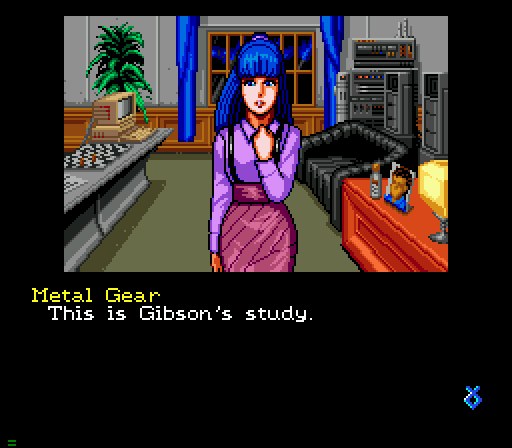
What Snatcher does better than almost any game of its era is sustain a mood. Neo Kobe at Christmas — the story unfolds in December, against neon and snow — is rendered in detailed pixel art and a synth score that shifts from lounge-smooth investigation themes to genuine dread without ever showboating. The CD format gives the soundtrack room to be music rather than loops, and the art direction sells rain, steam and fluorescence in a 64-colour world through sheer craft. You remember places from this game — JUNKER headquarters, the seedy Alton Plaza, a certain factory — the way you remember locations from films.
The supporting cast carries the city
Gillian gets the cover, but Neo Kobe lives in its supporting players, and the script lavishes attention on them. Random Hajile, the bounty hunter whose name is an in-joke and whose entrances are timed like a western gunfighter’s; Katrina, the daughter of a murdered colleague, whose subplot gives the investigation a human cost; Harry, JUNKER’s engineer, whose warmth and bar-room philosophy scenes do the game’s quiet emotional groundwork; and Chief Cunningham, managing the politics above Gillian’s pay grade. Even the videophone contacts — a dial-up directory of informants, colleagues and one increasingly exasperated wife — build the sense of a city with a telephone network’s worth of grudges and debts. The game’s famous fourth-wall jokes and Konami in-references (you will meet characters whose names reward anyone who knows the publisher’s catalogue) never break the spell, because the world is solid enough to absorb the winking. That solidity is the real answer to why a menu-driven game from 1994 still gets finished, in one or two sittings, by first-time players today: nobody puts it down mid-case.
Its influence, finally, is written across its creator’s later career — the world-building density, the genre cinema woven into interactive form, the willingness to let a game be talkative and strange — all of it is present here, in English, on this disc, first.
Verdict
Snatcher is the Sega CD’s proof that the format could deliver a mature, literary, impeccably localised adventure years before that became normal — and it remains, in English, exclusive to this disc in its original form. Atmospheric, funny, frightening and written with total confidence, it is one of the finest adventure games of the 16-bit era on any platform.
Score: 9.5/10