
At a glance: Ratchet & Clank: Up Your Arsenal (2004) · Developer: Insomniac Games · Publisher: Sony Computer Entertainment · Platform: PlayStation 2 · Release: 2 November 2004 · Players: 1 (campaign), 1–8 (multiplayer) · Genre: third-person shooter / platformer · Score: 9.0/10
Three games in three years. That was Insomniac’s cadence in the early 2000s, a production line that would break most studios, and on 2 November 2004 it produced the one the others are measured against. Ratchet & Clank: Up Your Arsenal takes everything Going Commando had proven a year earlier — the weapon levelling, the arena combat, the spherical worlds — refines the controls, doubles down on the comedy, and then, almost as a dare, bolts on the PlayStation 2’s most enjoyable online multiplayer. It earned a 91 on Metacritic, sold over three million copies, and is still the Ratchet game that veterans name first. Twenty-two years later, it has lost almost none of its snap.
A villain worth framing
Every great series eventually finds its great villain, and Up Your Arsenal is where Ratchet & Clank found theirs. Dr. Nefarious — a robot tyrant with a operatic hatred of “squishies,” organic life — intends to convert every living thing in the Solana Galaxy into robots using a superweapon called the Biobliterator. Armin Shimerman plays him as a malfunctioning Shakespearean actor, prone to freezing mid-rant into a soap-opera broadcast his butler Lawrence has to slap him out of. He is funny in a way game villains in 2004 simply were not, and the writing around him is the sharpest Insomniac had produced: a pop-star robot, Courtney Gears, sings a propaganda music video (“Death to Squishies”) that doubles as a Britney Spears parody; Clank is kidnapped and replaced by an evil double, Klunk, in a soap plot the game plays completely straight for maximum absurdity; and Captain Qwark, the galaxy’s most fraudulent hero, is discovered living feral on Florana and has to be rehabilitated through his own playable history. The comedy never stops the game from working — it is the reason the campaign’s twenty-odd hours of shooting feel like a cartoon you are starring in rather than a checklist you are completing.
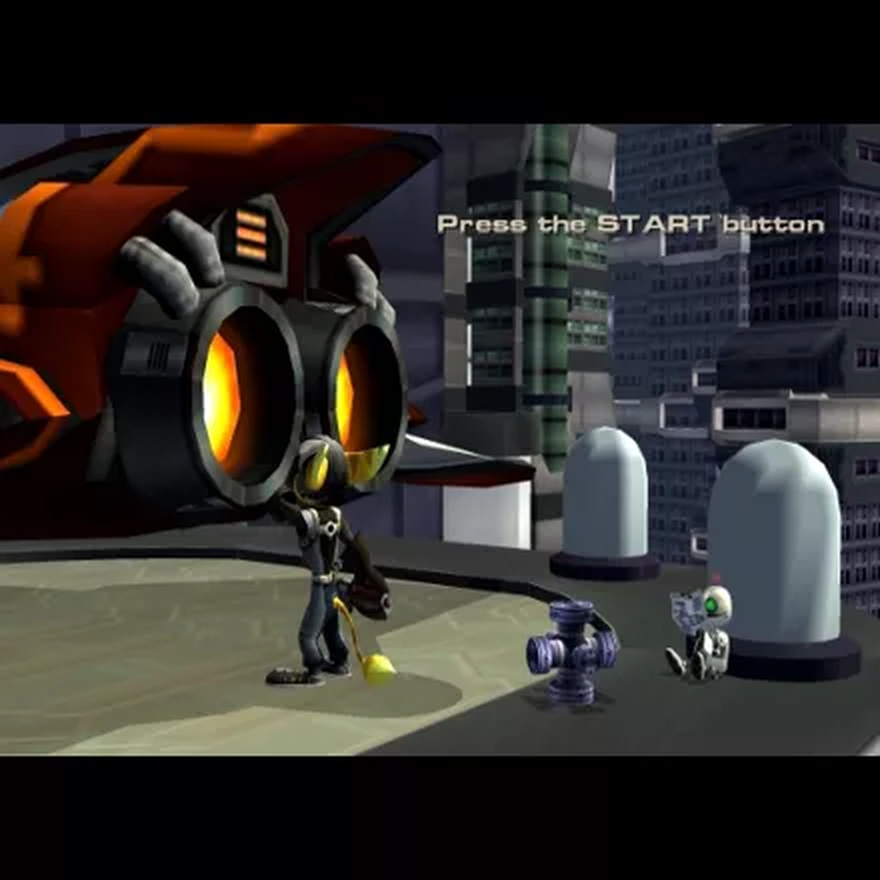
The framing device holds it all together beautifully. The campaign runs from the Starship Phoenix, a Galactic Rangers capital ship commanded by Captain Sasha Phyronix, and Sasha’s crew gives the game a home base with a pulse: briefings, banter and the slow rehabilitation of the Q-Force, Qwark’s hand-picked “elite” squad of series grotesques, all reporting to a captain who has faked his death once already and will again before the credits. When the Leviathan ambush appears to kill Qwark mid-campaign, the game stages a genuine memorial — and then lets the coward’s survival become one of its best jokes and, in the finale, its best redemption, as Qwark flies into the Biobliterator battle at the one moment heroism is actually required. For a series built on one-liners, the character writing here has real architecture: Ratchet matures from mercenary to leader, Clank’s celebrity (he is, canonically, the star of the Secret Agent Clank holofilms) becomes a plot weapon in Nefarious’s hands, and even Skidd McMarx’s skateboarding bravado gets its dark punchline when Courtney Gears turns him into a robot.
Twenty weapons, eight levels deep
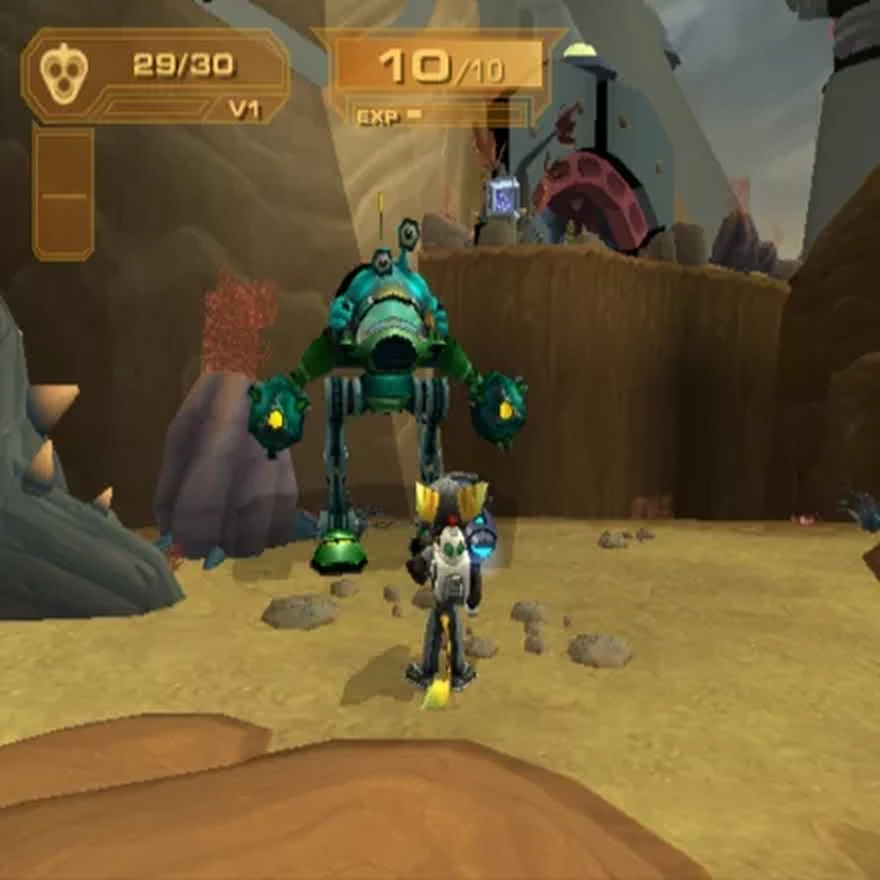
The arsenal is the series’ signature, and this is its finest vintage. Twenty weapons ship in the box, and where Going Commando let each gun evolve through four levels of power, Up Your Arsenal stretches the ladder to eight — five on the first run, three more waiting in Challenge Mode — so a favourite weapon keeps growing teeth for the entire game and into the replay. The N60 Storm matures from a pistol into a storm of ricocheting lightning; the Annihilator deals in guided demolition; the Plasma Coil arcs current through whole mobs; Agents of Doom deploy a personal robot honour guard; the Qwack-O-Ray turns Tyhrranoids into exploding ducks, because of course it does. At the top of the mountain sits the RY3NO, the series’ traditional game-breaker, which at full upgrade becomes the Rynocirator and simply removes problems from the screen. Own a Going Commando save and several classics return at a discount, a small kindness that made the trilogy feel like one growing toybox. Just as important is what your hands are doing: a new lock-strafe control scheme, borrowed from the shooter world, frees the camera and lets Ratchet circle-strafe like a proper gunfighter, and it quietly became the way the series would be played forever after.
Two games in one
Insomniac’s own team — around 115 people — described an ambition to make something that was “almost two games in one,” and the campaign honours it. Between the planet-hopping firefights (Veldin’s invasion, the Aquatos infiltration, the assault on the Tyhrranoid homeworld, Metropolis under attack) sit whole other genres. The Qwark Vid-Comics are five 2D side-scrolling platformers, drawn like a Saturday-morning cartoon, that retell Qwark’s youthful battles with Nefarious and double as the game’s most charming storytelling device. Giant Clank returns for kaiju-scale brawls. Clank sections hand you a squad of Gadgebots to command through puzzles. The Galactic Ranger missions open the maps into battlefields with a Turboslider buggy and a Hovership to pilot, turret defences to hold and drop-ships to repel — a light RTS flavour folded into a platform-shooter without ever breaking its stride. Planet by planet, the game keeps changing the question it asks, and it is that variety, more than any single weapon, that makes the campaign feel twice its length in the best way.
Finishing the story is roughly the halfway point. Challenge Mode restarts the campaign with your arsenal intact, a bolt multiplier that climbs as long as you avoid taking damage, and the remaining three upgrade levels for every weapon locked behind its paywall — the intended route to the Rynocirator and to the Mega versions of your favourite guns. Titanium Bolts hide in the usual impossible corners for the collectors, armour tiers climb toward the Infernox set, and the whole loop is tuned so that a second run feels like a victory lap with sharper teeth rather than a chore. Insomniac had quietly solved the action-game replay problem: make the toys so good that the reward for finishing is getting to keep them.
The soundscape deserves its footnote, too. David Bergeaud’s score bounces between military pomp and cartoon menace without ever fighting the action, the weapon effects are meaty enough that reviewers singled out the sound design by name, and the voice production was a generation ahead of most of the PS2 catalogue — full scenes, properly acted, with comic timing that depends on the performances landing. Play it today and the mix still sounds expensive.
Online, on a PlayStation 2, in 2004
Then there is the mode that made other PS2 developers quietly nervous. Up Your Arsenal was the first Ratchet game with online multiplayer — up to eight players, with voice chat through a headset, across three modes: Deathmatch, Capture the Flag, and Siege, in which teams storm a base to wreck its power core, commanding vehicles and turret emplacements on maps built for exactly that. It worked beautifully, because it was not a minigame: it was the campaign’s arsenal, movement and lock-strafe shooting pointed at other humans. Split-screen covered the couch, too. The PS2 servers ran until June 2012 — nearly eight years of service for a platform game with guns — and the mode’s DNA flows directly into Ratchet: Deadlocked and everything Insomniac did with multiplayer afterwards. In 2004, this was a platformer competing with dedicated shooters on their own turf, and winning rounds.
The honest debits
Flagship status aside, the flaws are real and worth recording. Contemporary reviewers noticed, correctly, that the campaign is a touch easier than Going Commando’s — the upgrade economy is generous, armour tiers blunt the difficulty curve, and a levelled arsenal can steamroll the mid-game before the Tyhrranoids catch up. A few Ranger missions repeat their templates once more than they should. The camera, improved as it is, still negotiates badly with tight interiors when the lock-strafe gets busy. And the humour — very much of its Cartoon Network moment — will land as dated for some modern players, though we’d argue the delivery sells it: James Arnold Taylor’s Ratchet had settled into the role, David Kaye plays both Clank and Klunk with a straight face, and Jim Ward’s Qwark remains one of the great comic performances in games.
It also fixed the template the whole series still follows: an evolving arsenal as the progression system, a comic-book villain with genuine theatricality, set-piece variety over raw level count, and a replay mode that treats your finished arsenal as the prize. Every Ratchet & Clank since 2004 is, in some measurable way, chasing this game.
None of it dents the verdict of history. GameSpot named it the best platformer of 2004; the Academy of Interactive Arts & Sciences nominated it for Console Game of the Year; IGN later placed it on their top-25 PS2 games of all time; Edge devoted a Time Extend retrospective to its weapon design. The 2012 HD Collection carried it to PS3 (and a Vita port followed), where a new generation discovered what the Solana Galaxy already knew. Dr. Nefarious, stranded on his asteroid by a teleporter whose destination nobody specified, went on to become the defining villain of the entire franchise — but he was never better than in the game that introduced him, screaming at the squishies, in a campaign that never once runs out of ideas.
“The PS2’s most joyful shooter: twenty evolving weapons, a villain for the ages, and an online mode a platformer had no business pulling off.”
Verdict: 9.0/10. Up Your Arsenal is the peak of the classic Ratchet & Clank trilogy — the moment a great series became a defining one.