
MASTER SYSTEM · FEATURES · FROM THE VAULT
If you grew up in North America, the 8-bit story was told to you as a one-horse race. Nintendo saved video games, the NES lived in every house on the street, and Sega was the scrappy also-ran waiting for the Genesis to matter. It’s a tidy story. It’s also wrong — or at least, it’s only the American chapter. While the NES was locking down US toy stores, Sega’s Master System was quietly building a library with richer colour, beefier sound in its Japanese form, and a string of games that in several cases beat Nintendo’s own versions of the same ideas. In Europe it genuinely rivalled the NES. In Brazil, thanks to Tec Toy, it never really died at all — Master Systems were still being sold there decades later, with new games nobody in Ohio ever saw.
So this is the other 8-bit library: ten Master System games that deserve a place in the conversation, ranked from “you should know this exists” to the one title that, on its own, justifies owning the hardware. Every one of them is playable today, most are still cheap, and a couple of them are better than the famous games they were imitating.
The machine itself

A quick orientation, because the hardware explains the games. The Master System launched in Japan in 1985 as the Sega Mark III and reached North America in 1986, into the teeth of Nintendo’s third-party lock-in: publishers who made NES games mostly couldn’t make Master System games, so Sega built its library itself and with a handful of loyal partners. The machine could put more colours on screen at once than the NES, and the Japanese model carried an FM sound chip that made its music sound a generation ahead. What it never got in America was shelf space. Europe and Brazil were another story — there, distribution muscle and aggressive pricing made Sega first a real competitor and then, in Brazil, a permanent institution. That split personality is why this list mixes stone classics with games many American readers will be meeting for the first time. That’s the point. Behind the NES, a whole library was hiding.
10. Kenseiden
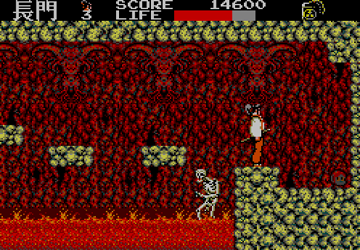
Every console has one game that’s just slightly too strange and too stern for its own commercial good, and on the Master System it’s Kenseiden (1988). You are Hayato, a samurai crossing a demon-infested Japan to recover the five secret scrolls and the Sword of the Dragon King from the warlock Yonensai. The structure is pure side-scrolling action, but the mood is what sells it: bruised reds and blacks, skeletal enemies, training stages where a master teaches you new sword techniques if you survive the lesson. Beat a warlock and you choose your route across the map of Japan, which gives it a light adventure-game spine that most 8-bit action games never bothered with. It’s hard, it’s atmospheric, and it feels like Sega channelling a chanbara film through an 8-bit cartridge. The gem of gems — start here if you want the library’s weird end first.
9. Wonder Boy in Monster Land

Before the series became the beloved Metroidvania of entry #2 on this list, Wonder Boy went on a shopping trip. Monster Land (1988 on Master System, from Westone’s 1987 arcade game) is an action-RPG in platformer clothing: you kill monsters for gold, then spend that gold in towns on better swords, shields, boots and armour, while an hourglass timer quietly eats your health if you dawdle. The Master System port is the version most home players met, and it holds up beautifully — bright, chunky, and with that distinctive structure where half the game is knowing which shop sells what. It also hides one of retro gaming’s great bits of trivia: gold is farmed most famously by a waggle trick on the controller that generations of kids passed around like scripture. This is the bridge between arcade action and console RPG, and it’s still a joy to route through.
8. Fantasy Zone
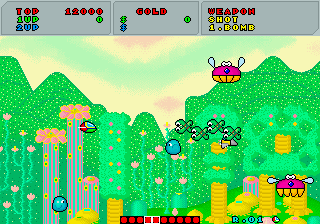
Sega called it the “cute-’em-up” and Fantasy Zone (1986 arcade; Master System port the same era) really is the template: Opa-Opa, a sentient spaceship with little feet, flies freely left and right across wrapping pastel worlds, destroying bases and spending the coins that spill out in flying shops — actual shops, tethered to balloons, where you buy bigger guns, bombs, and engine upgrades that make Opa-Opa faster and heavier. The Master System version matters because it was an early proof that Sega’s home machine could carry its arcade catalogue: the colours survive, the shop system survives, the bosses survive. And underneath the candy coating it’s a serious shooter with an economy — do you bank coins for the 7-Way Shot or survive this stage first? Space Harrier gets the Master System conversion glory, but Fantasy Zone is the one that plays best today.
7. Shinobi
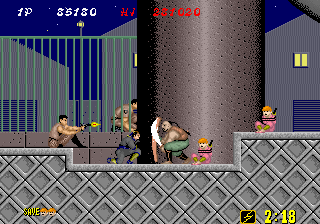
The Master System’s Shinobi (1988) is the conversion that had no right to work. The arcade game (1987) threw Joe Musashi across two depth planes, rescuing hostages and rationing shuriken and ninjutsu, and on paper the home port should have been a shrug. Instead Sega’s home team kept the bones — the hostages, the plane-hopping, the bonus stages played in first person with shuriken flying at the screen — and rebuilt it into one of the tightest action games on the system. What you lose in arcade gloss you gain in learnable, fair brutality: this is a game that wants you to memorise it, and rewards you like an arcade game should. Shinobi’s later fame lives on the Genesis with Revenge of Shinobi, but the series’ home story starts here, and this port is a big reason the Master System earned its arcade-at-home reputation in Europe.
6. Golden Axe Warrior

Here is the list’s best party trick: the finest Legend of Zelda clone of the 8-bit era is a Sega game with Golden Axe on the box. Golden Axe Warrior (1991) borrows almost nothing from its arcade namesake — no side-scrolling brawling at all — and instead builds a vast overhead action-RPG: an overworld of villages, forests and seas, labyrinths to raid, magic to learn, and a quest to gather crystals and face Death Adder. It wears its inspiration openly, right down to secrets hidden under specific trees, and then quietly out-executes half the games that inspired it, with a bigger, more varied world than Hyrule’s first outing and a sterner difficulty curve. It arrived late, sold modestly, and for years was the Master System’s collectors’ secret. If you play one “I can’t believe this is a Sega game” title from this list, make it this one.
5. Land of Illusion Starring Mickey Mouse

Sega’s Illusion games are the great licensed-platformer story of the 16-bit era, but the series’ secret is that its 8-bit entries were not cut-down ports — they were parallel games, designed for the Master System from scratch. Land of Illusion (1992) is the peak: Mickey crosses a storybook world to recover a stolen crystal, gaining abilities as he goes — a rope for climbing, shrinking flute melodies, the works — through stages that open up in light Metroid fashion as your toolkit grows. It is gorgeous in the way late Master System games are gorgeous, all confidence and colour, and the difficulty is pitched for humans rather than arcade cabinets. Alongside its predecessor Castle of Illusion’s 8-bit version, it proves the point this whole list is making: given a real development team and time, the Master System didn’t do lesser versions. It did different, sometimes better, ones.
4. Alex Kidd in Miracle World

Before the hedgehog, there was the monkey-boy. Alex Kidd in Miracle World (1986) was Sega’s first real mascot platformer, and it is a stranger, more interesting game than its mascot-duty reputation suggests. Alex crosses the planet Aries punching blocks for money bags, spending the cash on bracelets that smash rock, a pedal-powered helicopter, and a ring that… well, the shopping is half the game. Bosses are settled not by combat but by best-of-three rock-paper-scissors — janken — a decision so brazen it loops back to genius, and a generation of players learned to read the opponents’ tells like poker. The swimming, the vehicles, the one-hit deaths: it’s scrappier than Mario, and more inventive than it needed to be. Built into the Master System II as the pack-in, it became the system’s defining game for the European and Brazilian audiences who actually owned the machine. Play it for the history; stay because it’s genuinely good.
3. Sonic the Hedgehog
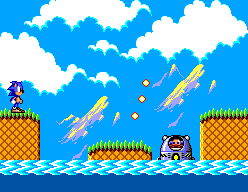
The most common misconception on this list: the Master System Sonic (1991) is not a demake of the Genesis game. Developer Ancient — studio of Yuzo Koshiro, who also composed its superb soundtrack — built a separate adventure that shares Green Hill Zone and Labyrinth with its 16-bit sibling and then goes its own way: Bridge Zone’s collapsing walkways over water, Jungle Zone’s vertical climbs, a hang-glider sequence, and a final approach to Sky Base that the Genesis never had. It’s slower and more exploratory than the original, closer in spirit to a traditional platformer, and the Chaos Emeralds are hidden in the stages themselves rather than in special stages — a design choice many players still prefer. This is the game that made the Master System a Sonic machine for the huge audiences who never owned a Genesis in 1991, and as a piece of game design it’s far more than a footnote. The superior 8-bit Sonic is a real argument, and this is where it starts.
2. Wonder Boy III: The Dragon’s Trap

Wonder Boy III: The Dragon’s Trap (1989) opens with its hero storming the Mecha Dragon’s castle — the ending of the previous game, replayed as a prologue — and then the dragon’s dying curse turns him into a lizard. What follows is one of the earliest and finest Metroidvania structures ever put on a cartridge: a hub village, spokes of themed worlds, and five animal forms (Lizard, Mouse, Piranha, Lion, Hawk) that each unlock new routes through old places — Mouse-Man walks on checkerboard walls and ceilings, Piranha-Man swims, Hawk-Man flies back to areas you crossed hours ago. Westone built it with a password system and a heart that modern games still imitate; the 2017 remake by Lizardcube treated the Master System original as scripture, layer for layer, and let you swap to the 8-bit graphics with a button — the ultimate compliment. If the Master System had produced nothing else, this would be enough. It produced one more thing.
1. Phantasy Star
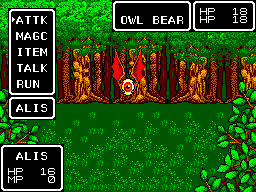
The Master System didn’t lose the 8-bit war everywhere — and Phantasy Star is the proof that, at its best, it wasn’t even playing the same sport.
There is no serious argument for any other #1. Phantasy Star (1987 in Japan, 1988 in the West) was Sega’s answer to Dragon Quest and Final Fantasy, built by a team led by Rieko Kodama and Yuji Naka, and it is almost absurd how far ahead of its 8-bit rivals it stands. You are Alis Landale, avenging her brother and gathering a party — the warrior Odin, the talking cat Myau, the esper Lutz — across three planets of the Algol system, travelling between them by spaceship. The dungeons are first-person, smooth-scrolling, fully mapped labyrinths that dwarf anything else on a home console at the time. The battles put big animated monsters against your party with spell effects that belonged on a 16-bit machine. It shipped on a 4-megabit cartridge with battery saves, cost more than other games, and felt like it. The Japanese version’s FM soundtrack is a revelation; the story’s dark turns — a party member’s death played straight — were years ahead of console RPG norms. Every Phantasy Star since, and a good slice of every JRPG since, lives in its shadow. On the Master System, it isn’t a gem. It’s the crown.
Where to start, and what it costs
The good news about collecting for the system that “lost” in America: prices stayed human. Loose cartridges for Fantasy Zone, Shinobi, Alex Kidd and Monster Land remain cheap; Phantasy Star commands a real but not absurd premium because of that battery-backed cartridge; Golden Axe Warrior and Land of Illusion are the two that have climbed as their reputations spread. The Brazilian chapter is its own rabbit hole — Tec Toy published localised versions and even original late releases — and European PAL copies of most of this list are plentiful. Playing is easy and legal: Sega’s own collections carry several of these (the Dragon’s Trap remake is on everything; Phantasy Star’s definitive Ages version is on Switch), Master System hardware is region-friendly between PAL and NTSC cartridges in most cases, and the system’s FPGA cores are mature. But if you can, play at least one of them on the real black box, pause button on the console and all. The NES told one 8-bit story. This library is the other one — and in Brazil, they’ll tell you it was the main one all along.