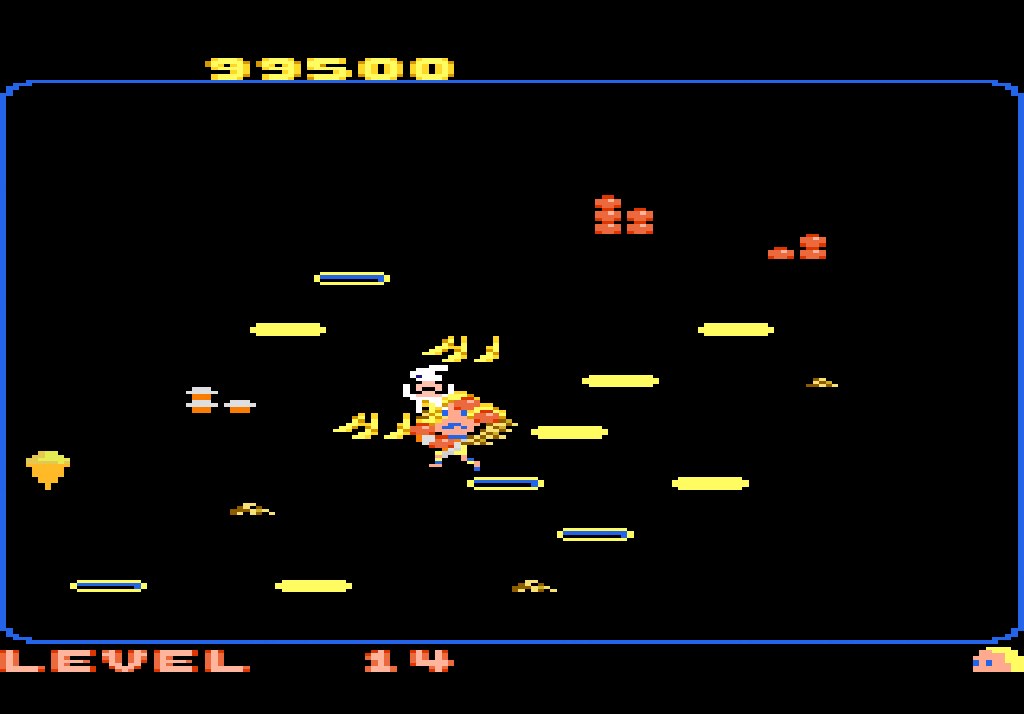
At a glance: Food Fight · Atari 7800 · General Computer Corporation / Atari, 1983 arcade (7800 version released 1986) · Arena action · Score: 9.0/10
Food Fight is joy with a throwing arm. You are Charley Chuck, a boy with an appetite and no fear, alone on a screen scattered with piles of food — watermelons, pies, bananas, burgers — facing an ice-cream cone that is melting, slowly, at the far side. Between you and dessert stand the chefs: Angelo and his colleagues, humourless men in tall hats who will chase you, corner you, and throw food back with professional pride. Eat the cone and you win the round. Get hit, get caught, or let the cone melt to a puddle, and you don’t. GCC designed the arcade original in 1983, and their 7800 port is the version’s loving homecoming: the funniest, warmest, most purely joyful game in the system’s entire library.
The genius is in the throwing. Any pile of food is ammunition, and ammunition is unlimited, so every screen becomes a slapstick artillery duel: you scoop and hurl in eight directions, chefs reply in kind, and the air fills with intersecting groceries. A well-thrown watermelon can clear a path; a panicked handful of pies can hold a doorway; and catching a chef mid-windup with a tomato to the face produces a satisfaction out of all proportion to the pixels involved. The chefs themselves escalate beautifully — early rounds give you plodders, later rounds give you coordinated, flanking, feinting menaces who have clearly discussed you in the kitchen.
The cone is melting
Food Fight’s pressure system is its melting cone: a timer you can see. The cone drips, shrinks, and leans, and the whole game tilts around it. Do you fight the chefs for points, farming throws and near-misses? Or do you run the gauntlet early, while the cone is tall? The scoring rewards daring — leftover food, defeated chefs, the famous watermelon bonuses — and every level redraws the arena’s food geography, so no two chases play alike. It is an arcade design of real elegance wearing a clown nose, and the 7800 keeps the elegance and the nose.

Then there is the instant replay. Finish a level in style — reach the cone with the action at full pitch — and the game may treat you to a replay of Charley’s run, the whole mad dash shown again like a sports highlight. In 1983 this was a marvel, a game applauding its own best moments. On the 7800 it survives intact, and it is impossible not to grin when it triggers. Features like this explain GCC’s reputation: they didn’t just build games, they built games that loved being played.
A house style, perfected
As a port, this is close to beyond reproach. The arena is the arcade’s arena, framed by its blue line; the food piles, the cone, the chefs’ hats and Charley’s cap all read instantly; the throwing has the arcade’s speed and the collision its fairness. The 7800’s colour helps the comedy — ripe reds, cake-icing pinks, banana yellows — and the sprite count in the big late-level brawls, with four chefs and a dozen airborne comestibles, is exactly the workload MARIA was built to shrug at. Sound is the TIA’s best effort: splats and thumps reduced to cheerful electronic punctuation. The arcade’s cartoon orchestra is missed, but the timing of the jokes survives, and timing is the joke.
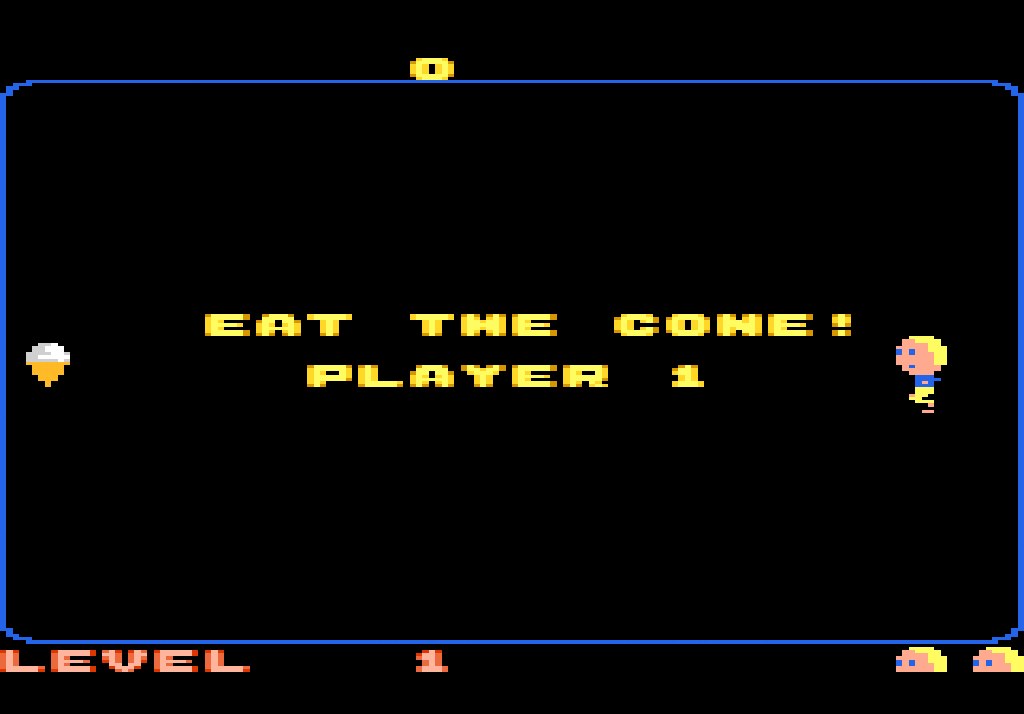
Unlimited ammunition, four armed chefs, one melting deadline. Food Fight is the arcade’s happiest design — and the 7800 port keeps every calorie.
If the game has a limit, it is the limit of its genre: one screen, one objective, escalating speed. The levels change their layouts and their population, but the verb never changes, and marathon sessions are sprints repeated rather than journeys taken. The difficulty also turns genuinely spiky in the teens of levels, where chef speed and numbers convert slapstick into survival horror with pies. These are the arcade’s traits, faithfully kept — and the arcade game is a acknowledged classic, so the port’s fidelity remains the headline.

Read the chefs
Depth, in Food Fight, hides in the chefs’ behaviour, and it rewards study as surely as any fighting game’s roster. Each chef has his own temperament — how directly he chases, how readily he throws, how he reacts when the food starts flying the other way — and the game’s escalating rounds are really lessons in crowd management. One chef is a duel. Two are a geometry problem. Four, at full speed, with the cone at half-melt, is a bar fight in a delicatessen, and the only way through it is the skill the game has been teaching all along: keep moving, throw ahead of your line, never let a pile of ammunition at your back go unused, and never — ever — get between two chefs and the wall. That this education is delivered entirely in slapstick, without a word of instruction, is design of a high order.
The scoring system teaches the same curriculum from the other side. Points live in the risks: in chefs defeated at range, in food left uneaten on the field when the cone is reached, in the sheer nerve of crossing a crowded screen instead of clearing it. Beginning players play Food Fight as a chase. Good players play it as an economy. The 7800 version keeps the economy’s exchange rates exactly where the arcade set them, which is why its high scores mean something and its replays feel earned. Add the two-player alternating game — the classic pub format, each player talking the other through the chefs’ patterns — and you have a cartridge with a social life as rich as its solo one.
A coda for the collectors and the curious: Food Fight’s arcade cabinet is rare, its story beloved — a GCC original from the team that built this console, created in the same burst of invention as Ms. Pac-Man. The 7800 port is therefore not a souvenir of the arcade game. It is the arcade game’s most accessible surviving form, complete and playable, hiding in a common cartridge. Treat it accordingly: buy it before the market finishes remembering.
So: pick up a watermelon. The cone is melting, the chefs are coming, and somewhere in the middle of the screen is the most fun the Atari 7800 knows how to have. Charley Chuck has been waiting forty years for you to start the fight. Don’t keep the boy hungry.
It is also, not incidentally, the easiest great game on the system to teach a newcomer: one screen, one appetite, four chefs. Thirty seconds of explanation, then the food starts flying and the room starts laughing. Whole libraries have been built on less.
Some ports preserve a game. This one preserves a feeling — the exact temperature of a 1983 arcade at the moment a room full of strangers started rooting for a boy and an ice-cream cone.
The verdict
One of the two or three best cartridges on the Atari 7800. Food Fight is GCC’s own arcade classic, ported by GCC, on GCC’s hardware, with every joke and every system intact — the instant replay included. It plays beautifully solo and begs to be shown to friends. If the system’s library has a heart, this is it, and it is wearing a chef’s hat, ducking a watermelon.
Score: 9.0/10 — Charley Chuck’s delicious riot, served exactly as the arcade cooked it.