
At a glance: Xevious · Atari 7800 · Namco / Atari, 1984 (released 1986) · Vertical scrolling shooter · Score: 8.0/10
Xevious changed the geometry of the shooting game. Before it, you shot what flew at you. After it, you shot what flew at you and bombed what waited below — two wars on one screen, divided between two buttons. Namco’s 1982 arcade game gave your Solvalou fighter a Zapper for air targets and a Blaster for ground targets, a scrolling landscape of forests, rivers and airfields to wage both wars over, and secrets — hidden Sol citadels, special flags — buried in the terrain for the obsessive. The 7800 port, another product of the console’s first, warehoused wave, brings that two-front war home with its ambitions unusually intact.
The first thing to admire is the scroll. The landscape unrolls beneath you in the arcade’s style — patchwork green fields, tan roads and clearings, grey installations — and the Solvalou holds station at the bottom of the screen while the world moves. Air enemies arrive in the familiar menagerie: spinning mirrors, darting fighters, the rotating torrent of energy balls. Ground targets squat where the arcade put them: the little domes, the pyramid batteries, the airstrips with their parked craft. And periodically the sky darkens in importance, because the Andor Genesis mothership is arriving — that vast grey fortress of a boss, vulnerable only in its core, which the 7800 draws at a scale that still impresses.
Two buttons, two wars
The Pro-System’s two-button controller earns its keep here more than anywhere else in the launch library. Air and ground fire are separate instincts, and Xevious is balanced so that neither can be neglected: bomb-happy players die to fighters; fighter-fixated players are swarmed by ground fire and miss the citadels. The bomb sight — that little reticle floating ahead of your ship, marking where the Blaster will land — is faithfully placed, and learning to lead ground targets with it while dodging in the air is the game’s central, enduring skill. On the 7800 it works exactly as it should, which is not a compliment every home Xevious of the era can accept.
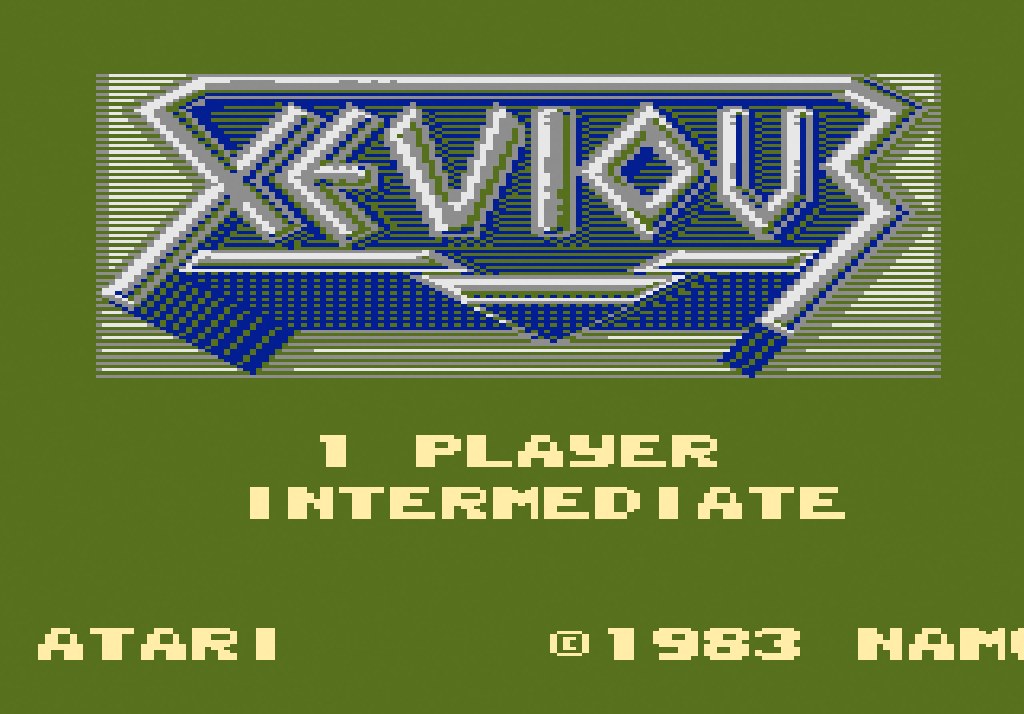
Set against its great rival, the NES version, the 7800 game cuts an interesting figure. Nintendo’s port is smoother in some motions and was the one the world actually played; Atari’s is chunkier in its sprite work in places, but it is vivid, characterful and — crucially — complete: the full area structure, the motherships, the ground-target ecology, the hidden bonuses for players who bomb the right patch of empty-looking forest. Where the 7800’s Xevious plainly wins is presence. Its colours are hot, its explosions assertive, its scale grand. It feels like an arcade game that has been let into the house, not a summary of one.
Secrets under the soil
Xevious was an early landmark in another way: it hid things. The Sol citadels rise from the ground only when bombed in the right spots; the special flags grant extra lives to those who know the terrain’s rumours. In 1984, home players had no internet to spoil any of this — the secrets travelled by playground and magazine — and the 7800 port preserves the whole hidden layer, which gives the game a second life as an exploration as well as a score chase. The areas loop and escalate rather than end, and the pursuit becomes geographic: how deep into the country can you get before the two wars overwhelm you?
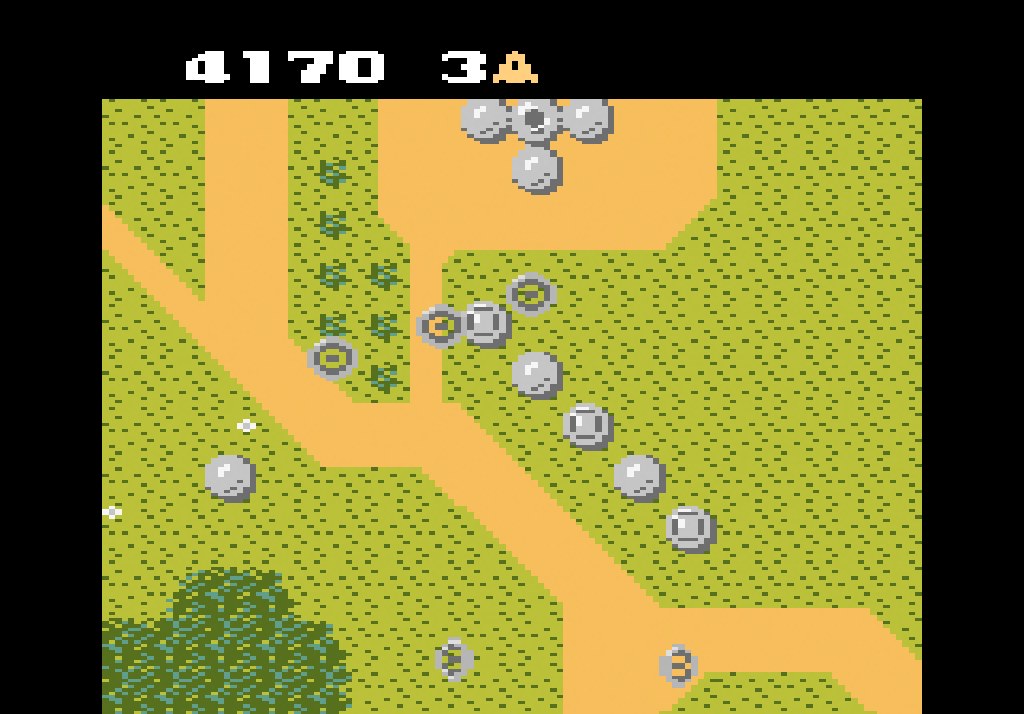
Two buttons, two wars, one reticle. Xevious taught shooters to think in layers — and the 7800 kept the lesson whole.
The debits are real. The TIA renders the arcade’s eerie, pulsing soundtrack as a determined buzz of approximations; Xevious without its hypnotic audio loop loses some of its trance. The sprite work, while characterful, occasionally betrays the port’s 1984 budget — some air enemies are simpler than their arcade selves. And the difficulty in the deep areas is the arcade’s difficulty, which is to say indifferent to your feelings. None of this is the port’s failure so much as the era’s physics, and none of it prevents the game from being the most substantial shooter in the 7800’s launch library.
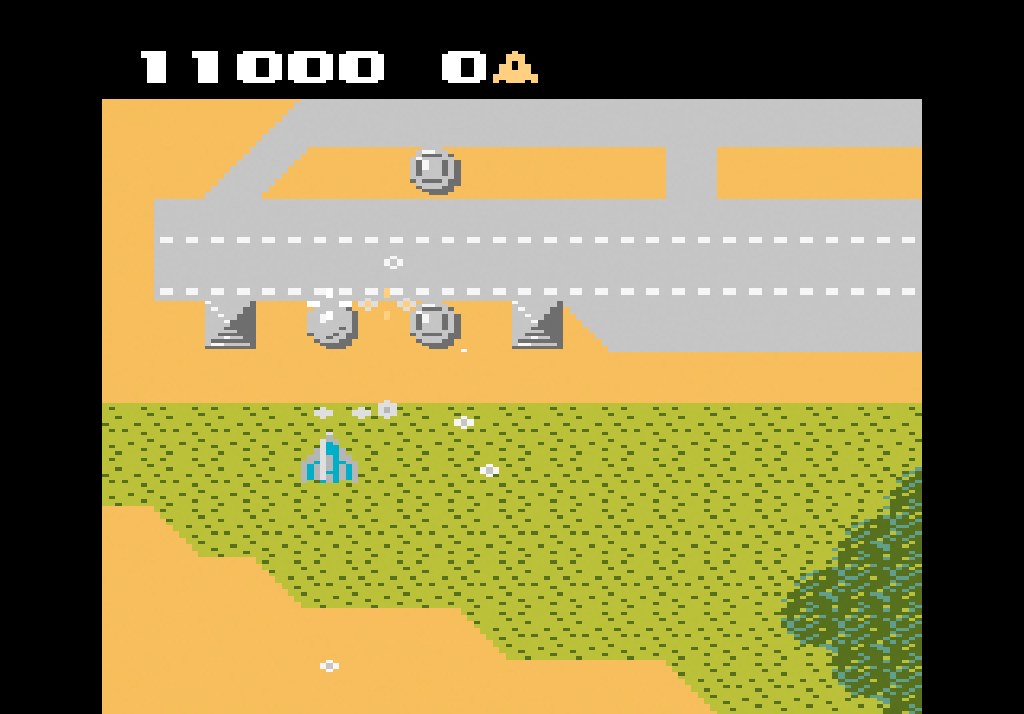
A flagship for the first wave
It is worth remembering what Xevious represented in the box in 1986: proof that the 7800 could do the modern arcade — the post-1982, scrolling, layered kind — and not merely polish the classics of 1980. Buyers comparing shelves saw Galaga for the old religion and Xevious for the new. The relaunch needed both arguments, and this cartridge made its half of the case about as well as the hardware allowed. For today’s player it remains a meaty, secret-stuffed shooter with a two-front discipline that modern games still borrow.
Learning the country
Serious Xevious play is cartography. The areas form a vast, looping country — sixteen zones of repeating but escalating terrain — and mastery means knowing it the way you know a commute: the airfield that always hides armour in its third hangar row, the river bend where the fighter wave commits early, the innocent clearing that is not innocent. The 7800 port supports this long game completely. Its ground targets hold their positions faithfully from run to run, its secrets stay secret until found, and its difficulty rises on the arcade’s gradient rather than a softened home one. That fidelity to the map is what converts Xevious from a novelty — “the one with the bomb sight” — into a campaign. Players in 1986 who chose the 7800 for this game were not short-changed; they were given the whole country and told to learn it.
Two smaller virtues deserve mention. The first is readability: for all the colour in its fields, the 7800 Xevious never confuses you about what can be shot from the air and what must be bombed — air enemies ride above the terrain visually, ground targets sit in it, and the reticle resolves the rest. The second is pace. The scroll speed is the arcade’s — patient, implacable — which gives the game its distinctive meditative menace. You are never rushed, and you are always dying. Very few shooters, then or now, manage that combination, and this port preserves it intact.
One last comparison completes the picture. The 7800’s shooter shelf is sometimes dismissed as a museum of 1984 — Asteroids, Galaga, Centipede, all golden-age. Xevious is the exhibit that refutes it: a game from the arcade’s next era, with scrolling, secrets and a boss the size of a building, running with its design whole. Own the console for its shooters? This is the one that proves the library grew up.
And if the mothership still beats you — it will, often — take the long view. Every pilot who ever cleared an Andor Genesis did so on the far side of a dozen wrecks. The 7800 version keeps that rite of passage exactly where Namco put it: in your path, in your sky, in your way. Report for duty.
Verdict on the port, in one breath: the country is whole, the wars are both open, and the mothership is waiting.
The verdict
The 7800’s most ambitious launch shooter: two wars at once, a landscape full of secrets, and a mothership that still fills the screen with dread. Sound aside, this is Xevious essentially whole — and Xevious whole is a landmark.
Score: 8.0/10 — The scrolling shooter grows up at home. Zapper ready, Blaster ready.