At a glance: Freedom Wars · PS Vita · Shift / Japan Studio, 2014 · Hunting action · Score: 8.0/10
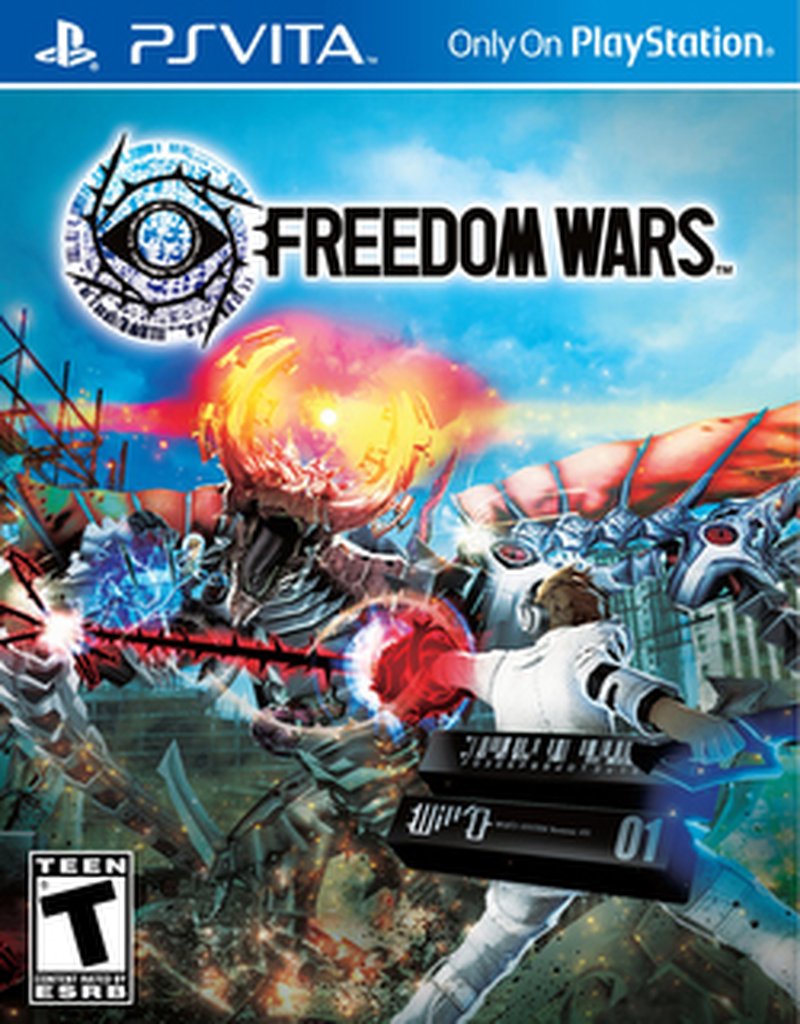
Freedom Wars opens with the worst birthday in gaming: you wake in the Panopticon, a prison-city of the far future, and are sentenced to one million years for the crime of being born. Existence itself is theft from the state; every life must be earned back, year by year, by fighting for your city against rival Panopticons and the enormous robotic Abductors that stalk the wastes — machines that kidnap your fellow citizens, who must then be rescued, carried home on your back, mid-battle, while everything shoots at you. It is a dystopia with the courage of its own absurdity, a hunting-action game with a satirical sting, and the Vita’s most ambitious late exclusive. That it never got its sequel, and its servers have long since dimmed, makes this review partly an elegy. It is also, still, a recommendation.
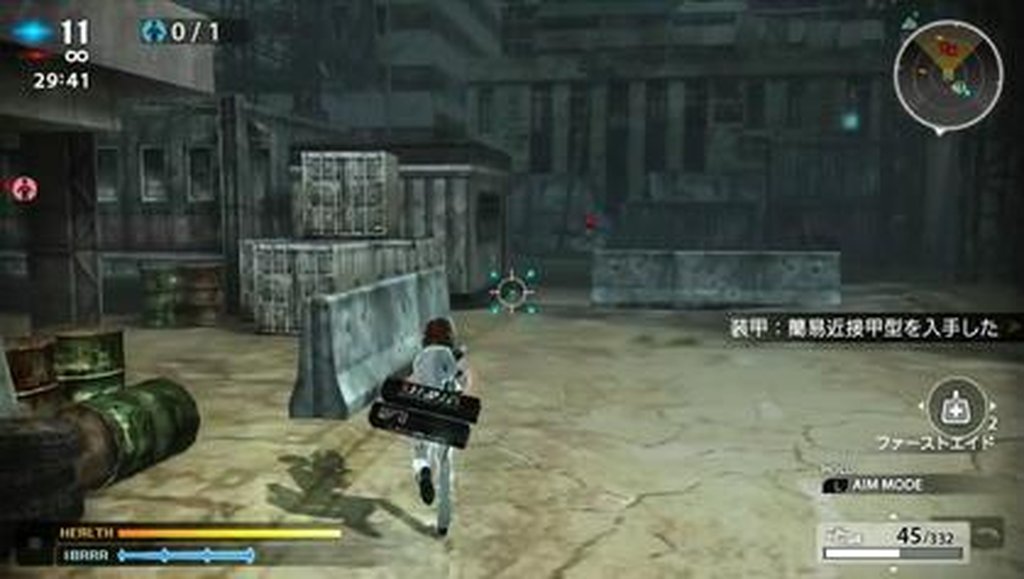
The hunting loop adapts its genre for the Vita with real intelligence. Missions are compact — escorts, eliminations, citizen rescues, Abductor hunts — and the Abductors themselves are the stars: multi-storey war machines whose limbs, pods and weapons can be severed individually, by climbing them. The Thorn, a technological vine every Sinner carries, is the tool that defines the game: it slashes, it heals, it trips and binds, and above all it grapples, letting you zip onto an Abductor’s hull, plant yourself on a missile pod and saw it off with your blade while your squad unloads below. Few action games have made scale feel this physical. Between hunts, the sentence ticks down: earn entitlements (the right to run, to lie down, to take more than five steps at a pace), donate resources to your city, customise your Sinner and your android Accessory — a silent partner who fights beside you and whose deadpan announcements narrate your shrinking debt to society.
A prison with personality
The Panopticon concept is executed with a satirist’s eye. Your cell is a cell; leisure is rationed by entitlement purchases; propaganda posters chirp about contribution; and the central joke — a million-year sentence itemised to the second, reduced by every rescued citizen and slain enemy — never stops being funny or bleak. Character customisation is enormous for a handheld game of its era, the Accessory customisation doubly so, and the story, involving a mysterious girl, a rival city’s raids and the truth about the world’s ruin, is told with more heart than the genre usually attempts. Cities themselves were regional — players chose real-world Panopticons in some versions — giving the community a tribal identity that the game’s fans remember fondly. Freedom Wars wanted to be a culture, not just a cartridge.
Most hunting games ask you to save the world. Freedom Wars asks you to buy yourself back from it, one year at a time — and the invoice is the best joke in the genre.
Combat, gun and blade both, is faster and more acrobatic than Soul Sacrifice’s spell-craft, closer to a character-action game wearing hunting clothes. The weapon classes — greatswords, spears, autocannons, launchers — reward manufacture and upgrading through a deliberately deep crafting system involving harvested parts of specific rarity. And here the honest criticism begins: that crafting system leans on randomised stat rolls and rare drops with a cruelty that even sympathetic players call out, and the endgame grind for perfect weapons was the community’s longest-running argument. Mission variety also thins in the late ranks; too many operations revisit the same fields against remixed Abductor loadouts, and the AI companions, Accessories included, occasionally path-find like they’re serving sentences of their own.
The Vita factor, and what was lost
On its own hardware Freedom Wars is a handsome production: the Abductors fill the OLED screen gloriously, the Thorn’s traversal is smooth, and the whole interface — touchscreen where it helps, buttons where it counts — respects the machine. It was built for co-operative play, four Sinners to an operation, and in its prime the lobbies embodied the game’s fiction: strangers serving sentences together, racing to shave years. The online shutdown took that heart away; what remains is a complete solo campaign with AI stand-ins, still substantial — thirty-plus hours to the story’s end, far more to clear the code-level ranks — but unmistakably a monument to a multiplayer life. Ad-hoc local play, where it can still be arranged, is the connoisseur’s route.
There is also a portability poetry to the design that solo play preserves: a mission is a ten-minute commute’s worth of years off your sentence, the sleep button is parole, and the entitlement shop — buying the right to jog in your own cell — lands differently when the cell is a handheld you carry through your own city. Freedom Wars understood its platform’s life-rhythm as well as any Vita game, and its failure to find the audience its ambition deserved remains one of the platform’s genuine injustices. Sony’s late-era support for the machine produced few swings this big. This one connected; the stadium was half empty.

What the numbers meant
The sentence system is more than a joke mechanic — it is the game’s economy of dignity. Years are deducted for victories, for rescued citizens, for materials donated to the Panopticon’s war effort; years are added for infractions as small as running in the corridors or speaking to a citizen above your station, infractions the game genuinely enforces and reports with bureaucratic relish. Watching your sentence fall from 1,000,000 towards zero across a forty-hour save is a progress bar with a philosophy attached, and the moment a new player first buys the entitlement to take a nap — and realises the game charged them years for the right to sleep lying down — is the moment Freedom Wars has them for good. Systems like this are why the game is remembered by its players with an evangelist’s heat a decade on: it committed to its premise at the level of menus, penalties and paperwork, where most games keep their themes safely inside cutscenes.
The Abductor design deserves its own salute. These are not dragons with serial numbers; they are industrial machines with roles — carriers that snatch citizens in cages, gun platforms that saturate a field, shield-bearers that force flanking — and their damage model is the game’s best idea made visible. Limbs come off and stay off. A severed arm cannon becomes cover. A stripped Abductor, limping and sparking, dragging itself towards the extraction point with its stolen cargo while four Sinners swarm its legs, is a set-piece the game generates rather than scripts, and it generates it dozens of times without wearing it out. The weapon crafting built on their salvaged parts gives every amputation a second meaning: that pod was a rifle, that hull plate was a coat. Hunting games live or die on their quarry. These quarry are machines, and they die wonderfully.
Verdict
Freedom Wars scores 8.0/10: a bold, funny, melancholy hunting game with the genre’s best traversal tool, an unforgettable premise executed with total commitment, and a crafting grind plus a silenced multiplayer that hold it back from greatness. As a solo artefact it remains well worth serving time with — original, atmospheric and unlike anything else on the Vita. One million years. Start now, and you’ll be out in no time.