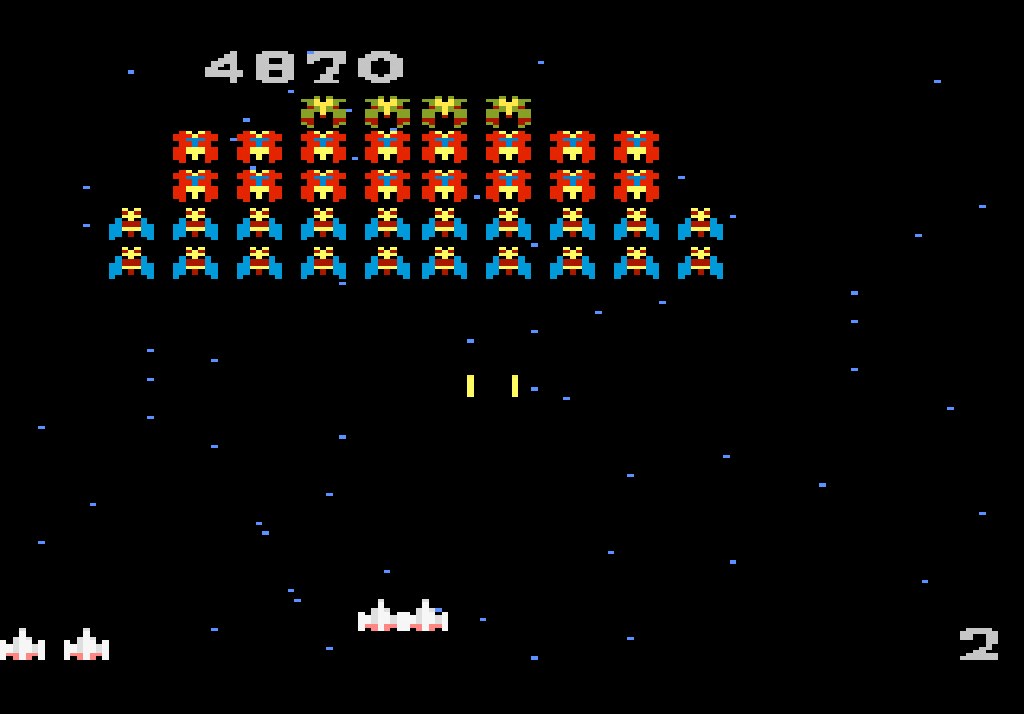
At a glance: Galaga · Atari 7800 · Namco / General Computer Corporation / Atari, 1984 (released 1987) · Fixed shooter · Score: 9.0/10
Galaga is the fixed shooter’s perfect form. The formation assembles in those swooping entry spirals; the bees, butterflies and boss Galaga take their stations; and then the diving begins — enemies peeling off in ones and twos, looping down the screen in arcs that are beautiful right up until they’re fatal. Everything that defines the genre’s golden age is here: the tractor beam, the captured fighter, the dual-ship rescue, the challenge stages with their parade of forty unmissable targets. The 7800 version, built by GCC in 1984 and released in the relaunch era, is quite simply the finest home Galaga of the 8-bit years — the port against which the NES and every other contemporary version should be measured.
The claim rests on details. The entry patterns — the twin streams curling in from the screen edges, the formation filling row by row — are timed and curved as the arcade times and curves them. The diving attacks have the arcade’s swoop, that peculiar acceleration as a bee breaks formation and commits. The starfield scrolls. The explosions blossom in the right colours. And the whole ballet runs at a pace that never stumbles, even with a dual fighter pouring out shots and three divers crossing the lower screen. The 7800’s sprite muscle was made for this game, and it shows in every wave.
The captured fighter, gaming’s best bargain
Galaga’s genius is the bargain it offers you. Let a boss Galaga capture your fighter in its tractor beam — sacrifice a life, effectively — and you can win it back by shooting the boss while it flies in formation with your ship as escort. Rescue it, and the two fighters join side by side: double firepower, double width, double target. It is a risk economy in a single mechanic. Every Galaga player develops a personal policy about the capture — when to allow it, when the formation is too dangerous to attempt the rescue, how long a dual fighter can be nursed through the escalating waves — and the 7800 version preserves the whole negotiation exactly. The beam’s shimmering cone, the “FIGHTER CAPTURED” legend, the little ceremony of the rescue: all present, all correct.

The challenge stages are the other pillar. Every few waves, the shooting stops being survival and becomes marksmanship: forty enemies cross in set patterns, none of them firing back, and the game simply counts your hits toward the perfect-score bonus. They function as breathing spaces and skill examinations at once — and as a memory test, because the patterns are fixed and learnable. The 7800’s versions are faithful, right down to the rhythm of the entry streams, which means the muscle memory of arcade veterans transfers without translation.
Measured against its rivals
Context matters here, because Galaga was everywhere. The NES version is good — genuinely good — but it trims and slows in places, and its formation feels a half-step more sedate. The 7800 game feels urgent in the way the arcade is urgent: divers arrive sooner, the lower screen gets crowded faster, and the dual fighter is both more powerful and more precious. Even small things are right — the bonus life thresholds, the way a rescued fighter’s escort boss must be killed in formation rather than mid-dive (shoot it while diving and the captured ship is lost with it), the exact behaviour of the enemies that transform and split in the later waves. GCC had the arcade’s measure, and this port, like their Ms. Pac-Man and Dig Dug, plays like it was built by people unwilling to be caught approximating.

Every home Galaga asks you to remember the arcade. The 7800 version is the one that makes you check whether you’re sure it isn’t the arcade.
What are the debits? Sound, as ever on this system, is TIA-rendered: the formation’s ambient hum is absent, the shots and explosions are spare, and the capture beam’s warble is more suggestion than symphony. It’s functional, it’s in time, and it never rises above that. The other caveat is Galaga itself: a fixed shooter is a fixed shooter, and by the late waves the game’s escalating speed turns sessions into endurance tests that modern players, raised on variety, may find repetitive in long stretches. But that is the arcade game’s contract too, and breaking it would have made a worse port, not a better one.

An endurance test that rewards study
Play it seriously and Galaga reveals its depth: formation management (which rows to thin first), dive prediction, the discipline of not firing at the wrong boss at the wrong time. High scores are earned in the hundreds of thousands by players who treat every wave as a resource problem. The 7800 cartridge supports that pursuit completely — responsive controls, honest collision, and a difficulty curve that scales into genuine brutality without ever feeling cheap. It also helps that the game is common and inexpensive: like Dig Dug, this is top-tier quality at flea-market prices, a combination the 7800 library specialises in.
The sound of formation
One more fidelity deserves its sentence, because Galaga players will ask: the pacing of a wave. In inferior ports, the formation settles and the game idles — divers come politely, the tempo sags, and the screen’s threat drains away. The 7800 Galaga keeps the arcade’s impatience. The formation sways with the correct menace, expanding and contracting as it crosses the screen; the divers come in pairs and then in streams; and the moment your dual fighter starts harvesting the top rows, the game answers by sending its best pilots down in retaliation. It is an ecosystem with a temper, and reproducing temper is the hardest part of porting any classic. This cartridge has it.
There is also history folded into the plastic. Galaga was part of the 7800’s planned 1984 first wave — completed, like the rest of GCC’s launch library, for a debut that politics postponed. That it still felt current when it finally reached shelves years later, against a maturing NES catalogue, says everything about the quality of the original work. Some games are released. This one was released twice, and deserved to be.
Finally, a word about difficulty honesty. Galaga’s later waves are ferocious by any era’s standard — the dive speed, the shot density, the way a thinned formation sends its survivors down in angrier patterns. Weaker ports quietly sand this down, and their scores inflate into meaninglessness. The 7800 keeps the arcade’s teeth, which keeps its high scores meaningful: a six-figure score on this cartridge is the same achievement, against the same behaviour, as a six-figure score in the arcade. For a game whose entire social life was the high-score table, that equivalence is not a detail. It is the whole product, delivered.
Put it on the short list with confidence: Asteroids, Ms. Pac-Man, Food Fight — and this. The 7800’s launch-era Namco and Williams ports form a little golden age of their own, and Galaga is their crown.
The verdict
The best home Galaga of its generation, and one of the 7800’s flagship cartridges. Faithful where fidelity matters, fast where speed matters, and generous with the one mechanic — the captured fighter — that turns a great shooter into an immortal one. If you are building a 7800 shelf, this goes on it in the first handful of purchases.
Score: 9.0/10 — The fixed shooter’s perfect form, perfectly ported.