At a glance: Joust · Atari 7800 · Williams / General Computer Corporation / Atari, 1984 (released 1986) · Arena action · Score: 8.5/10
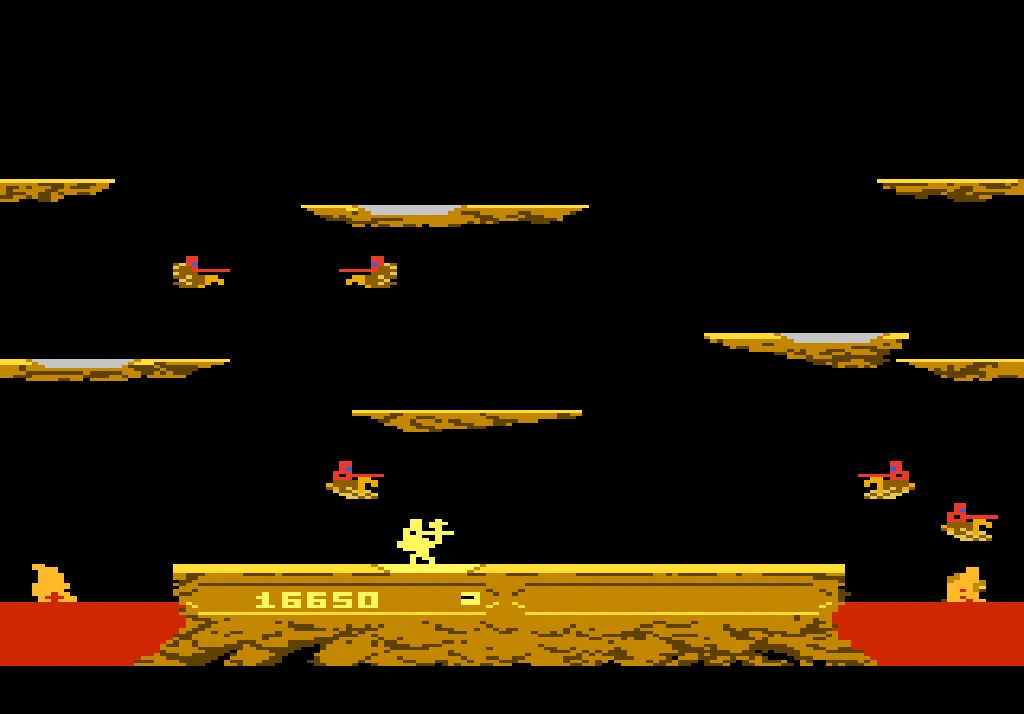
Joust should not work. You are a knight on a giant flying bird — an ostrich for player one, a stork for player two — in a lava-lit cavern of floating rock ledges. Flight is one button, mashed: every tap is a wingbeat, and your altitude is a negotiation between tapping, gravity and momentum. Combat is decided by a single rule — higher lance wins — so every encounter is a tiny aerial negotiation about who is above whom at the moment of contact. It is one of the strangest designs of the arcade’s golden age, and one of the best. The 7800 version, GCC’s port from 1984, is the home Joust to own: faithful, fast, colourful, and with its two-player soul fully intact.
The feel is everything in Joust, and the feel is right. The bird has the correct weight — that slight delay as wingbeats become climb, the skid across a ledge when you land too hot, the bounce when two riders meet at equal height and separate unharmed to circle again. Running along the ground is fast; flight is faster; the lava at the bottom is patient. Kill a rider and his bird lays an egg that drifts down to a ledge and starts to hatch: collect it for the bonus, dawdle and a fresh rider climbs out of it at a higher difficulty tier. That egg timer is Joust’s engine of panic, and the 7800 keeps it merciless.
The ladder of riders
The enemy progression is a curriculum. Bounders, the red first rank, are tuition: they fly patterns, they make mistakes. Hunters, grey and quicker, come looking for you. Shadow Lords, blue and faster still, fly like they know the rule about altitude better than you do. Above them all circles the pterodactyl — the screeching, nearly indestructible punctuation mark that arrives when a wave drags on too long, beatable only by a precise lance strike to its open beak as it charges. The 7800 reproduces the full ladder, and with it the game’s distinctive dread: every wave you clear raises the average intelligence of the sky.
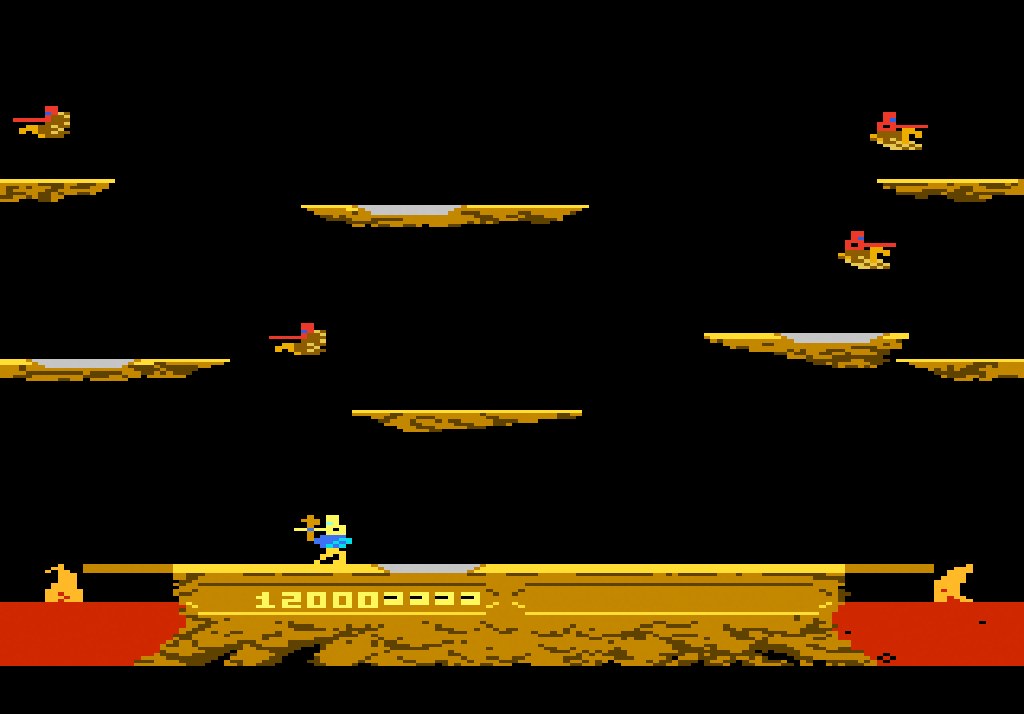
The arena itself is drawn with the arcade’s character — the rocky ledges with their pale tops, the central platform over the lava, the troll’s hand that rises from the fire to grab riders who linger too low in the later waves. (“Thy game is over” the arcade would eventually tell you; the 7800 says it too.) Colours are strong, sprites are many, and in the late waves, when the sky holds six riders, loose eggs and a pterodactyl, the display list never buckles. This was MARIA showing the neighbours what she could do.
Two birds, one sky
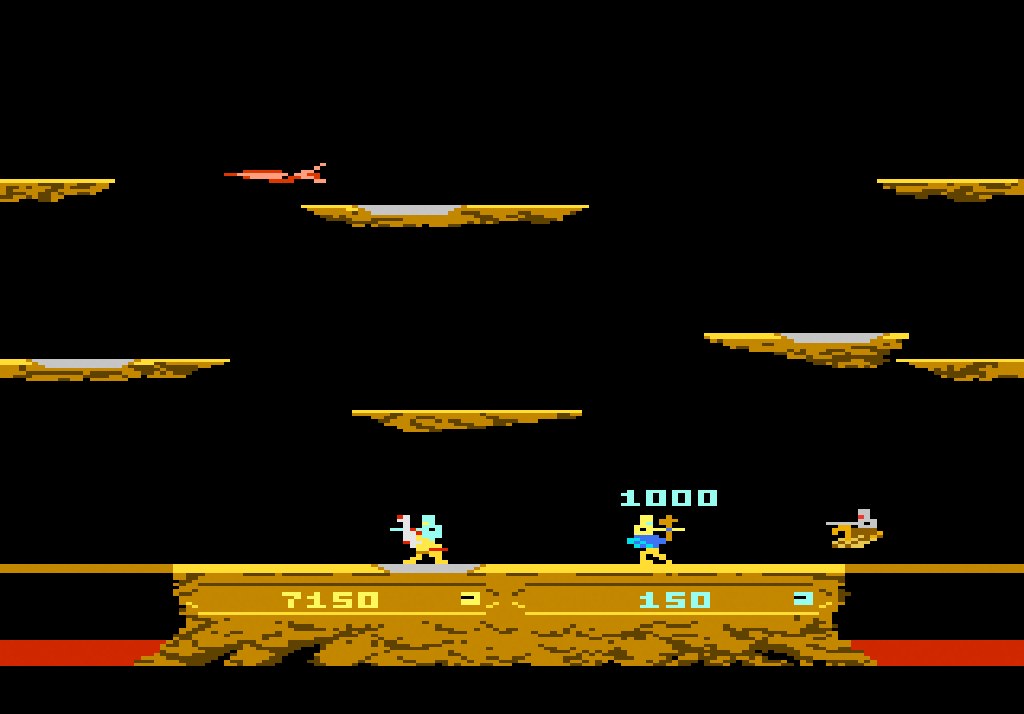
Joust was designed as a social game, and the 7800 version keeps both of its social modes: cooperation and betrayal, available simultaneously, switchable without a menu — just a decision. Two riders can clear waves together, dividing the sky, rescuing each other from bad bounces. Or one rider can lance the other, on purpose or “on purpose,” and the wave becomes a duel with interruptions. The arcade’s survival and team variations layer further rules on top. No home version of the era captures this better, because none of the others had the hardware to hold the full sky at full speed. The 7800 does, and couch Joust remains, nearly forty years on, one of the great two-player experiences on any Atari console.
One button, one rule, infinite treachery. Joust is the purest multiplayer design of its era, and the 7800 port loses none of it.
Caveats are the familiar ones. The flap button will test your thumb and your controller — this is a game that benefits from a good stick and punishes a mushy one. The audio is TIA-minimal: wingbeats, collisions and the pterodactyl’s screech rendered in determined little noises that convey information without atmosphere. And Joust’s difficulty is honest to a fault; Shadow Lord waves are a wall that casual players may never pass. But walls, in Joust, are just altitude problems, and the game teaches you to climb.
Waves with names and intentions
The wave structure is worth a closer look, because it is where Joust’s design intelligence concentrates. The game deals its waves in distinct flavours: Survival Waves that pay a bonus for finishing without a death; Egg Waves that start with the sky pre-scattered with eggs, turning the opening seconds into a collection sprint before the hatching begins; Pterodactyl Waves that send the screeching menace in early and dare you to end things quickly; and, in the two-player game, Team Waves that reward a wave cleared with both riders alive — and the infamous Gladiator Waves, which pay a bounty for unhorsing your partner. Read that list again. In 1982, Williams was already building cooperative-competitive hybrid rules, bonus economies and anti-stalling enforcement into a game with one button. The 7800 version carries every one of these wrinkles intact, and they are the reason Joust sessions still generate stories: the bounty claimed, the egg missed by a frame, the pterodactyl beaten by a lance held exactly at beak height.
Technique, too, is faithfully demanded. The masters’ skills — the ledge-skimming run that builds lethal speed, the controlled ceiling bounce, the art of meeting a Shadow Lord on the rise so the altitude rule breaks your way — all live or die on frame-honest physics, and they live here. Even the lava troll, that grasping hand for low fliers, arrives on schedule. A port can have every sprite and still miss the game; Joust is nothing but timing and momentum, and timing and momentum are precisely what GCC preserved.
For collectors, Joust is another of the launch library’s friendly buys: produced in quantity for two launches, common today, and cheap for the joy it returns. If your 7800 shelf has a two-player gap, fill it here first.
One technical grace note: the 7800 version’s handling of the two-player start. Both riders take the field together on the central platform, and the game’s opening seconds — that first scramble for altitude while the Bounders spawn at the ledges — compress Joust’s entire appeal into five seconds: physics, rivalry, comedy, danger. Launch libraries are remembered by their first impressions, and a console that could open with this — alongside the arcade purity of Asteroids and Centipede — was arguing, correctly, that it belonged in the same conversation as any machine of its decade. The market didn’t listen in time. The cartridge doesn’t care. It still argues, every time you flap.
Bring a friend, agree nothing in advance, and let the Gladiator Wave bounty do its ancient work. Joust has been starting friendly arguments since 1982; on the 7800, it starts them at full speed and in full colour.
The pterodactyl alone would justify the cartridge: gaming’s first great enforcer, screeching in to punish hesitation, beatable only by nerve and a lance held at exactly the right height. It is here, it is horrible, it is perfect.
The verdict
The definitive home Joust of the classic era: the full rider ladder, the true physics, the two-player modes that made the arcade game a legend, all running at speed on hardware GCC built for exactly this kind of crowded sky. Essential for one player; close to mandatory for two.
Score: 8.5/10 — Flap, bounce, bragging rights. The arcade’s strangest sport, faithfully kept.