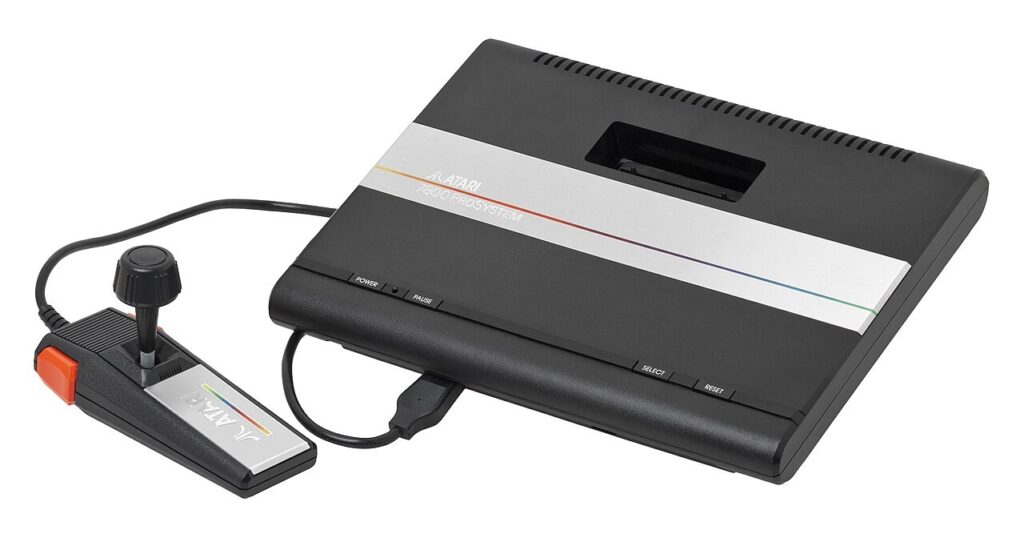
At a glance: General Computer Corporation · Atari 7800 · Company profile · The little company that built the ProSystem
The Atari 7800 has two creators, and only one of them is Atari. The console’s hardware, its graphics chip, its launch library, its industrial design direction — and, not incidentally, Ms. Pac-Man and Food Fight, two of the defining arcade games of the golden age — came from a small Massachusetts company called General Computer Corporation: GCC. In the early 1980s, GCC may have been the most consequential games company that most players had never heard of at all. This is their story — the enhancement-kit pirates who sued-proofed themselves into becoming Atari’s secret weapon, built an entire console in about a year, and then watched it spend two years in a warehouse.
GCC began, as so many good stories do, slightly outside the law’s comfort. Founded in 1981 by a group of MIT friends, the company made its name with enhancement kits — circuit boards that arcade operators could drop into existing cabinets to create new games. Their Super Missile Attack upgraded Atari’s Missile Command. Atari sued. The settlement, remarkably, became a business relationship: rather than crush the upstarts, Atari agreed to let GCC develop games for them, with a moratorium on further unauthorised kits. It remains one of the great “if you can’t beat them, hire them” moments in industry history — and it put GCC in position for the job that made them immortal.
Crazy Otto becomes Ms. Pac-Man
GCC’s maze kit, Crazy Otto — a leggy monster chasing through Pac-Man’s maze — was shown to Midway, the American licensee of Pac-Man, at precisely the moment Midway needed a sequel. Otto was reskinned, rebranded and released in 1982 as Ms. Pac-Man. It became one of the best-selling arcade games in American history and, by most critical reckonings, a better game than the original: four mazes, bouncing fruit, ghosts with a touch of randomness. GCC followed it with Food Fight — Charley Chuck’s food-flinging classic — and Jr. Pac-Man, building a reputation as the arcade’s most reliable hit factory. Their ports and originals alike shared a signature: arcade systems understood completely, and wrung completely dry.

So when Atari, post-crash, decided it needed a new console — one that could play the arcade games of the day properly, and play the enormous 2600 library besides — it went to the company that had humiliated and then enriched it. GCC’s answer was the 7800 ProSystem: a machine designed around a custom graphics chip, MARIA, that could throw arcade-sized crowds of sprites around the screen, built on the familiar 6502 family so its own ex-arcade team could program it at full speed from day one, and engineered for backwards compatibility with the 2600’s library through the old TIA chip riding along inside. GCC didn’t just design the hardware. They wrote the launch library: Asteroids, Centipede, Dig Dug, Galaga, Joust, Ms. Pac-Man — the ports this site’s reviews keep praising, because they were made by the people who understood both the games and the silicon.
That a contract dispute and a change of corporate ownership could freeze all of it — the hits, the hardware, the momentum — says something melancholy about the era’s business. The games were ready. The machine was ready. Only the paperwork wasn’t.
The warehouse years
The console was announced in May 1984 and test-marketed that summer. Then Warner sold Atari’s consumer business to Jack Tramiel, and the 7800 — finished, manufactured, boxed — was shelved while the new regime audited what it had bought and fought over what it owed. GCC’s position was particularly cruel: the company had staked its future on the console, was owed substantial money, and spent the warehouse years in dispute over payment while its masterpiece sat in storage. When the 7800 finally relaunched in 1986, it did so into a market Nintendo was busy owning. GCC, burned by the experience, pivoted away from games entirely — into printers and peripherals, where as GCC Technologies it built a long second career far from the arcades. The games industry lost its best porting house just as porting became an industry.

They upgraded Missile Command until Atari sued them, made Ms. Pac-Man until Midway crowned them, then built Atari a whole console. GCC is the 7800’s second creator — and its best-kept secret.
The work speaks in their absence. Play the launch library today — the arcade-true Asteroids, the two-player Centipede, the Ms. Pac-Man that plays like a homecoming — and you are playing GCC’s portfolio, built by a team so fluent in arcade design that they had literally written some of the games being ported. The Lucasfilm connection runs through them too: GCC developed the 7800 versions of the Lucasfilm experiments, Ballblazer among them, and the console’s Rescue on Fractalus! port — cancelled in the warehouse years, finished decades later by the homebrew scene — remains the most poignant artefact of the partnership: a glimpse of the library the 7800 might have had if its creators’ console had been allowed to live on schedule.

One more detail completes the portrait, because it explains the launch library’s quality better than any other: GCC was paid in the coin of the realm it understood. The Atari relationship included the design of the console itself — MARIA is a GCC chip, the ProSystem a GCC system — which meant the people porting Asteroids in the morning had designed the silicon it ran on the night before. Ports are usually archaeology: strangers reverse-engineering a target. GCC’s launch titles are closer to architecture: a team building on its own foundations. That is why these forty-year-old conversions still benchmark the field, and why the 7800’s story, properly told, is a story about a little company from Massachusetts that for about three years was quietly the best in the world at the thing it did.
It is a strange legacy — a company remembered by initials, folded into the footnotes of other companies’ histories. But the 7800 itself is the monument: every unit ever made is a GCC design, running a GCC chip, most famous for playing GCC games. Few studios in history are so thoroughly built into the hardware their work survives on. If you own the console, you own their archive. Play it accordingly.
The printer years were prosperous, by all accounts, and there is no reason to begrudge them. But history is written by the games that survive, and on that ledger GCC’s account is enormous: a console, a chip, a launch library, and the maze queen herself. Not bad for a company that started by improving other people’s arcade games until the owners of those games decided the safest place for GCC was on their own side.
The verdict of history
Every console has a creation myth; the 7800’s is unusual because its creators were contractors, and its tragedy is contractual too. GCC built the right machine, at the right moment, with the right games — and the industry changed owners underneath it. What remains is the work: a console that still impresses, a launch library that still benchmarks home conversion quality, and two of the greatest arcade games ever made with a little Massachusetts company’s fingerprints all over them. The next time Ms. Pac-Man’s fruit bounces through the maze exactly as it should, spare a thought for the people who put it there. They also built the maze, the machine beneath it, and half the library around it.