
At a glance: Ikari Warriors · Atari 7800 · SNK / Atari Corporation, 1989 · Run-and-gun · Score: 7.0/10
Ikari Warriors is a march. SNK’s 1986 arcade game took Rambo’s silhouette, Commando’s top-down formula and a rotary joystick that let you aim in a different direction from the one you were walking, and produced the defining co-operative run-and-gun of its era: two commandos, Ralf and Clark, dropped into a jungle that contains an entire army, walking north through all of it. The 7800 port, arriving in 1989, had an impossible problem to solve — the rotary stick has no home equivalent — and an enviable one: the 7800’s sprite muscle was exactly what the arcade’s crowded battlefields required. The result is one of the system’s most faithful-looking conversions, and one of its sternest tests.
First impressions are all fidelity. You begin at the wreck of your own plane — that lovely opening tableau, the crashed aircraft in the jungle clearing — and the country unrolls northward in the arcade’s palette: brown earth, green fringes, rivers on blue bridges, grey rocks and installations. Enemy soldiers in blue come in the arcade’s numbers, which is to say in squads, in waves, in ambushes from the treeline; grenades arc; the red “pow” pickups restock your bombs; fuel and ammunition economies tick quietly underneath the carnage. The two-player simultaneous mode — the arcade’s social heart — is fully present, and the screen can hold both commandos, a dozen enemies, explosions and a tank without the hardware breaking a sweat. On presentation, this is close to the coin-op.
The missing twist
The famous compromise is aiming. In the arcade, the rotary joystick let you strafe: walk one way, shoot another, hold a direction with your gun while your feet retreated. On a standard two-button stick, that independence is gone — you shoot where you face, and the buttons divide between bullets and grenades. The 7800 port does the sensible thing within the constraint, and good players adapt: positioning replaces strafing, and the game becomes a discipline of approach angles. But something real was lost in translation, and veterans of the arcade will feel it in the first ambush, when the instinct to back-pedal-and-fire produces a commando walking backwards into trouble, gun politely pointing the wrong way.
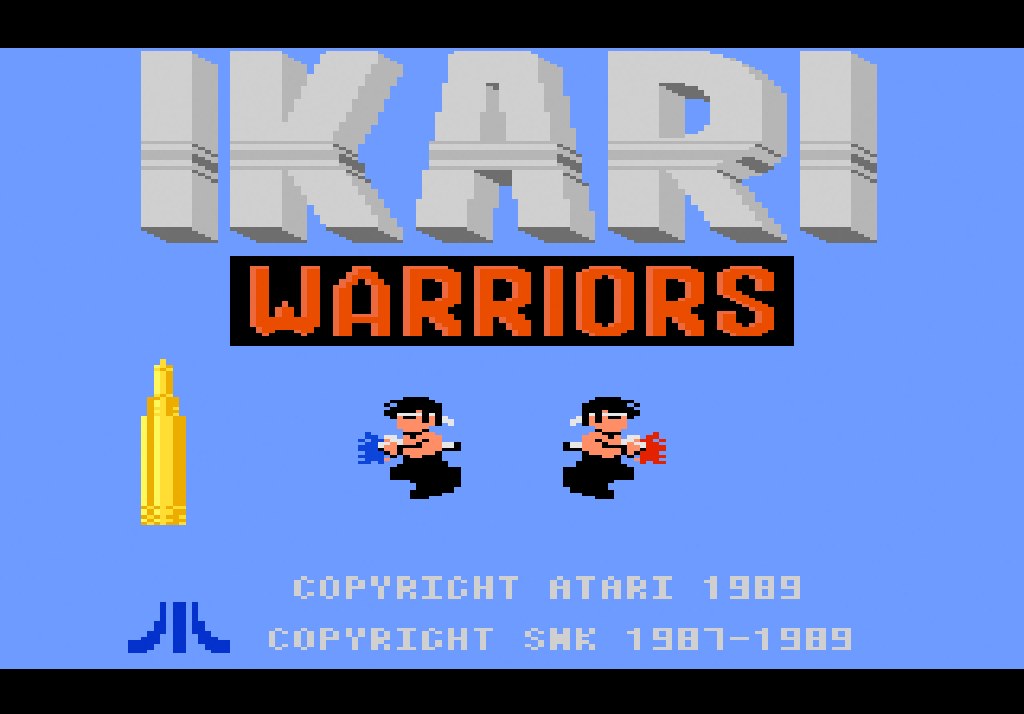
What compensates is how much of the campaign survives. The long, single, scrolling war — village, river, installations, the whole northward grind — is intact in character if compressed in places, with its tanks to commandeer (the great Ikari pleasure: steal armour, become the problem), its gates and gun emplacements, its POW rescues. The difficulty is the arcade’s difficulty, which is to say designed to eat currency and now eating evenings instead: one-hit deaths, dense crossfire, and a continue structure that asks whether you meant it. Two-player co-op is the recommended dosage — the game halves in cruelty and doubles in legend with a partner.
War is hell, and long
The flaws beyond the aiming are matters of the genre’s age and the port’s honesty. The scroll is a forced march; there is no retreat and little variety beyond the terrain dressing, and a full run is an endurance event that exposes the repetition — the same squads, the same ambushes, the same rocks, arranged with escalating spite. Enemy bullets can be hard to read against the brown earth at the worst moments. And the sound is the usual TIA compromise, gunfire reduced to a determined static that gets the job done without ever sounding like a war.

The rotary stick stayed in the arcade, but the war came home whole: two commandos, one endless jungle, and a tank with your name on it.
Measured against the famous NES version — the one most of the world played — the 7800 game is the more honest conversion of the two: better colour, bigger presence, the arcade’s density of enemies, and none of the NES version’s legendary sluggishness. It lacks the NES’s (in)famous continue-code folklore, but what it has is the actual game, at something like the actual intensity. For the 7800’s late period, when so much software was budget-priced and budget-made, a port with this much of the arcade still in it was a statement.

A note on the tank, because the tank is the game’s soul in miniature. Scattered along the march are armoured vehicles you can simply steal — climb in, and the one-hit commando becomes a rolling argument the enemy infantry cannot win by shooting. Fuel becomes your new mortality, and the stretch of jungle ahead rearranges itself around your armour. These interludes are the campaign’s exhalations, the moments where the hunted becomes the hunter, and the 7800 port gives them their full weight: the tank is big, loud in presence if not in sound, and drawn with the arcade’s authority. Every co-op pair develops tank etiquette — who drives, who walks point — within the first vehicle. Games that generate etiquette are games that generate memories, and Ikari Warriors, for all its sternness, generates them steadily.
Marching orders for the modern player
Practical counsel for those taking the march today. First: play it with a partner if you possibly can — the game was balanced for two guns, and solo runs turn the late jungle into a war of attrition against your own patience. Second: grenades are for emplacements and knots of infantry, never for single soldiers; the economy will punish waste an hour later. Third: when the tank appears, take it, and when its fuel runs low, leave it before it becomes a coffin — the game teaches this once, memorably. And finally, set your expectations to the arcade’s terms: this is a game to be survived in stretches and conquered over weeks, not an afternoon’s entertainment. Judged on those terms — SNK’s terms — the 7800 port is an honourable campaign: the colours right, the crowds right, the long northward grind right. The rotary stick is mourned, then managed, then mostly forgotten somewhere around the river, where the shooting gets too honest to think about anything else.
There is one more comparison worth making, and it is with the system’s other great co-op conversion, Commando. Together they form the 7800’s run-and-gun shelf: Commando the earlier, leaner mission; Ikari the longer, denser campaign. Owning both, a pair of players can re-fight the entire late-80s arcade war from one couch, on one console, at something close to full strength. That is a shelf any retro collection should be proud of.
Ralf and Clark have been walking north since 1986. On the 7800, the walk is long, the jungle is honest, and the end of it — when two tired commandos finally see it — is earned the old way: together.
Solo players, one final kindness: the early jungle is genuinely fair, and the game teaches its economy — grenades, fuel, armour — in the order you’ll need it. The wall comes later, and by the time it comes, you’ll have a partner or a grudge. Either will do.
The verdict
A faithful, demanding port of a co-op landmark, docked for the aiming the hardware couldn’t carry and the relentlessness the arcade wouldn’t surrender. Bring a partner, bring patience, and bring grenades. The jungle is exactly as long as you remember.
Score: 7.0/10 — Two commandos, one brutal march. The war came home nearly whole.