
Twenty years ago today — November 8, 2006 — the biggest, hungriest graphics card most of us had ever handled went on sale, and PC gaming quietly split into a before and an after. The GeForce 8800 GTX cost $599, stretched about 27 centimetres end to end, took up two slots, and wanted two 6-pin power connectors and a 400-watt power supply before it would even talk to you. Plenty of period cases could not fit it. Plenty of period power supplies could not feed it. None of that mattered, because what was under that long black cooler was not just a faster GeForce. It was two revolutions sharing one circuit board: the card that brought DirectX 10 and unified shaders to games, and — almost nobody outside a university lab noticed at the time — the first CUDA-capable GPU ever sold.
I am a hardware man, so let me put the thing on the bench before we get misty-eyed about it. Here is what $599 bought you in November 2006:
- GPU: NVIDIA G80 (Tesla architecture), 90nm, 681 million transistors
- Shaders: 128 unified stream processors at 1.35GHz
- Core clock: 575MHz
- Memory: 768MB GDDR3 on a 384-bit bus, 86.4GB/s of bandwidth
- APIs: DirectX 10, Shader Model 4.0
- Power and size: about 155W, dual-slot, roughly 270mm long, two 6-pin connectors
- Launch price: $599 (the 8800 GTS under it cost $449)
The GeForce 8800 GTX Was Two Revolutions in One Slot
To understand why this card mattered, you have to remember how graphics chips were built before it. A GPU in 2005 had separate, specialised pipelines: some hardware did vertex work — placing the corners of the world — and other hardware did pixel work — colouring it in. If your game was heavy on one and light on the other, half your silicon sat around waiting while the other half drowned. It was two crews of specialists sharing a building and refusing to do each other’s jobs.
G80 fired both crews and hired 128 generalists. Its unified stream processors could be assigned to vertex, pixel, geometry or physics work as each frame demanded, and they were scalar, flexible and fast — clocked at 1.35GHz while the rest of the chip ran at 575MHz. That is the design every GPU since has followed, from both NVIDIA and AMD, right up to the card in your machine today. It was also the first shipping DirectX 10 hardware — Microsoft’s reference platform for the Vista-era API — which meant the games of the next few years were, in a very literal sense, designed around this chip’s idea of what a GPU should be.
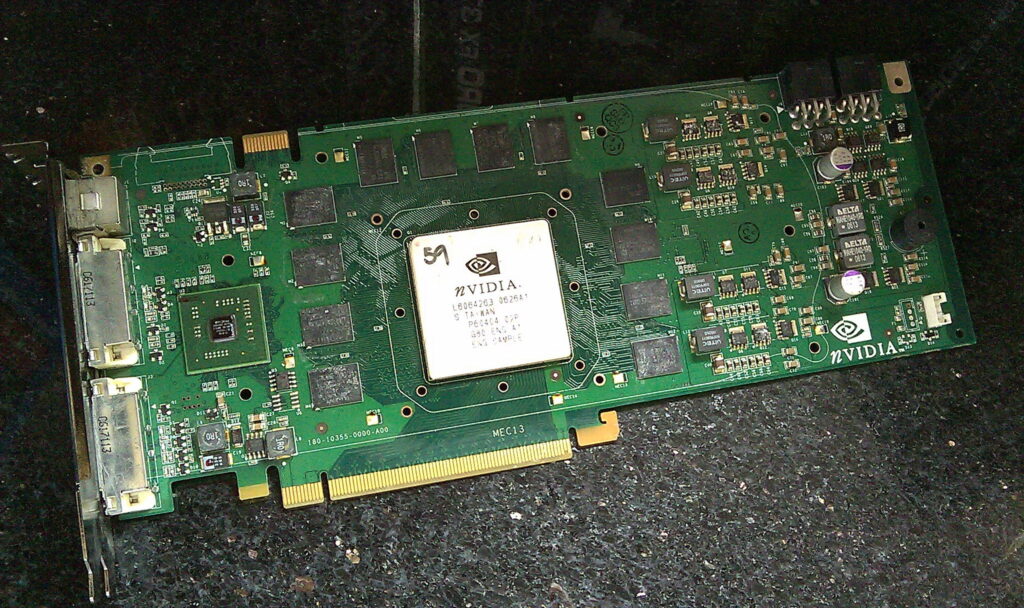
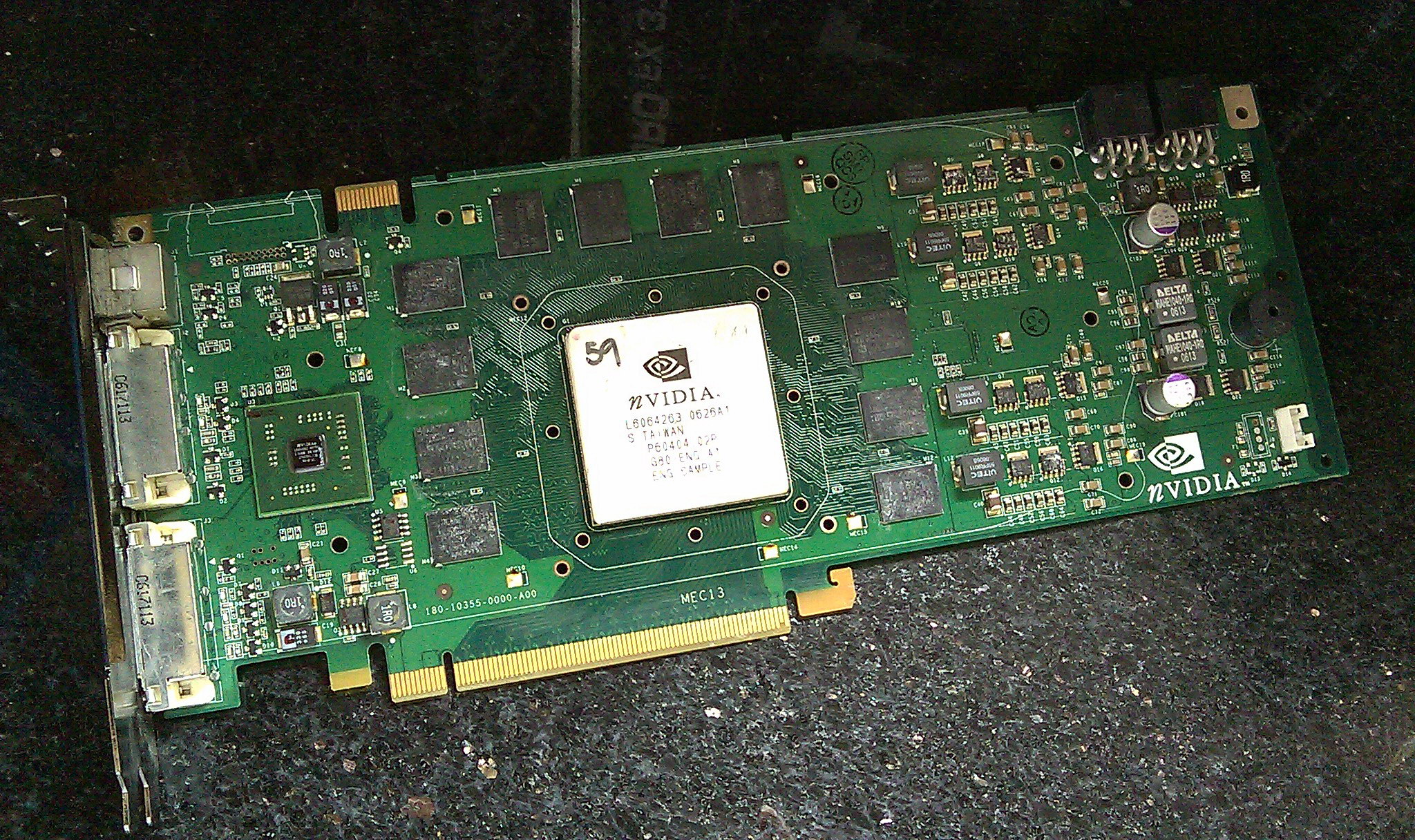
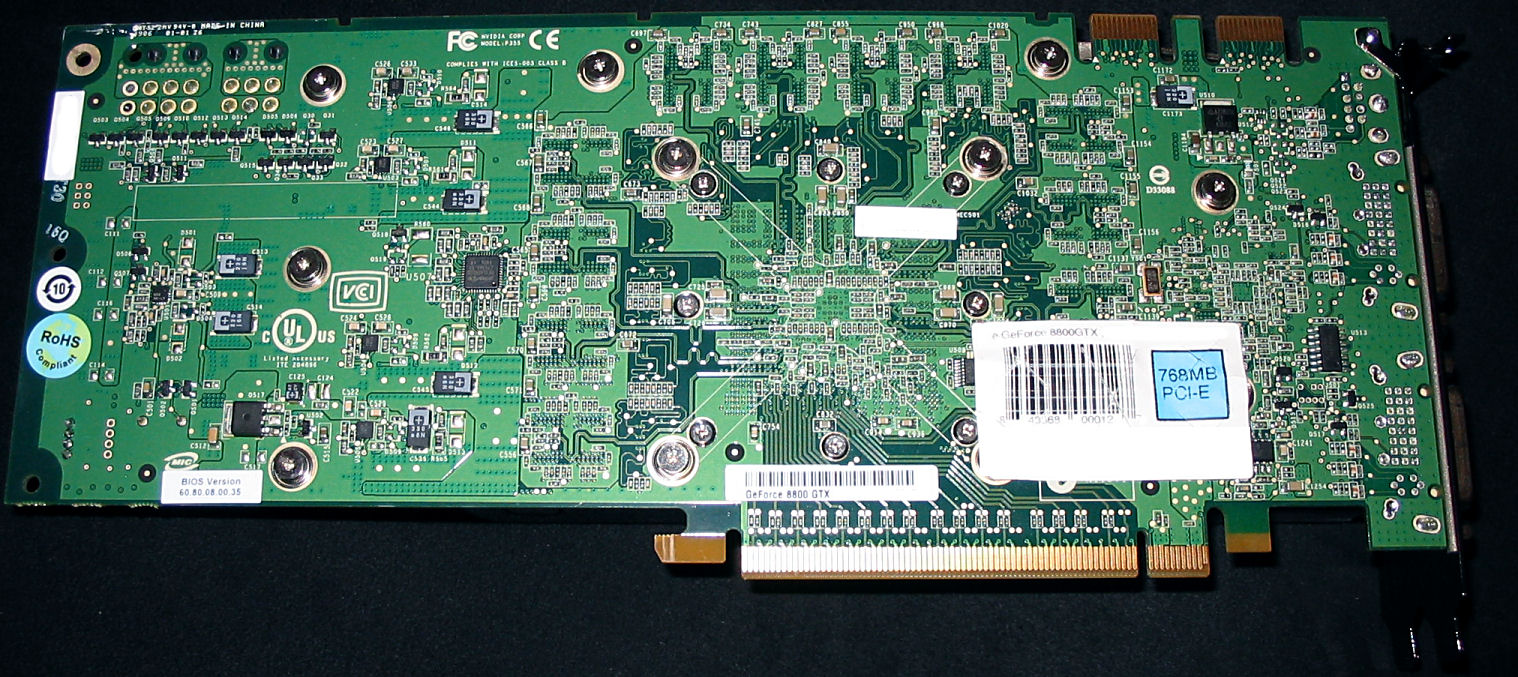
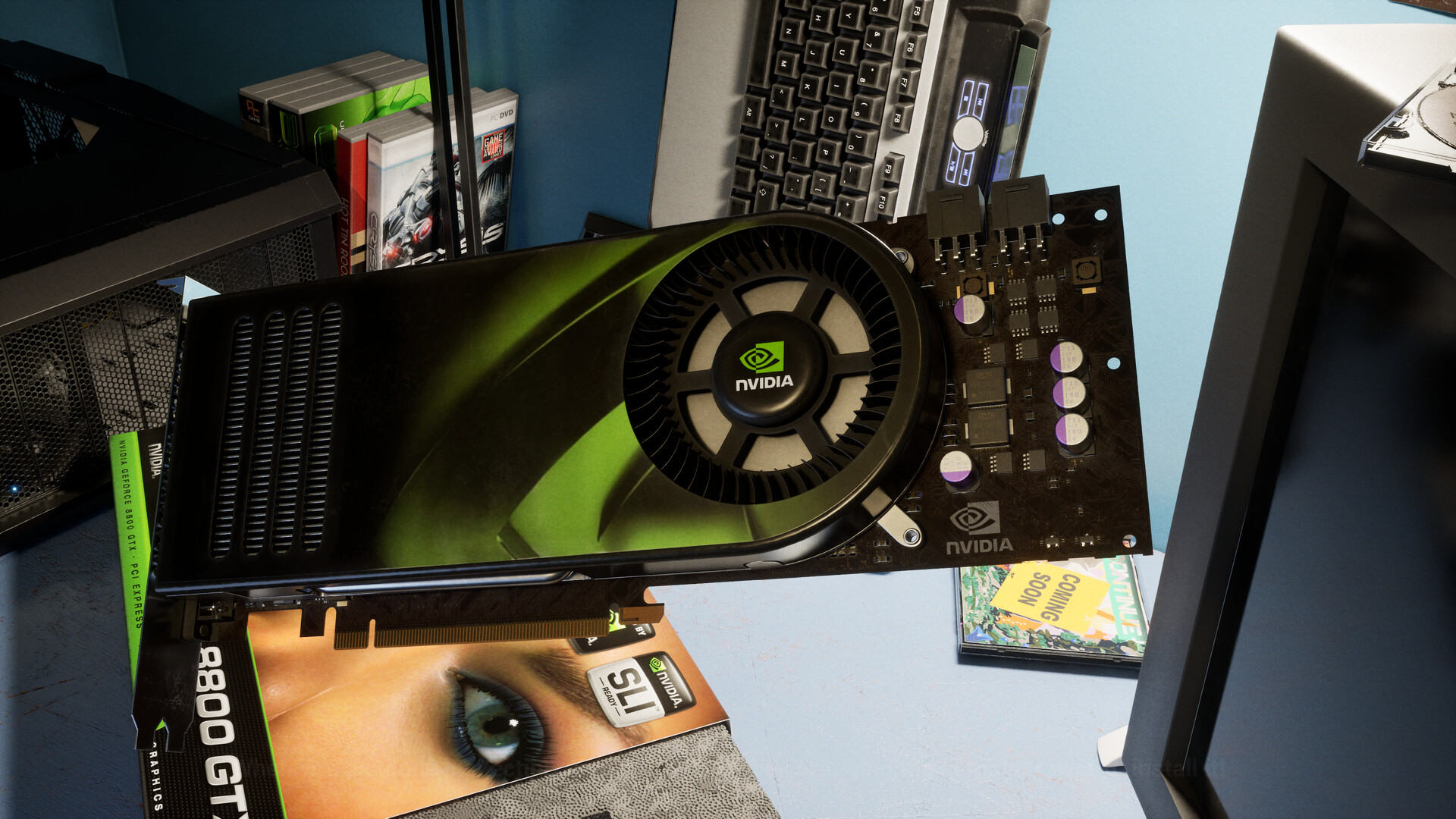
And it was honest, heavy hardware. I have handled these cards. The reference cooler is a serious lump of engineering — a long blower shroud over a dense heatsink, built to move real heat out of the back of the case, because 155 watts was a lot to shift in 2006. The board itself is a small city: twelve memory chips around that enormous 484mm² G80 die, dual SLI fingers on top for the truly committed, and a back side busy enough to need its own map. Cards this size are normal now. In 2006, fitting one felt like installing an appliance.
The Games It Was Built For
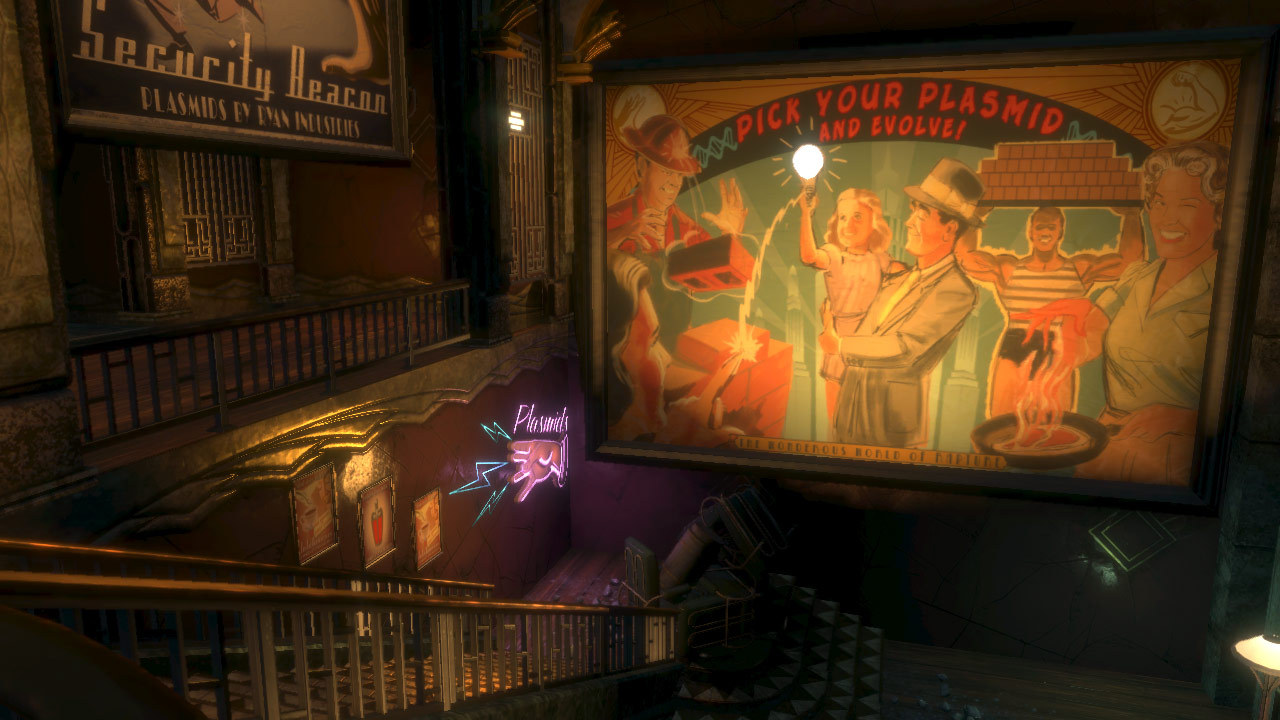
NVIDIA’s own anniversary look-back names the era the way any of us who were there would: Company of Heroes, BioShock and Crysis. That is the right list. Company of Heroes had arrived that September and already made a good PC sweat; BioShock followed in August 2007 with water and light that were basically a DirectX 10 sales pitch you could play; and then, in November 2007, Crysis landed and gave the culture a sentence it has never put down: “But can it run Crysis?”
Here is the specs-honest truth about that sentence, because this desk does not do mythology: the 8800 GTX could run Crysis — genuinely, playably, better than anything else you could buy — but it could not run it maxed out at high resolution, and neither could anything else for a couple of years. That was not the card failing. That was Crytek building a game for hardware that did not exist yet, and the 8800 GTX being the closest thing to it on the shelf. If you owned one in 2007, you were not wondering whether your PC belonged in the conversation. You were the conversation.

The Second Job Nobody Bought It For
Now the part that turned a great gaming card into a historical one. G80 was the first GPU built for CUDA, NVIDIA’s way of letting a graphics chip do general-purpose computing — breaking a problem into thousands of small tasks and running them in parallel. In 2006 that meant a handful of scientific and video-processing experiments. The gamers buying the card, myself included, mostly ignored it. We wanted frames.
Look what the ignoring turned into. The same unified, programmable design that let G80 shuffle shader work around turned out to be exactly what researchers needed, and CUDA became the foundation under modern GPU computing — simulation, video, scientific work, and eventually the machine-learning boom that now defines the entire industry. NVIDIA’s anniversary piece puts it plainly: the 8800 GTX was the first CUDA-capable graphics card, and CUDA today is the language linking the most popular software frameworks directly to NVIDIA hardware. A $599 gaming card from the Vista era is, by direct line of descent, where that story starts. There are not many pieces of gaming hardware you can say that about. There may not be another one.
Every graphics card since 2006 is built the G80 way. The 8800 GTX just had to go first — and going first, it accidentally taught PCs to compute.
A Tribute That Needs an RTX 4070
Which brings us to this week’s genuinely strange and rather lovely anniversary present. On November 5, NVIDIA published its celebration — “GeForce 8800 GTX: 20 Years of Gaming & CUDA” — and released, free on Steam, GeForce 8800 GTX – 20 Years of a Legend, a semi-interactive demo by Unreal Engine artist Dylan Browne, the developer of Through The Ages, made with NVIDIA’s support. It is coming soon to GeForce NOW for Ultimate members as well.
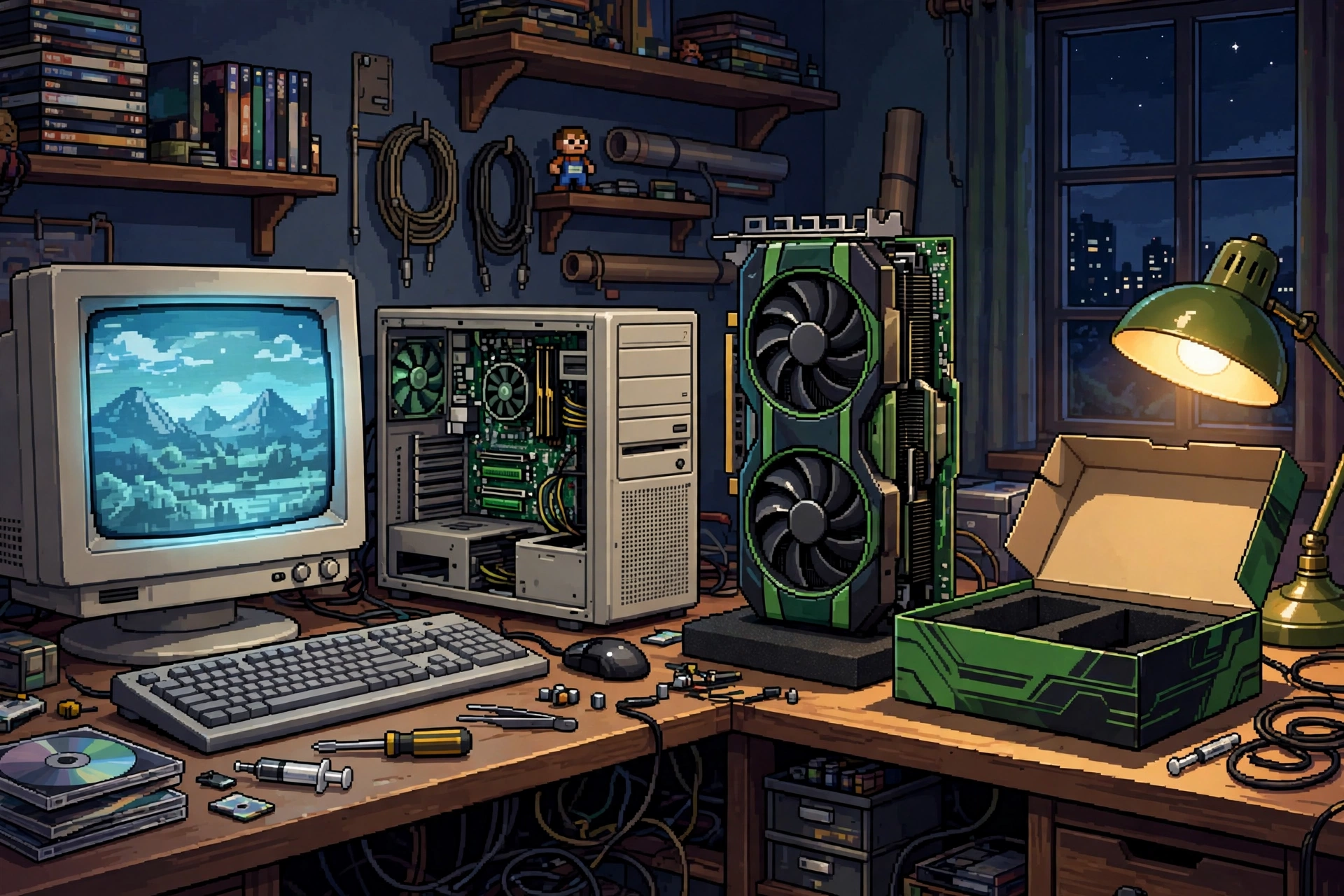
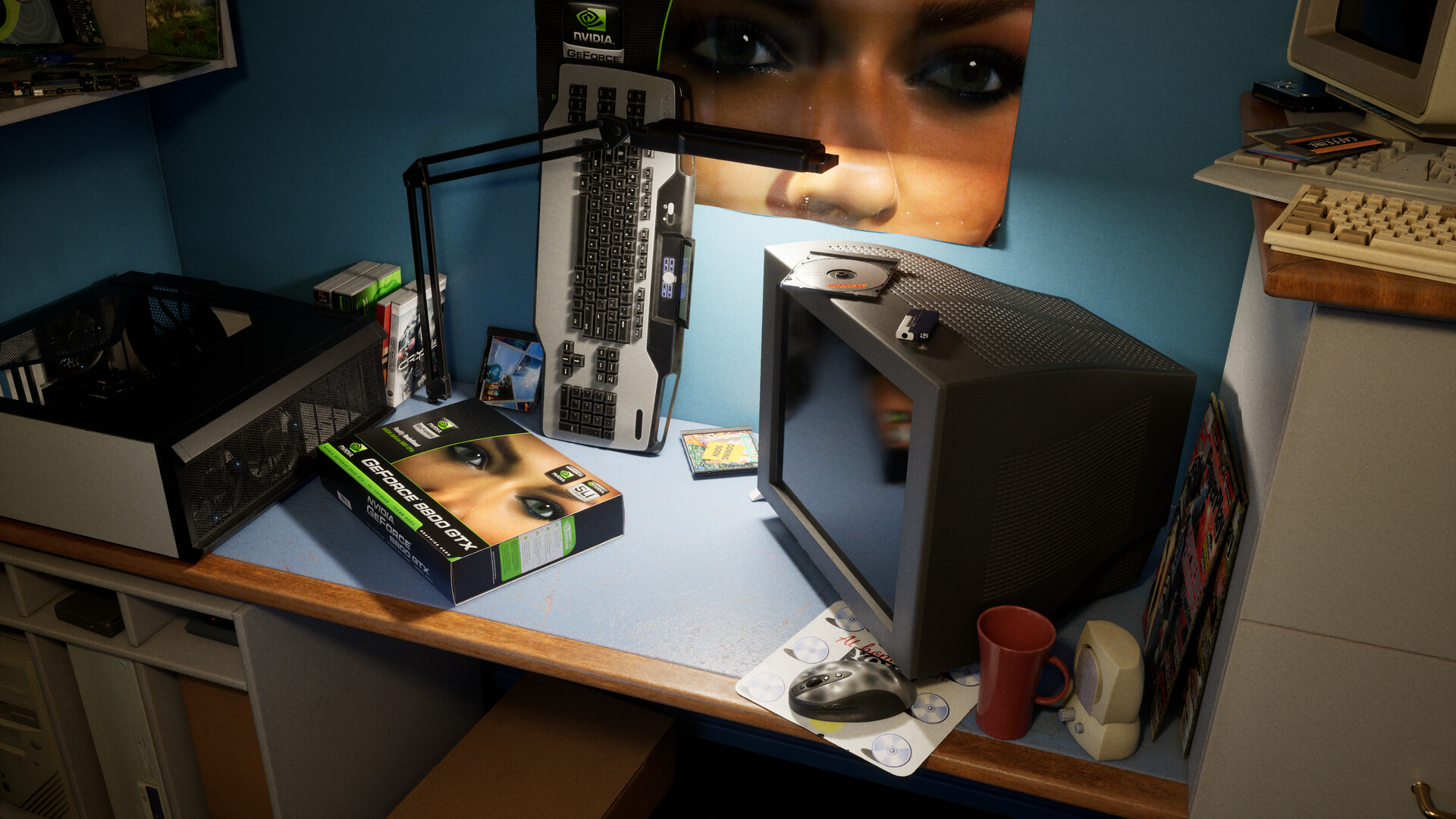
The demo puts you in an era-accurate 2006 gaming room. You unbox an 8800 GTX, inspect it up close, install it in a period tower, wander the room and hunt for nods to GeForce history — the old tech-demo posters, the CRT glow, the whole time capsule. It is rendered with the full modern stack: path tracing, DLSS 4.5 Ray Reconstruction, Dynamic Multi Frame Generation and RTX Mega Geometry. As a piece of hardware nostalgia built by people who clearly love hardware, it is exactly the right idea.
Now the hardware-man’s footnote, and it is a funny one. To run this tribute to a 768MB card from 2006, Steam asks for an RTX 4070 at minimum, recommends an RTX 5080, and wants 32GB of system RAM and 30GB of storage either way. The original card had less memory than the demo’s installer probably does. That is not a scandal — path tracing a whole room is real work, and the demo is free — but it is the most 2026 sentence in this entire story, and the Steam reviews so far (Mixed, at the time of writing) suggest plenty of players have noticed the irony too. One honest discrepancy to flag before you download: NVIDIA’s post says Game Ready Driver 621.14 or newer is required, while the Steam page itself says 621.12 or later. Install the newer one and you are covered both ways.
Twenty Years On, It Still Earns the Slot
Anniversaries are cheap in this industry; every week something is twenty. This one is not cheap. The GeForce 8800 GTX set the template for every GPU that followed it, powered the defining PC games of its generation, asked the “can it run it” question in its sharpest form, and — in its spare time, without being asked — started the computing era we are all now living in. If you have the RTX hardware, the free demo is a half-hour well spent this weekend: go and unbox the thing properly. And if you ever see a real one at a swap meet, pick it up before you buy it. Feel the weight of it. Two slots, two power connectors, 681 million transistors of nerve. They do not make a first of its kind twice.