
At a glance: God of War: Chains of Olympus · PSP · Ready at Dawn / Santa Monica Studio, 2008 · Action adventure · Score: 9.0/10
The conventional wisdom of 2008 said the PSP could not do this. God of War was the PlayStation 2’s spectacle benchmark — hydra battles on burning ships, cameras swooping across marble cities, a bald rage-machine tearing gods apart in widescreen. A handheld version, built by a small studio in Irvine, sounded like a demotion. Chains of Olympus is instead one of the great acts of translation in games: Ready at Dawn did not port God of War down. They rebuilt its grammar, shot by shot, until the PSP was not imitating a console game but hosting one.
It is a prequel, set in the ten years of service Kratos owes the Olympians between the first two console games. The sun god Helios has been pulled from the sky by Morpheus, the world is falling into dreamless sleep, and Kratos — sent to Attila’s besieged city of Attila first, then down into the underworld itself — finds the trail leads to Persephone and a bargain no other God of War game has dared to offer him: peace, at a price he has already paid once.
The Blades, translated faithfully
Everything that defines the series’ combat survives: the Blades of Chaos on their chains, the square-square-triangle rhythm, grabs, parries, context kills rendered as small operas of violence. What impresses is not inclusion but feel. The PSP has no second analogue stick and no shoulder-button surplus, so dodging moves to a stick-plus-shoulder combination and camera control is simply designed away — the fixed cinematic camera, always the series’ real director, means it is barely missed. Combos flow, hit-stop lands, and the game runs at a fluidity the hardware had no business sustaining.
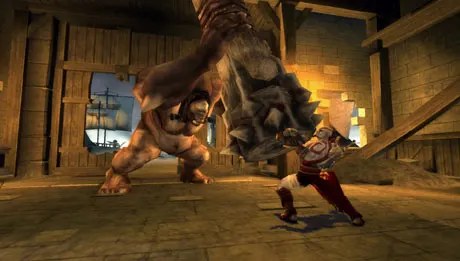
New tools earn their place. The Efreet, a summoned fire djinn, gives crowd-clearing spectacle; the Sun Shield adds a proper parry game with a timed-reflect that rewards nerve; and late in the story Kratos takes up the Gauntlet of Zeus, a slow, obscene fist that turns armoured enemies into an argument you win one punch at a time. A boss fight against Charon — the ferryman of the dead, fought on his own boat — and a genuinely shocking mid-game defeat keep set-piece hunters fed across the roughly six-hour campaign.
A technical showpiece that holds up
Ready at Dawn famously persuaded Sony to unlock the PSP’s full 333MHz processor speed for this game, previously capped for battery reasons, and the result still startles: draw distances across the Elysium fields, lighting on wet stone in the caves of Olympus, character models that survive close-ups the camera loves to take. Gerard Marino’s score, recorded with full orchestra and choir, pours out of headphones like the machine is cheating. On a PSP screen in 2008, this was the game you loaded to silence doubters.
The story is the other surprise. God of War plots usually run on betrayal and volume; Chains of Olympus runs on a father visiting his murdered daughter in Elysium and choosing, in the game’s most famous sequence, to push her away — a quick-time event recast as an act of self-mutilation — because the world cannot afford his happiness. It is the most human Kratos has ever been allowed to be, and it retroactively deepens every console game around it.

Short, and not sorry
The honest criticisms are length and lineage. Six hours is a weekend, not an odyssey; the puzzle design is lighter than the console games’; and a couple of environments — temple, cave, underworld — are series furniture rearranged with skill rather than invention. If you demand novelty over execution, note it. But judged on what it attempts, a full-scale God of War that respects both the source and the handheld, there was nothing else like it on any portable machine in 2008, and the later Ghost of Sparta only confirms the template by repeating it bigger.
The studio that could
Ready at Dawn was founded by former Naughty Dog and Blizzard staff, and Chains of Olympus was only their second game — after Daxter, another PSP translation of a console giant that nobody expected to work. Their twin successes share an explanation: the studio treated the PSP not as a compromise but as a specification, redesigning rendering, controls and pacing around it. Sony noticed. The studio’s next decade included a second God of War for PSP and eventually The Order: 1886; the craft on display here, in miniature, is where that reputation was minted.
Difficulty, treasures and second runs
Four difficulty tiers, from Mortal to God, re-tune enemy aggression rather than merely inflating health, and the game’s challenge rooms — framed as the challenges of the gods in series tradition — test the Efreet-and-parry toolkit the campaign teaches. Costumes, including a mimed Kratos and a suit of spartan armour with joke statistics, reward completionists, while the red-orb upgrade economy stays lean enough that a first run forces real choices between maxing the Blades and feeding the magic bar. It is a compact package that respects the replay instinct instead of padding against it.

Sound and fury, through headphones
Play this one with headphones or not at all. Marino’s score leans on the series’ signature male choir and percussion, but the sound design underneath — chain rattle, shield ring, the wet percussion of the combat — does as much for scale as the graphics. The PSP’s speakers flatter none of it. Plugged in, on a train, in 2008, Chains of Olympus was the closest thing portable gaming had to a cinema, and its audio remains the single easiest way to explain to a sceptic what the machine could do.
Where it sits in the saga
Chronology makes Chains an ideal second God of War: after the 2005 original, before the sequels’ escalation. Its revelations about Helios, Atlas and the underworld’s geography feed directly into God of War II and III, and its Elysium sequence reframes Kratos’ later cruelties as choices made by a man who was once offered an exit and refused it. Replayed alongside Ghost of Sparta — Ready at Dawn’s bigger, bolder sequel — it forms a portable duology that matches the home games arc for arc. Two of the finest action games on the system share a hero, a studio and a standard neither ever dropped.
Battery, brightness and the 333MHz bargain
There is a hardware story under the legend: Sony’s decision to unlock the PSP’s full processor speed, made under pressure from exactly this kind of software, quietly redefined what every later PSP game could attempt. Chains of Olympus drank battery at the new clock like a god of war should — a full charge bought an evening, not a weekend — and owners accepted the trade without blinking, because the exchange was written on the screen. It is a tidy parable of the PSP era: the machine always had more to give, and this game was the proof.
There is a postscript worth recording: Chains of Olympus was later ported to PlayStation 3 in the Origins Collection, where its craft survived the move to a television intact — the surest test of a handheld game’s foundations. But the PSP original remains the version with the story attached: a small studio, a capped processor unlocked by persuasion, and a god-tier franchise discovering it could live in a coat pocket without losing its soul. If you own the machine, you owe it this game. The gods demand service. For once, saying yes is easy.
Verdict
The PSP’s defining technical achievement and a top-three God of War campaign. Short, savage and unexpectedly sad — Kratos at his most portable and, paradoxically, his most powerful.