
At a glance: Crisis Core: Final Fantasy VII · PSP · Square Enix, 2007 (JP) / 2008 (West) · Action RPG · Score: 9.0/10
Everybody who played Final Fantasy VII in 1997 already knows how Crisis Core ends. Zack Fair’s fate was settled a decade before this prequel existed, sketched out in a handful of flashbacks and one optional, easily missed cutscene. That ought to make Crisis Core a doomed exercise — a fifty-hour walk towards a wall. Instead, Square Enix turned foreknowledge into the game’s greatest weapon. This is not a story about what happens. It is a story about watching a decent, funny, hopelessly earnest young man become the person who had to happen to, and it lands harder than almost any twist-driven plot could.
You play Zack, a SOLDIER 2nd Class with a hero complex, a mentor named Angeal who preaches about honour and dreams, and a company — Shinra — that treats both as marketing copy. Across a campaign that runs from the war in Wutai to the last stand outside Midgar, Crisis Core fills in the VII universe from the inside: Sephiroth before the fall, Aerith before the flower cart became an icon, Cloud as a shy infantryman who has not yet invented his persona. It should feel like homework. It feels like a homecoming.
A slot machine where your heart should be
Combat is real-time, third-person action: Zack runs, dodges, blocks and chains sword combos and materia spells from a shortcut bar, long before that shape became the series standard. Hovering over everything is the DMW — the Digital Mind Wave — a slot reel of faces and numbers that spins continuously in the corner of the screen. Match three portraits and Zack unleashes a Limit Break drawn from the characters he has met; match numbers and he levels up. Not through experience points. Through a roulette wheel tied, the game insists, to his emotional state.

It sounds like a gimmick designed by a committee, and for the first hour you may resent the randomness — levelling by lottery feels wrong in an RPG. Then the design clicks. The DMW externalises Zack himself: his memories literally empower him, flashback vignettes unlock as relationships deepen, and in the final battle the mechanic produces one of the most quietly devastating sequences the medium has ever staged. Few systems have been mocked so quickly and defended so fiercely, by the same players, in the same playthrough.
Built for a handheld, paced like one
Crisis Core understands the machine it lives on. Between story chapters sit some three hundred optional missions — short, sharp assignments selectable from any save point, graded across ten categories, most finished in two to five minutes. They are perfect bus-stop gaming, and they are also where the game’s real build-crafting lives: materia fusion, stat-boosting accessories, and encounters with series summons from Ifrit to Bahamut, all rendered with a confidence that made 2008 reviewers reach for the word impossible.
The production values remain the PSP’s high-water mark alongside the God of War games. The CG cinematics are feature quality, the score by Takeharu Ishimoto threads Motomu Toriyama-era VII motifs through driving rock arrangements, and the voice cast — Rick Gomez’s Zack above all — sells every beat. Load times, the tax every UMD game paid, are softened by an optional data install, a courtesy more PSP games should have offered.

What dates, what doesn’t
Honesty demands the caveats. The mission structure recycles a small pool of environments until repetition sets in; corridor, cave, corridor again. The camera can sulk in tight spaces. And the DMW never fully escapes its casino DNA — a boss fight can turn on a lucky spin in a way that flatters nobody’s skill. Players coming fresh from modern action RPGs will also find Zack’s moveset compact: this is a 2007 handheld game wearing its limits openly.
None of it dents the whole. Crisis Core is the best of the Compilation of Final Fantasy VII by a distance, the one entry that justifies the entire project, because it treats its source with affection rather than reverence and gives its hero a complete arc instead of a mythology lecture. The 2022 Reunion remaster smooths the edges for modern machines, and it is a fine way to play — but the original still has a rawness, and a portability, that made it a phenomenon on trains and in bedrooms the first time around.
From compilation to centrepiece
Crisis Core began as the riskiest limb of the Compilation of Final Fantasy VII, the mid-2000s project that also produced the film Advent Children, the shooter Dirge of Cerberus and the mobile game Before Crisis. Of those siblings, only Crisis Core was trusted to carry a mainline emotional arc, and the pressure shows in its polish. Director Hajime Tabata, later of Final Fantasy XV, built it as a character study first and a merchandise extension second — which is why Zack, a footnote in the original game’s lore, walks away with the whole saga’s most quoted line about the price of freedom.
Materia, fusion and the grind that isn’t
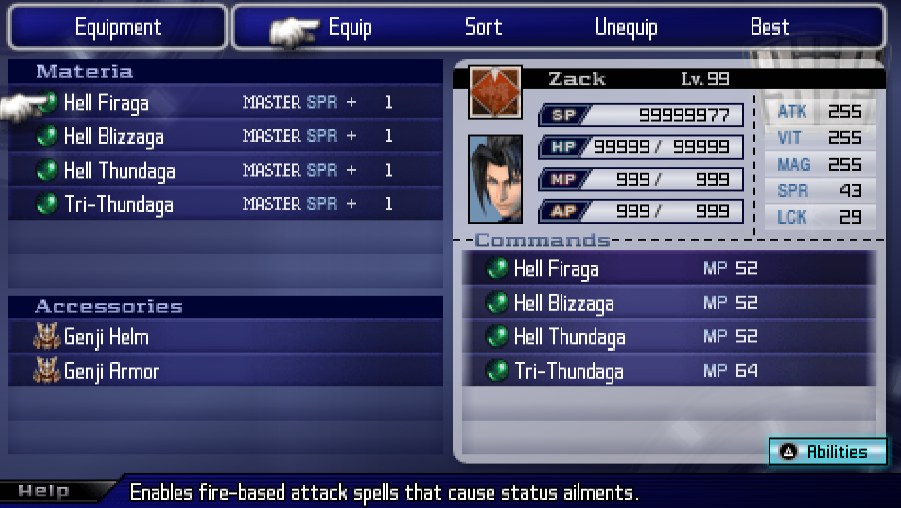
Under the action sits a proper RPG workshop. Materia can be fused, consuming duplicate stones and items to create new spells with built-in stat bonuses, so a Fire can grow into a Dark Blizzaga carrying plus-fifty magic if you feed the system patiently. The mission board is where this experimentation pays rent: rewards include summons, rare fusion fodder and the Genji equipment set, the connoisseur’s armour of the VII world. None of it is required to finish the story, and all of it is there for the player who treats a handheld RPG as a long-term residence rather than a visit.
A score with two hearts
Takeharu Ishimoto’s soundtrack deserves its own paragraph in any honest account. Its rock-forward arrangements — all electric guitar, strings and urgency — were divisive in 2007 among players expecting Uematsu’s piano lyricism, yet they fit Zack precisely: this is a younger, louder generation’s Final Fantasy. When the arrangements do quote the original themes, in the Nibelheim sequences and the closing stretch, the contrast lands like a hand on the shoulder. The ending sequence, scored to Ayaka’s Why, remains a famous tear-extraction device, and it has lost none of its potency on a small screen in the dark.
Playing it today
On original hardware, seek the version with the data install and give it the ten minutes it asks for; the PSP’s UMD drive is the game’s only recurring enemy. The controls, mapped before twin-stick action became handheld law, ask for a short adjustment period — camera on the triggers, lock-on on a tap — and then disappear. Save often between missions, fuse curiously, and do not rush the main story for the grind: Crisis Core is generous with power, and its final hours are tuned for a Zack built by a player, not a spreadsheet.
The install and the artefact
A note on the physical object, because Crisis Core rewards collectors with one of the PSP’s finest packages: the UMD case carried some of the system’s best cover art, the manual is a proper artefact of the era when Square Enix still wrote them like storybooks, and the limited PSP bundle hardware — silver, engraved with the game’s art — remains a grail of PSP collecting. None of this changes the score. All of it explains why this game, of all the Compilation’s children, is the one kept on shelves rather than in storage boxes.
A last word for the sceptics who file Crisis Core under fan service: fan service does not usually come with this much risk. A slot machine for a heart, a hero whose fate is a spoiler printed on the original’s box, a final stand rendered as a mechanic failing in real time — these are choices made by people trying to say something, and the PSP gave them the perfect stage: a huge story carried close, in private, one commute at a time. Embrace your dreams, indeed — and, whatever happens, protect your honour as SOLDIER. The price of this particular freedom is one game you will never quite get over.
Verdict
Play it for Zack. Play it for a battle system that risks absurdity and wins. Play it knowing the ending, and discover that knowing was never the point.