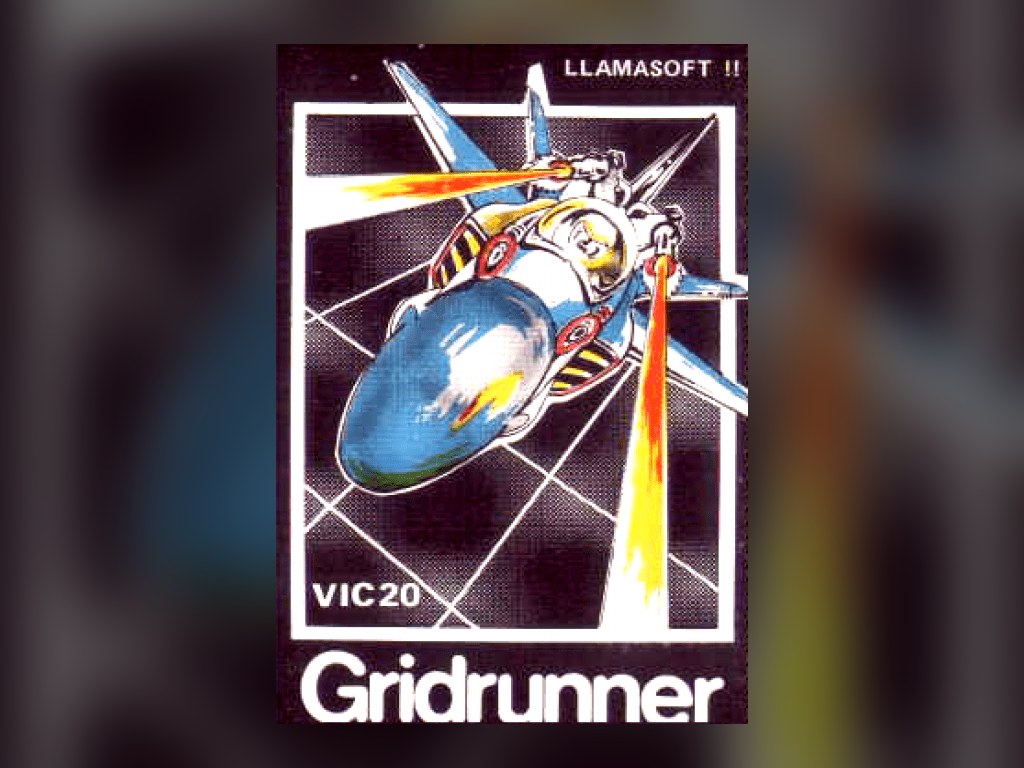
At a glance: Gridrunner · VIC-20 · Llamasoft, 1982 · Grid shooter · Score: 9.0/10
Every great career has a big bang, and Jeff Minter’s is Gridrunner. Written for the VIC-20 before the Commodore 64 version that made his name, it takes the bones of Atari’s Centipede — segmented serpents winding down a playfield — and rebuilds them as something faster, meaner and unmistakably Minter’s own. You command a small ship locked to the lower portion of a glowing grid while serpent-like Gridrunners descend in sections, pods sprout and mature across the lanes, and the X and Y axis zappers patrol the edges waiting to fire along the rows and columns. It sounds like a homework exercise in arcade conversion. It plays like a lightning strike. On a machine with 3.5K of usable BASIC memory and no hardware sprites at all, Gridrunner’s speed is not just impressive — it is a manifesto for everything the little VIC could do when a programmer refused to accept its limits.

Serpents, pods and crossfire
The genius of Gridrunner is how many threats it stacks into a screen you can read at a glance. The Gridrunners themselves arrive in segments, snaking down the grid and splitting when shot, so a lazy burst of fire creates two problems where there was one. Pods appear randomly and, left alone, grow through stages until they become a genuine menace — shooting them young is housekeeping, shooting them late is survival. Then there are the zappers: one sweeps the bottom edge firing up your column, another patrols the side firing along your row, and both telegraph their shots with a beam you learn to respect the hard way. None of this is decoration. Every element forces movement, so the grid never settles into a safe pattern you can camp in.

What elevates it above the crowd of 1982 shooters is tempo. The VIC-20 version moves with a snap that the hardware had no business delivering: your ship answers the joystick instantly, enemy patterns escalate in waves that feel hand-tuned rather than random, and a lost life returns you to the action before frustration can set in. Minter understood, earlier than almost anyone programming home computers, that speed itself is a feature — that a game running at the edge of control feels more exciting than a prettier game running safely inside it. Gridrunner is where that philosophy first catches fire, and the VIC’s chunky, luminous graphics suit it perfectly: big, readable shapes in saturated colour, with none of the visual muddle that plagued fussier conversions.
The VIC-20 version, judged on its own
Because the C64 Gridrunner is the famous one, the VIC original is often treated as a rough draft. Play them back to back and that judgement collapses. The VIC game is the design in its purest form: a tighter grid, chunkier targets, and a difficulty curve that gets its hooks in within the first minute. The C64 edition adds polish and variety, but the VIC’s rawness is part of its character — this is a game built inside severe constraints by a programmer treating those constraints as a dare. Cartridge release through HES in the US put it in front of American owners as well, and it deserved the audience: in 1982, most VIC-20 software still looked like type-in listings with ambitions. Gridrunner looked like the arcade had moved in.

Sound is the one place the VIC hardware shows its hand honestly. The VIC chip’s three pulse voices and noise generator cannot reproduce arcade audio, but Minter leans into the machine’s voice — harsh zaps, thudding explosions and effects pitched to cut through a television speaker. It is functional rather than musical, and in the heat of a wave that is exactly right. The bigger point is that nothing here feels compromised in a way that matters. Where other VIC conversions apologise for existing, Gridrunner simply gets on with being one of the fastest, most replayable shooters of the machine’s first wave — and arguably of its whole life.
Why it still burns brightest on the VIC
There is a temptation, when a game exists on several machines, to treat the most powerful version as the real one and the rest as footnotes. Gridrunner inverts that logic. The VIC-20 original is not a reduced C64 game; it is the design at its most concentrated, written by a programmer who knew this exact hardware — its character grid, its colours, its sound voices — the way a racing driver knows a home circuit. Every element sits at the resolution the VIC can make beautiful: the serpents are huge, the grid glows, and the action occupies a screen your eyes can own. Nothing is decorative and nothing is missing. When historians call Gridrunner a landmark, they are usually picturing the C64 box. The game they are actually remembering — the speed, the structure, the serpent splitting under fire — was born here, in this version, on this machine.
It also rewards the VIC-20’s particular social life. This was a cartridge-and-tape machine in teenagers’ bedrooms, and Gridrunner is engineered for that room: instant starts, three-minute games, a high-score table that becomes a household championship. Modern play confirms the design’s instincts. Load it for a sceptical friend and the conversion takes ninety seconds — one death blamed on the joystick, one on the zappers, and then the lean-in, the silence, the score-chase trance that great arcade games have induced since 1978. Games twice its size, on machines ten times as powerful, routinely fail that test. Gridrunner on the VIC-20 passes it in a machine with less memory than the message you would send to arrange the evening.
In the slot today
Practical notes for today’s player: Gridrunner asks nothing of your setup but a working joystick and ten unguarded minutes, yet it rewards the period touches — a CRT’s glow flatters its grid, and the VIC’s own joystick port gives the ship the digital snap the design assumes. Emulation is faithful and freely available through the machine’s well-supported emulator scene, but the cartridge, HES or Llamasoft flavoured, remains common enough that original hardware play is no hardship. However you load it, resist the urge to read strategy first. Gridrunner teaches by velocity: the pods, the zappers and the serpent’s splitting logic all announce themselves within three waves, and the discovery is the game working as designed.
One more distinction belongs in the record. Many early VIC games are conversions of other machines’ ideas, competent and derivative in equal measure. Gridrunner is the opposite traffic — an original that flowed outward, from the VIC to the C64 and beyond, carrying its author’s name with it. The VIC-20 library contains the headwaters of several great careers, but only one game that a whole genre of grid shooters descends from. It started here, at this resolution, in these colours, and the source still runs fastest in the memory of everyone who was there.
Gridrunner is a game built inside severe constraints by a programmer treating those constraints as a dare — and it still crackles.
Scores in Gridrunner are chased the way they were in the arcades: one more run, one more wave, one cleaner split of the serpent before the zappers line up. Its learning curve is honest — deaths are your fault, patterns can be read, and improvement is measurable in waves survived rather than luck. For collectors, the cartridge is common enough to find and essential enough to justify hunting; for everyone else, this is the first title to load when someone asks what the VIC-20 was actually for. The C64 may have made Minter famous, but the VIC-20 made him dangerous.
Verdict: the definitive early VIC-20 shooter and the starting point of the Llamasoft legend. If you own the machine, you own this game in spirit already — go and get the high score to prove it.
That is why this review scores it at the top of the VIC scale. Not as a courtesy to a famous name, and not as nostalgia arithmetic, but because the cartridge in front of us — judged as a VIC-20 game, against VIC-20 games — does everything its machine could be asked to do, at a pace its machine was never supposed to reach. The C64 version is a classic. This is the classic’s source code, and it plays like lightning. Own both if you can. Start here.