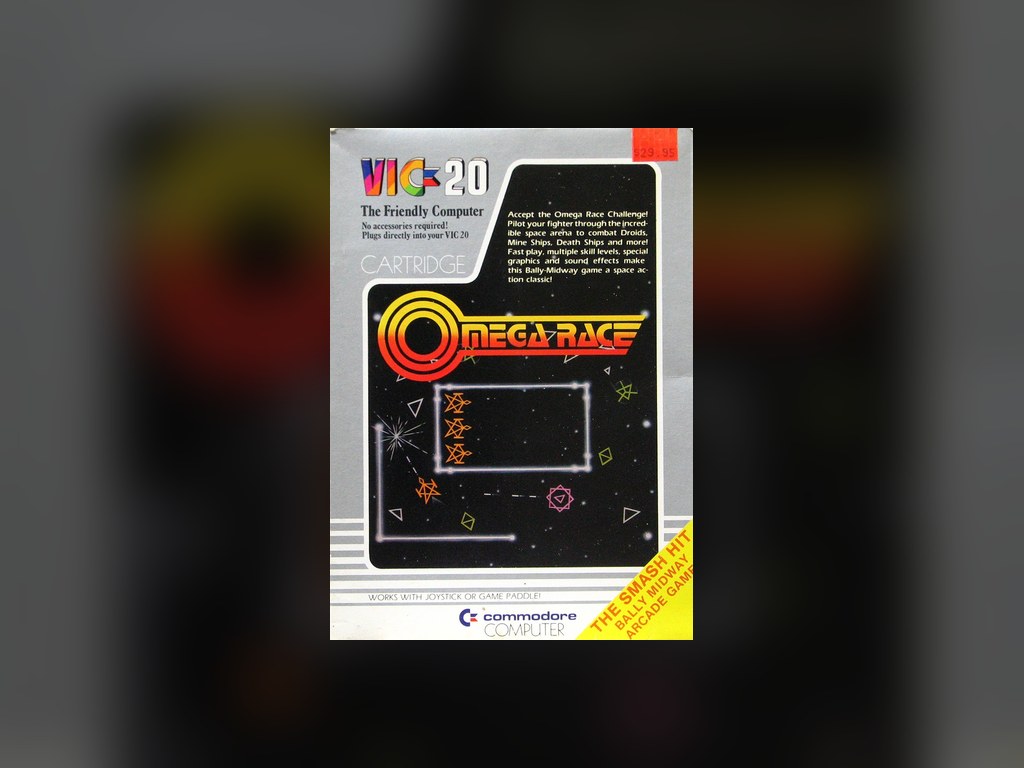
At a glance: Omega Race · VIC-20 · Commodore, 1982 · Arena shooter · Score: 8.5/10
Midway’s Omega Race was the only vector game the company ever made, a black-and-white arena shooter in which your ship ricochets around a rectangular battlefield, bouncing off the walls while drone ships hunt you down. Converting a vector display to the VIC-20 — a machine whose graphics are built from chunky character blocks — should have been impossible. Commodore’s programmers did it anyway, and the result is one of the most respected conversions in the VIC library. The glowing lines become solid raster shapes, the arena becomes a boxed field with the score display at its centre just like the coin-op, and the essential physics survive intact: your ship does not stop when you release the controls, it drifts, spins and caroms, and mastering that momentum is the entire game.

Momentum is the game
Omega Race controls take an evening to learn and a lifetime to master. You rotate your ship, thrust, and fire — but thrust in a world without friction means every burn commits you to a trajectory, and the walls are both your enemy and your best weapon. Skilled players do not steer around the arena so much as aim their bounces, ricocheting off one wall to line up a shot on a drone, then using the rebound to escape the return fire. The drone ships escalate in intelligence and aggression as waves progress, command ships appear as high-value targets, and mines seed the field to punish predictable paths. It is a game about geometry played at panic speed, and the VIC version keeps that tension beautifully.

Judged strictly as a VIC-20 program, the conversion is a small miracle of priorities. The programmers spent the machine’s resources on the things that matter — smooth ship movement, faithful bounce physics, responsive fire — and let the visuals be bold and simple rather than detailed and slow. The drones are clear shapes, the arena is uncluttered, and the action never stutters when the screen fills. Compare it with the era’s many VIC conversions that tried to look like their arcade parents and played like treacle: Omega Race understood that an arcade port lives or dies on feel. On the VIC’s low resolution, the ships are necessarily chunkier than the vector originals, but the trade is worth it every time.
A thinker’s shooter
What keeps Omega Race on ‘best of the VIC’ lists four decades later is its depth-to-simplicity ratio. There are no power-ups to memorise, no levels with new scenery, no gimmicks — just an arena, a drifting ship, and waves of drones that get cleverer faster than you do. Every death teaches something specific: you thrust too long, you bounced predictably, you chased a bonus into a crossfire. That purity made it a favourite of the paddle-and-joystick generation and makes it a perfect score-chaser now. It also helps that the VIC cartridge loads instantly and plays in short, fierce sessions — the format this machine was always best at.

If there is a criticism, it is that the game’s starkness is all there is: players raised on variety will find one arena and one escalating challenge. But that was the arcade bargain of 1981, and Omega Race honours it better than almost anything else on the VIC-20. It is also a historically important cartridge — proof, arriving early in the machine’s life, that Commodore’s own software teams could out-convert anyone when they focused on playability over prettiness. New VIC owners sometimes skip it because screenshots look plain. Those screenshots are lying. In motion, at speed, with the drones closing in and your ship sliding sideways toward a wall you meant to hit, Omega Race is anything but plain.
The arena, forty years on
Omega Race’s afterlife is unusual: unlike most arcade conversions of its era, it never really needed rescuing by nostalgia, because the players who mastered it never stopped citing it. It turns up on ‘best of the VIC’ lists compiled in every decade since, usually near the top, and the reason is the physics. The bounce is a complete language. Beginners carom helplessly; intermediates aim their rebounds; masters play shots off two walls and use the arena’s centre block — the score display housing, inherited from the coin-op — as a shield, a pivot and a trap. That learning curve, measurable in your own hands across a single evening, gives Omega Race a depth its one-screen simplicity should not be able to hold. It is the VIC-20’s purest example of easy to learn, lifetime to master, and it achieves it with a ship, some drones and the laws of reflection.
It is worth pausing on the conversion’s historical position, too. When Commodore’s team undertook a vector game — the single hardest kind of arcade display to imitate on a character-mapped home computer — and shipped a version that players preferred to most raster-native shooters, they set the VIC library’s quality bar. The machine’s later great conversions, from Jelly Monsters onward, were measured against the standard Omega Race established in the library’s first year: respect the feel, spend memory on motion, let the graphics be bold rather than busy. Judged by that standard — the VIC-20’s own standard — this cartridge is not merely good. It is foundational.
In the slot today
For players meeting Omega Race away from original hardware, know that the game’s feel survives emulation well — the physics are the program, not the peripherals — but the bounce was tuned for a television’s scale, and the arena deserves the biggest screen you can give it. On cartridge, it remains one of the most affordable of the genuinely great VIC titles, a consequence of its healthy original sales: Commodore knew what it had and shipped it in quantity. That abundance is a gift to new collectors. Few machines let you buy a consensus top-five game for loose-change money; the VIC-20, characteristically, insists on it.
Its influence also deserves a line. The momentum arena shooter — drift, bounce, shoot, survive — became a durable genre dialect, spoken later by games on far grander hardware. Omega Race was not the first to speak it, but the VIC conversion was the version a generation of home players learned it from, in bedrooms rather than arcades. Dialects outlive empires. Load the cartridge and you can still hear this one spoken fluently, at speed, off every wall in the arena.
Omega Race understood the first rule of arcade conversion: a port lives or dies on feel, not on screenshots.
This is essential VIC-20 software — a top-tier conversion, a masterclass in momentum physics, and a score-attack game with genuine staying power. It belongs in the first rank of cartridges any collector should own, alongside the Minter games and Commodore’s own best arcade work. The vector original will always be the purist’s choice, but on a television in 1982, bouncing a raster ship around Commodore’s little arena was as close to the arcade as home gaming got.
Verdict: plain to look at, brilliant to play. Omega Race turns the VIC-20’s limitations into a physics playground, and it has barely aged at all.
For new owners assembling a first shelf, Omega Race is the cartridge that explains the machine to arcade purists: the one that proves the friendly computer’s games were not approximations endured for the price, but designs chosen and converted with intent. Put it in the slot, learn to love the walls, and mind the command ship. The arena has been waiting since 1982, and it has not slowed down.