
At a glance: Guardian War · 3DO · Micro Cabin / Panasonic, 1994 · Tactical role-playing game · Score: 7.0/10
Guardian War — released in Japan and Europe as Powers Kingdom — is a tactical RPG built from toy soldiers. Micro Cabin’s 1994 strategy game sends parties of wind-up knights, golems and animated warriors across 3D battlefields in one of the earliest attempts to bring the tactics genre into the third dimension. It is clunky, slow in places, and frequently delightful: a game whose ideas — fully 3D terrain, destructible positioning, a party of collectible bodies to possess — ran ahead of the hardware and the genre’s conventions alike.
The framing is enjoyably strange. You are a guardian spirit, a soul without a body, fighting to free a fantasy world from a gathering darkness by possessing the inanimate warriors scattered across it. Your party is therefore literally a collection: the knight Pumpkin, golems, dolls and stranger vessels, each found, recruited and fielded like pieces in a war game. Death in battle is the loss of a body, not a friend, which gives the game’s tactics a distinctive coldness — pieces can be spent — wrapped in some of the most charming character design on the system.
Chess in the third dimension
Battles play out on isometric 3D fields — deserts of cacti, forests, ruins — where elevation, facing and range genuinely matter, rendered in real-time polygons at a moment when the tactics genre was still flat. Your view can rotate, the camera pulls over the battlefield like a table being walked around, and the grid is draped over terrain rather than drawn on a board. In 1994 this was revelatory presentation for a strategy game, and the fields still have a diorama quality that suits the toy-soldier cast: this is a war game that looks like the games of war children play on a bedroom floor.
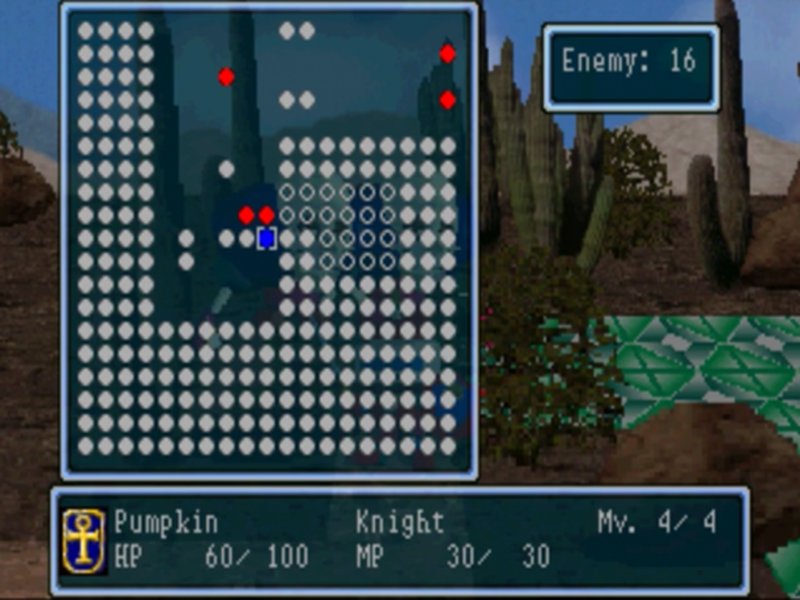
The systems underneath are solid period tactics. Units have movement ranges, attack ranges, elemental strengths and job-like roles; experience builds your vessels toward promotion; between battles, towns offer shops, recruitment and the map-walk that strings the campaign together. Difficulty is fair and failure is instructional — the game wants you to learn its terrain logic, and its mid-game battles, where enemy numbers and height advantages combine, deliver genuine tactical puzzles.
Where the gears grind
The era’s constraints are equally visible. Battles are slow: enemy turns play out at a stately pace, animations cannot be hurried, and large maps become tests of patience as much as tactics. The interface — selecting, rotating, confirming through menus layered over menus — belongs to a genre still inventing its controller grammar, and misclicks cost turns. The story, told in brief scenes, never develops the strangeness of its premise into real drama, and the campaign’s structure repeats its rhythms across a long run time.
Guardian War treats its soldiers as toys and its battlefields as playsets — and finds, inside that idea, the future shape of the tactics genre.
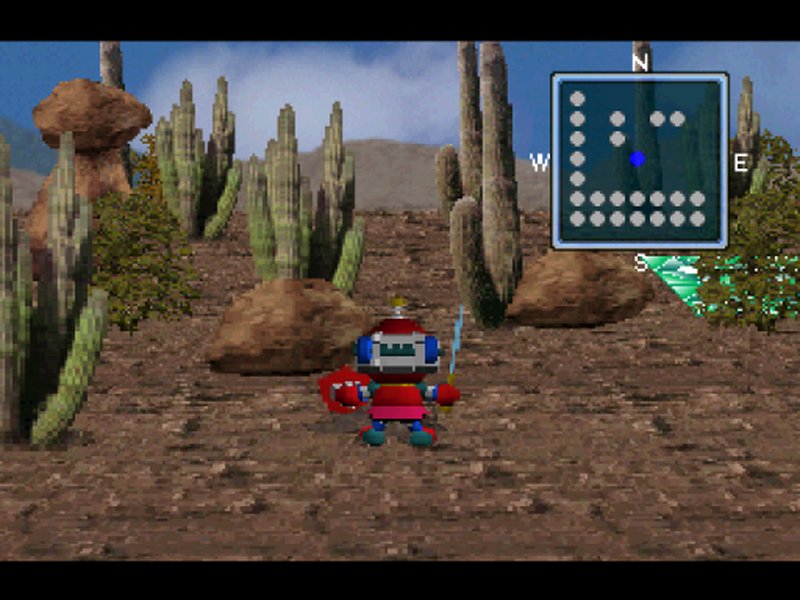
Set against its contemporaries, though, the ambition is undeniable. Shining Force was flat. Tactics Ogre was a year away. Guardian War was already rotating its camera over 3D hills and asking where your knight should stand on them. Its possession system — building a party from found vessels, each with its own growth — anticipates collection-driven design the genre would spend decades adopting. Even its pacing problems come from the honourable direction: there is simply a lot of battle here, presented at a scale the hardware could barely serve.
Micro Cabin’s two 3DO RPGs bookend the system’s Japanese story: where Lucienne’s Quest is warm and story-led, Guardian War is mechanical, strange and quietly pioneering. Collectors know it as the affordable one of the pair. Players should know it as the interesting one — a tactics game from the genre’s Cambrian explosion, weird edges intact.
The campaign, and its strange party
The campaign’s structure deserves a closer look, because it explains both the game’s length and its hold. The world map strings together battlefields, towns and recruitment points in a loose chain, and the party grows by discovery rather than by script: a vessel found in one region answers a problem posed three battles later, and the temptation to field favourites against the logic of terrain is the game’s quiet strategy layer. Bodies are equipment as much as characters — you will bench a beloved knight because a golem’s resistances suit a desert, and feel the game’s toy-box philosophy working exactly as designed. Experience accrues to the vessel, so investments are tangible and losses, when a favourite falls in a hard battle, have a collector’s sting: that was one of a kind, and the map will not simply hand you another.
The enemy design keeps the long campaign fresher than the pacing suggests. New unit types arrive with new rules attached — flyers that ignore your front line, ranged units that punish clustered formations, bosses that occupy several squares and demand the whole party’s attention — and the elemental system, simple on paper, forces regular rethinking of who stands where. Height is the third combatant in every battle: archers and mages on roofs and ridges dominate lanes, and the scramble for the high squares gives even routine encounters a shape. Veterans of later tactics games will recognise the grammar being assembled here in real time, in 3D, by a studio clearly delighted with its own experiment.
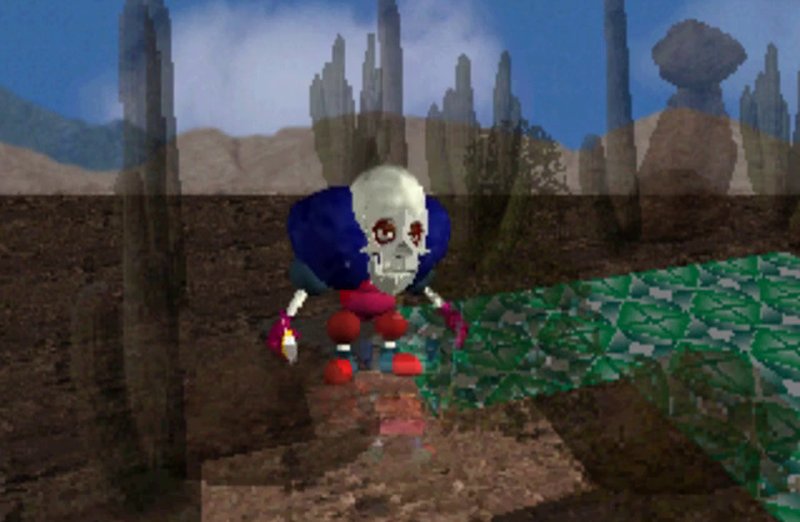
It should also be said that the game’s visual charm has aged in its favour. The little vessels — Pumpkin’s round knight, the stamping golems, the skeletal ranks — read beautifully as crafted objects, and the 3D fields, crude as their geometry now is, have the hand-built quality of a model railway. Guardian War looks like a thing someone made, which is more than can be said for many smoother productions of its year.
Finding it, and its family
Guardian War also benefits from context its original audience never had: it is half of a pair. Micro Cabin built the 3DO’s entire RPG identity between this and Lucienne’s Quest, and the two games share a sensibility — toy-like craft, systems that welcome rather than intimidate, and production values aimed at charm over spectacle. Played together they make the case that the machine had a Japanese development story worth telling, years before the Saturn made that the industry’s main narrative. Guardian War is the easier of the pair to find and the cheaper by an order of magnitude, which makes it the sensible ambassador: start here, and if the toy soldiers win you over, the expensive little quest awaits further up the shelf.
Patience, and its rewards
A practical word on the pacing complaint, because it decides the audience: Guardian War is a slow game by design inheritance, a tactics title from the years when a battle was an evening’s commitment rather than a coffee break. Players raised on the genre’s modern tempo should set the game up as they would a board game — one battle, full attention — and the slowness resolves into ceremony: the turning camera, the marching vessels, the map becoming a plan. Judged at its own tempo, the friction fades and the design’s bones show clean. Judged at anyone else’s, it will feel like a queue. Know which player you are before the first battle, and the game will treat you fairly.
Verdict
Guardian War is a pioneering, peculiar tactics RPG: genuinely 3D battlefields, a collectible toy-soldier party and solid strategic bones, taxed by slow pacing and period interface friction. For tactics fans tracing their genre’s family tree, this is a fossil that still moves. Score: 7.0/10