At a glance: The 3DO Company · 3DO · Trip Hawkins, 1991–1993 · The licensing model
Trip Hawkins did not want to sell you a games console. He wanted to sell everyone else the right to make one — and to take a small royalty on every game ever sold for it, forever. The 3DO, launched in 1993, is usually remembered for its $699 price tag and its short life. But the machine was the physical form of a business idea so prescient that the modern games industry now runs on it: Hawkins looked at Nintendo and Sega’s walled gardens and proposed the opposite — a single open standard for interactive entertainment, licensed to any manufacturer, the way VHS had beaten Betamax by being everywhere at once.
Hawkins had the standing to try it. He had founded Electronic Arts in 1982 on the then-heretical idea that game makers were artists whose names belonged on the box, and he had watched Nintendo’s licensing regime from the front row: the lockout chips, the content approvals, the manufacturing control, the royalty — reported at the time in the region of ten dollars and more per cartridge — extracted from every publisher on every sale. To a man of Hawkins’ free-market instincts, the console business was a toll booth. His idea was to pave the road and charge almost nothing to drive on it.
The deal, in full
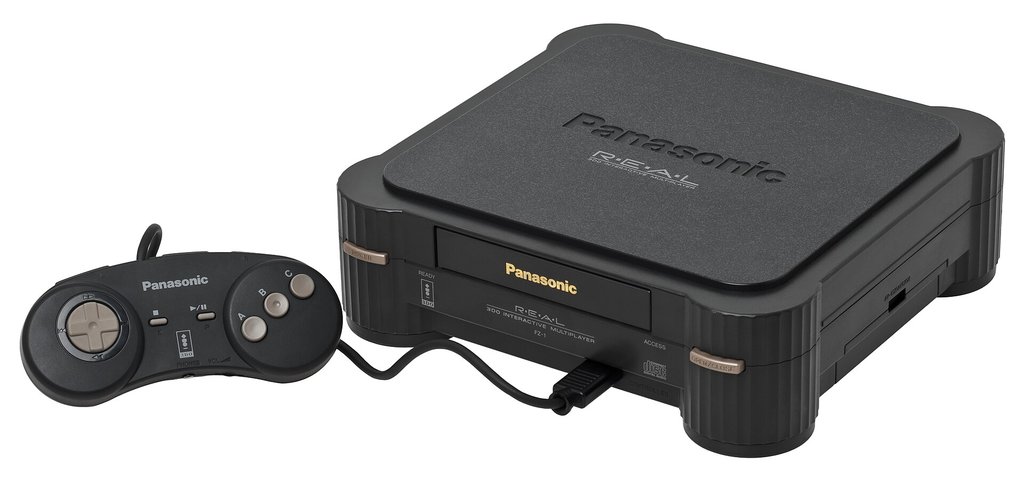
The 3DO Company’s terms were revolutionary in their simplicity. The company designed a standard — the REAL 3DO Interactive Multiplayer specification — and licensed the hardware design to manufacturers, who would build and sell their own machines: Panasonic first, then GoldStar, with Sanyo and others following. The 3DO Company made no consoles and took no hardware profit. Its revenue was the software royalty, set at around three dollars per game — a fraction of the Nintendo and Sega toll — with none of the old regime’s content censorship or manufacturing chokehold. Publishers kept their margins, manufacturers kept their hardware business, and Hawkins’ company would collect its modest slice of an enormous, standardised market.

Read those terms again with modern eyes and they are startling. An open platform. A low, predictable platform fee. Any manufacturer welcome. This is, almost exactly, the settlement the industry eventually reached — through Android, through the PC, and through platform holders who learned to compete on services rather than lockout chips. Hawkins was not wrong about where the business was going. He was early, which in business is a more expensive way of being wrong.
Why the licence needed the price
The model’s elegance contained its trap, and the trap is the part of the story that belongs to economics rather than failure mythology. Nintendo and Sega could sell consoles cheaply — at cost, or below — because the royalty toll repaid them on every game. The 3DO Company had deliberately surrendered that toll. Its manufacturers, Panasonic above all, therefore had to make their money the old-fashioned way: on the hardware itself, at retail, in a box on a shelf next to a Super Nintendo that cost a third as much.
Hence $699. Not greed, not madness — arithmetic. A manufacturer building a cutting-edge CD-ROM machine in 1993, with no software subsidy to reclaim, had to charge what the machine cost. Hawkins spent the launch arguing, correctly, that the 3DO was a new category of home electronics rather than a games console — comparing it to early VCRs and CD players, which had all launched at luxury prices and descended as manufacturing scaled. He was right about the pattern. The market simply declined to wait for the descent, because the games — however good the best of them were — could not yet justify a VCR’s price to a family choosing one box for Christmas.
Hawkins built the platform business the industry would eventually adopt — then discovered that being right ten years early is a debt, not an asset.

The standard that spread anyway
What the standard did achieve deserves its due. Because the specification was licensed rather than guarded, the 3DO became a genuinely international machine: Panasonic in America and Japan, GoldStar in Korea and the West, Sanyo in Japan, and the design licensed onward into arcades, hotels and even the Korean market under local brands. Publishers faced one target and a friendly royalty, and the library they produced — Electronic Arts’ flagship titles, Crystal Dynamics’ originals, Capcom’s finest conversion — was wildly disproportionate to the installed base. The low toll worked exactly as designed. There just weren’t enough machines for the toll to feed on.
The coda is the vindication. Within a decade, the industry’s centre of gravity had shifted to precisely Hawkins’ assumptions: hardware as a platform for other people’s software, platform fees as the real business, openness as a competitive weapon. Valve built an empire on the model. Android put it in every pocket. Even the console makers moved toward it, competing on ecosystems rather than exclusion. The 3DO Company itself exited hardware, became a software publisher, and eventually folded — but the idea it was founded to prove outlived it so completely that we now struggle to remember the toll-booth world it was rebelling against.
That is the right way to remember the $699 machine: not as a punchline, but as a price — the price of a business model arriving before the market that could sustain it, charged to the customers least able to pay it. Hawkins’ licence-to-print-money dream printed no money. It printed the future’s business plan, and let everyone else cash it in.

The road not taken, priced
It is worth pricing the counterfactual honestly, because the model’s defenders and detractors both skip the arithmetic. Had Panasonic been able to launch at $399 — the price the FZ-10 eventually reached a year later, to genuine interest — the 3DO’s first year looks entirely different: the software attach rate the royalty needed becomes plausible, the standard’s spread accelerates, and the PlayStation arrives in 1995 to find an installed base rather than an opening. The gap between those timelines is not vision or execution. It is roughly three hundred dollars of unsubsidised hardware cost, in a single Christmas season. Business models, it turns out, are timing devices — and Hawkins’ was calibrated for a market that would exist by 1996, attached to a machine that had to survive 1993.
The man, briefly
Hawkins himself remains the model’s best exhibit: an Apple alumnus who had defined EA’s artist-first philosophy, served on the front lines of the cartridge wars, and arrived at the 3DO convinced that the industry’s structure — not its technology — was the thing worth redesigning. He raised serious money, recruited serious partners, and persuaded Time magazine to make the machine a cover story. The idea deserved the advocate. It simply also deserved a subsidy, and the advocate’s whole philosophy forbade charging one.
The last word on the model
There is a final irony worth recording. The low royalty that doomed the hardware’s price also guaranteed the library’s quality: developers who kept their margins could afford to make their best games for a tiny audience, which is why a machine that sold in the low millions is remembered for classics at all. The toll booth would never have permitted Star Control II’s voice cast or Road Rash’s soundtrack at those sales figures. The licence made the library. The library is why we are still talking about the machine. Hawkins would probably have taken that trade — eventually, so did the industry.