
This page once served up Turok 2 on Game Boy as a Thanksgiving turkey, and yes, the dinosaur pun was doing most of the work there. Set the joke aside, though, and a more interesting question remains: what actually happens when one of the Nintendo 64’s biggest, bloodiest shooters gets shrunk onto a Game Boy Color cartridge? The answer, released in late 1998, is neither the disaster its reputation suggests nor a hidden masterpiece. It is something stranger and more typical of its era — a completely different game wearing a famous name, built by a small Spanish studio that understood handhelds better than it is usually given credit for, and let down by a handful of design decisions that still sting. Judged fairly, on its own terms, Turok 2: Seeds of Evil for Game Boy Color deserves a proper hearing.
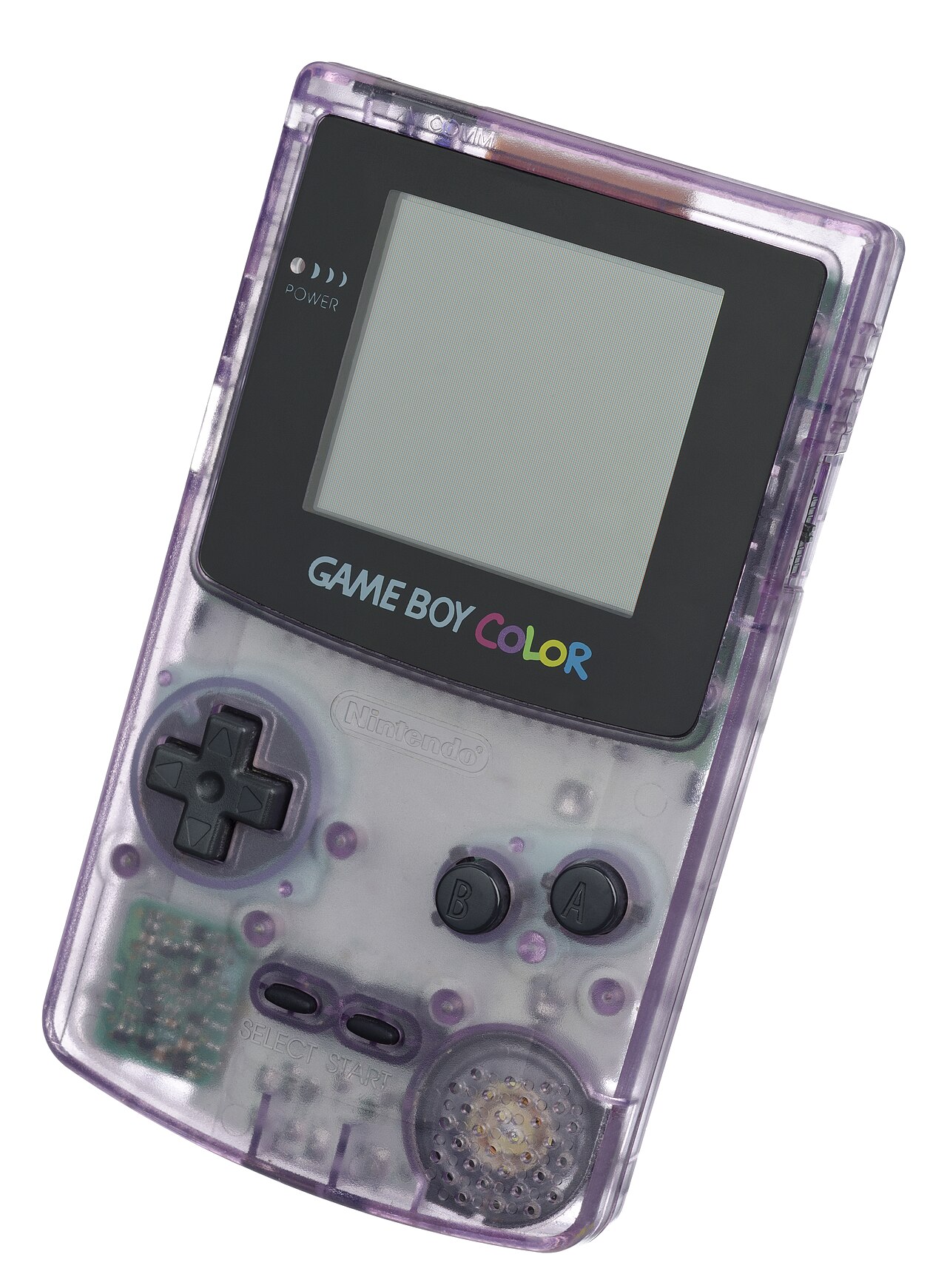
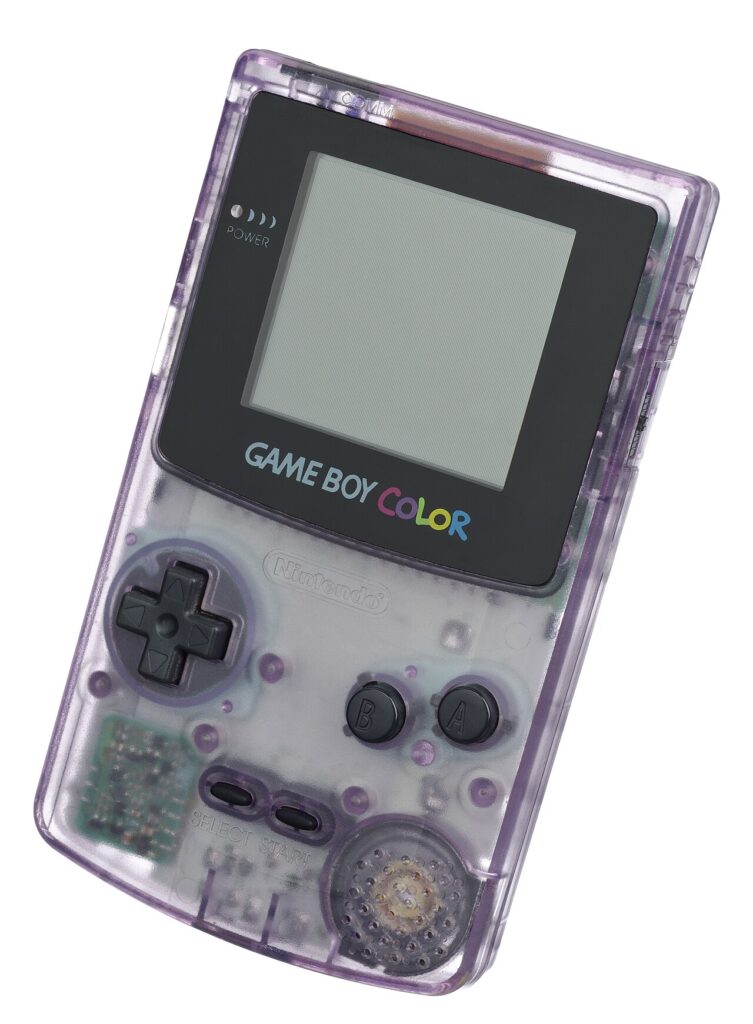
The Game Boy Color, in its translucent Atomic Purple shell — the little machine asked to carry a Nintendo 64 blockbuster in 1998. Photo: Evan-Amos / Wikimedia Commons, public domain.
An impossible brief
Consider what Bit Managers was handed. On the Nintendo 64, Turok 2: Seeds of Evil, developed by Iguana Entertainment, was a showpiece: a sprawling first-person shooter with enormous levels, a small army of weapons including the notorious Cerebral Bore, full voice acting, four-player multiplayer, and an M rating earned through cheerful gore. It was one of the defining big-budget releases of the 1998 holiday season. Acclaim, which published both versions, wanted a handheld companion on shelves at the same time — and the handheld in question had a 160-by-144-pixel screen, two action buttons, and processing power closer to a pocket calculator than to the N64.
There was never a version of this job that involved porting the shooter itself. First-person games on the original Game Boy hardware were curiosities at best, and the Game Boy Color’s modest upgrade — more colour, a faster processor, the same basic architecture — did not change that equation. So Bit Managers, based in Barcelona and already veterans of the first handheld Turok, did the only sensible thing: they threw out the genre entirely and built a 2D side-scrolling action-platformer that shared the N64 game’s hero, setting, and box art, and almost nothing else. The cartridge even ran on the original monochrome Game Boy, in shades of grey, for the many owners who had not yet upgraded.
That decision — adaptation by reinvention — was standard practice for licensed handheld games of the period, and buyers knew it, or quickly learned it. But it set the terms on which the game would be judged, unfairly, ever after: not as a platformer, but as a failed shooter.
What the Game Boy Color version actually does
The story is its own invention. Where the N64 game sends Joshua Fireseed against the Primagen, the handheld plot has him fighting the Amaranthine Accordance, a Dinosoid faction scheming to march an army out of the Lost Land and onto Earth. It is delivered in a few lines of text at the start and largely forgotten afterwards, which is honestly fine — nobody was carrying this cartridge around for the narrative.
The structure underneath is solid enough. There are eight side-scrolling levels and four boss encounters, saved by password rather than battery, and the route through them keeps changing shape. Some stretches are straightforward run-and-gun platforming. Others put Joshua in a canoe paddling downriver, on the back of a galloping velociraptor in an auto-scrolling chase, on a pterodactyl in a flying stage, or fleeing a giant sand worm. There are short underwater sections, hidden passages behind breakable walls, and switches that send you briefly back on yourself — though, to the game’s credit, backtracking stays modest, and defeated enemies stay defeated, which makes retracing your steps painless.
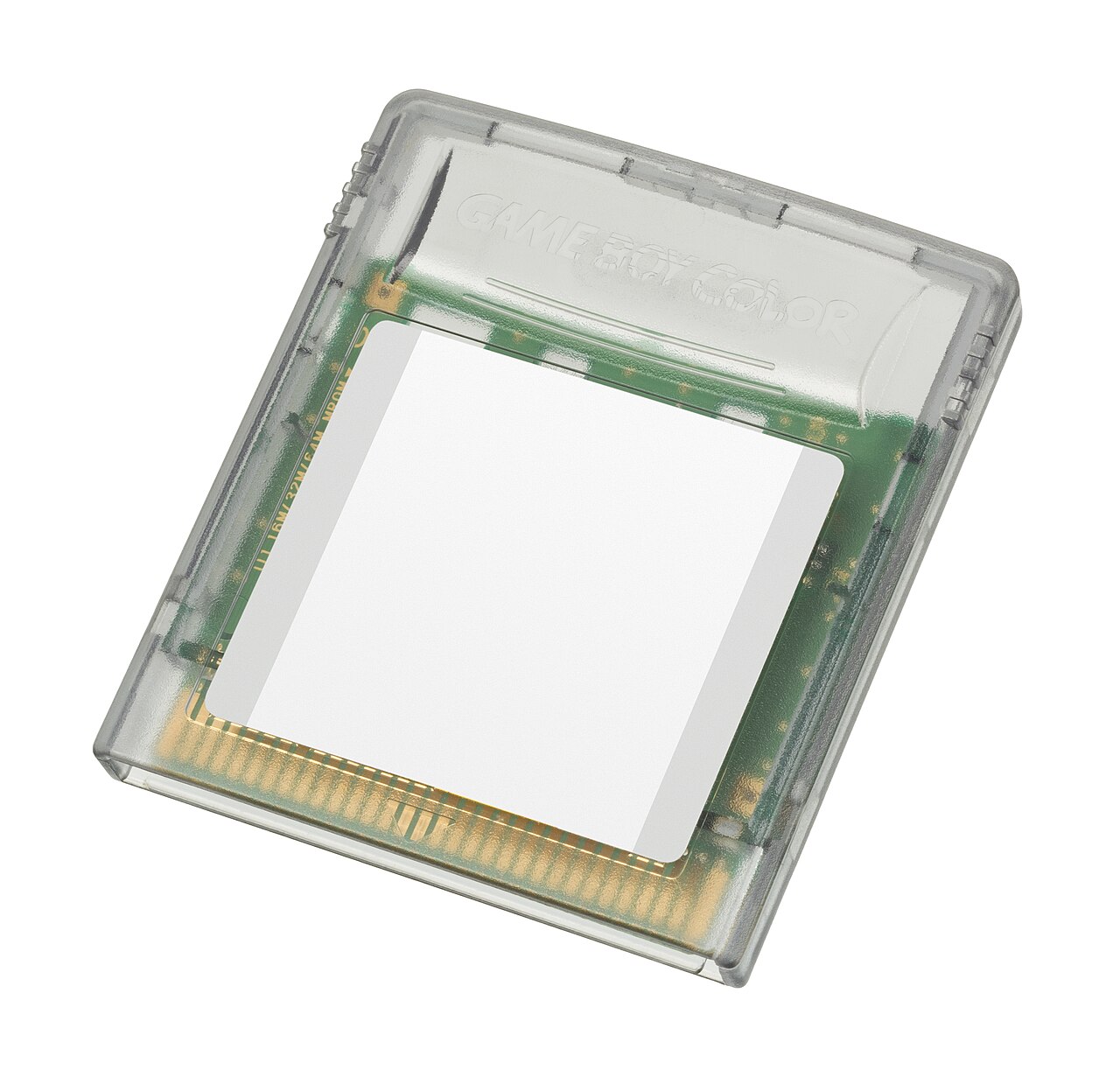
A Game Boy Color cartridge — everything Bit Managers built, the eight levels, ten weapons, and Alberto José González’s score, had to live on one of these. Photo: Evan-Amos / Wikimedia Commons, public domain.
The arsenal is the clearest inheritance from the N64 original. Joshua starts the first level unarmed, with a punch that can only stun, picks up a knife, and gradually builds out a collection of around ten weapons: a bow, a pistol, a shotgun, a machine gun, a grenade launcher, and more besides. You can fire in seven directions, which matters, because enemies lurk above and below as well as ahead. The levels themselves were laid out on graph paper before being rebuilt in a level editor, according to contemporary magazine coverage — an old-fashioned method that shows in their deliberate, hand-placed feel. And the music, by Alberto José González, a veteran of the Barcelona scene who scored the whole handheld Turok run, is a genuine highlight: propulsive, melodic work that later reviewers have singled out as some of the best audio on the system.
Where it genuinely stumbles
A fair hearing is not the same as an acquittal. The game’s first level is a small disaster of communication: you begin unarmed, acquire the knife partway through, and only then discover that progress means turning around and fighting back the way you came, killing everything you stunned on the way in. First-time players routinely marched to the level’s end and stood there, stuck, through no fault of their own. It is the worst possible first impression, and it colours almost every hostile review the game ever received.
The frustrations continue in smaller denominations. Falling from too great a height kills Joshua outright, which turns several long leaps into exercises in pixel-perfect timing. Ledge-grabbing works in some places and not others, with no visible logic separating the two. Weapon-switching — hold Select and tap left or right to cycle — is tolerable with two guns and miserable with ten, especially mid-fight when one runs dry. A few of the late weapons must be charged while standing still, an invitation to be mauled. The pterodactyl sprite is so large, filling a generous slice of the little screen, that dodging incoming fire on the flying stage becomes partly guesswork. None of this is imaginary, and none of it should be waved away: the game’s difficulty often comes from friction rather than challenge.
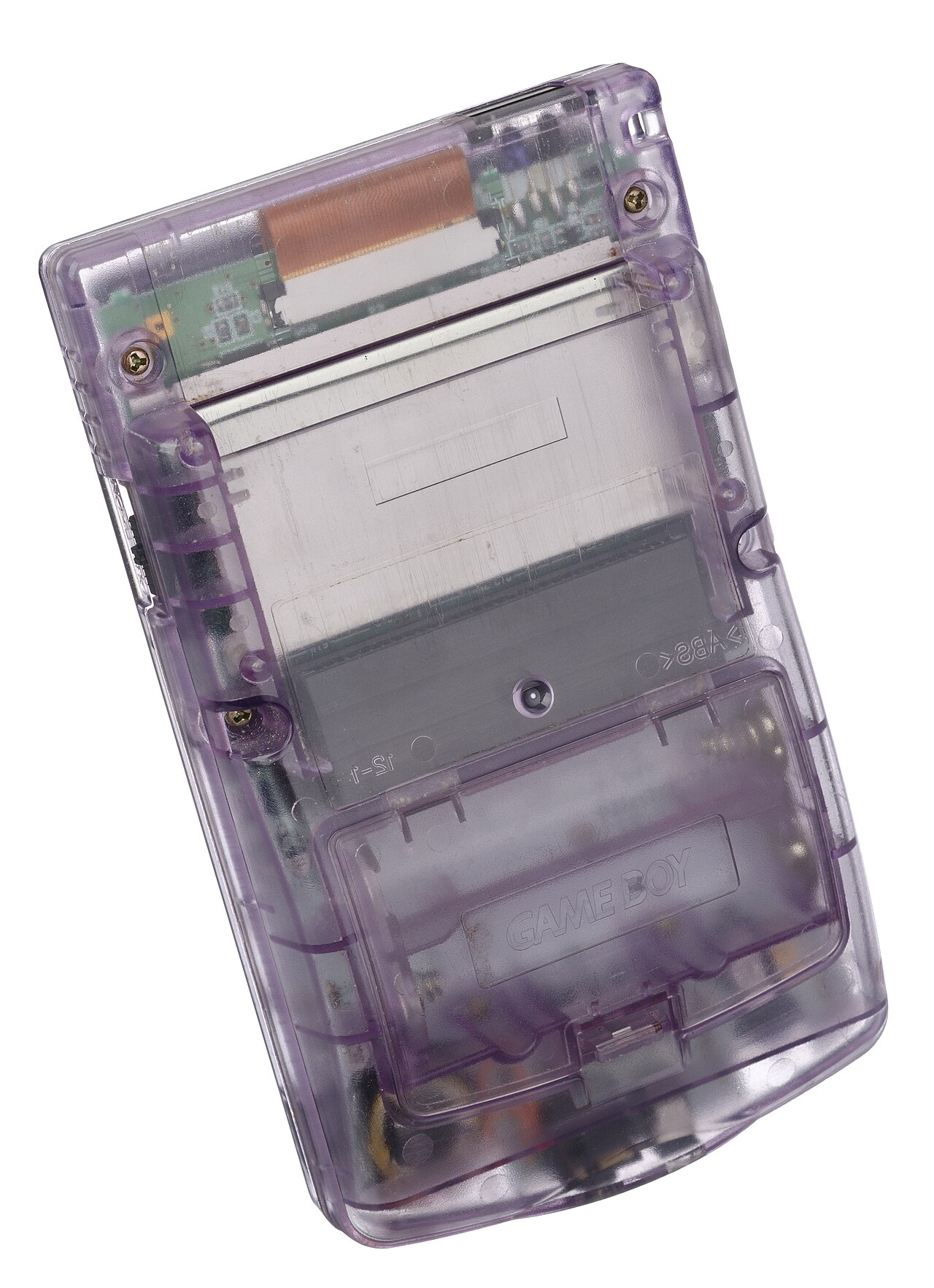
The back of the Game Boy Color. The handheld Turok games were password-saved, so progress lived on paper beside the machine rather than inside the cartridge. Photo: Evan-Amos / Wikimedia Commons, public domain.
Critics at the time landed all over the map, which usually signals a game with real strengths and real flaws rather than a turkey. IGN’s Peer Schneider gave it 5 out of 10, calling it an E-rated, cookie-cutter side-scroller with decent controls and unimpressive visuals. Total Game Boy went lower, at 40 percent, and complained that it bore little relation to the N64 game. Nintendo Power scored it 6.4 out of 10, praising the hero’s wide range of moves while knocking the limited use of colour. And Spain’s Nintendo Acción, reviewing Bit Managers on home turf, awarded 92 out of 100 and praised its length, animation, and tight controls. That spread — from 40 to 92 — is the honest summary: a competent, sometimes clumsy platformer whose reception depended heavily on what the reviewer expected it to be.
One studio, four very different Turoks
The fairest context for this game is its own family. Bit Managers made four handheld Turoks for Acclaim, and no two play alike. The run began with Turok: Battle of the Bionosaurs for the original Game Boy in 1997, a side-view adventure built around exploration — large, interconnected levels, keys and Chronoscepter pieces to hunt down, and an arsenal advertised at fourteen weapons. It is slower and more deliberate than its sequel, and it has aged gracefully in the estimation of players who have rediscovered it.
Turok 2 tightened that formula into a more linear, action-first platformer. Then the studio changed its mind completely. Turok: Rage Wars, in 1999, abandoned the side view for a brand-new top-down engine with movement and jumping in eight directions, across four large worlds, with weapons that could be upgraded and combined. Turok 3: Shadow of Oblivion followed in 2000 on the same engine, mixing top-down stages with vehicle sections and side-scrolling missions — and it was the one the critics finally applauded, with IGN calling it the best Turok on the Game Boy Color and GameSpot praising its balance and variety, even as Nintendo Power noted it could be finished in about an hour.
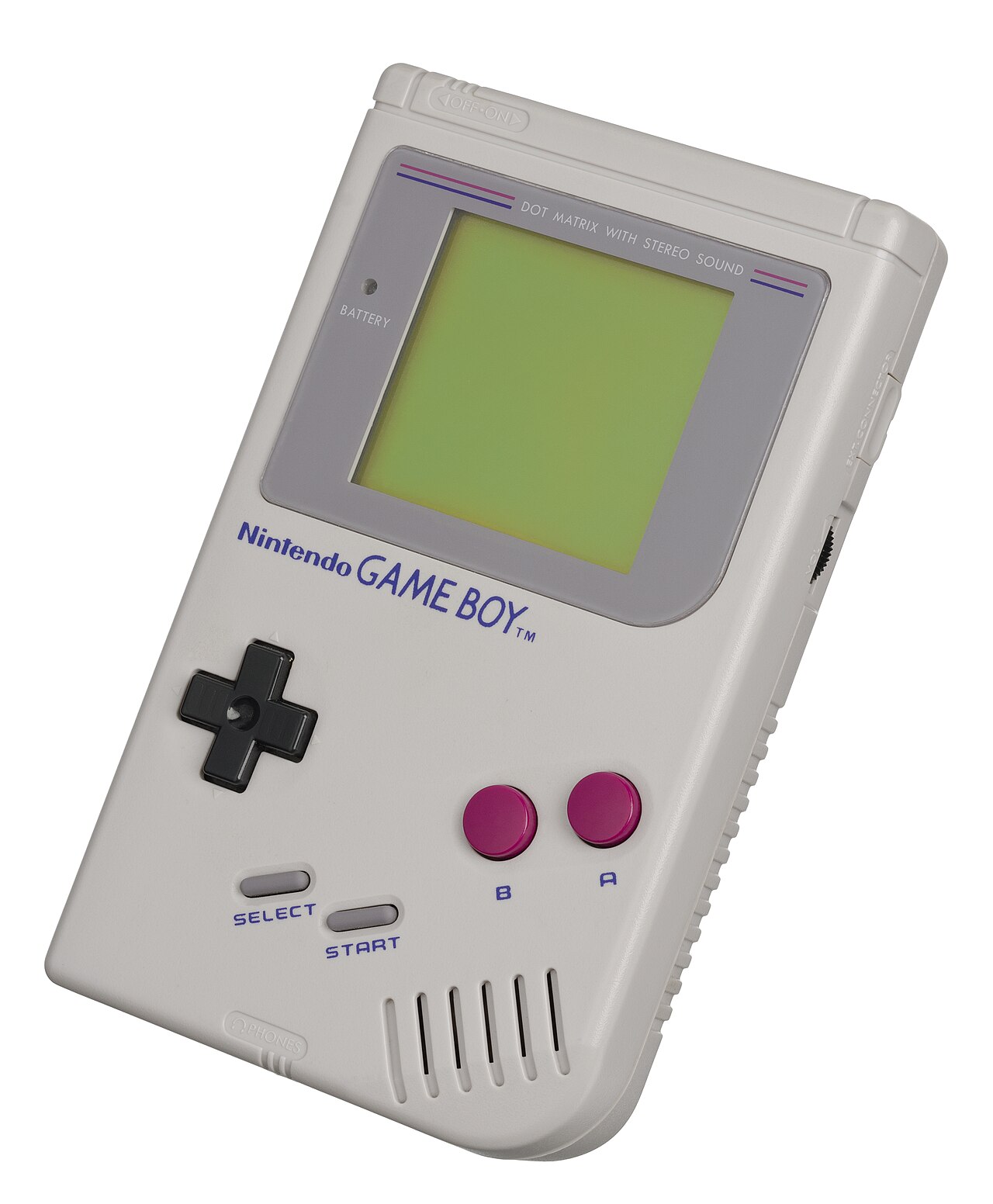
The original 1989 Game Boy. Bit Managers’ Turok run began here with Battle of the Bionosaurs in 1997, and the Game Boy Color Turok 2 still ran on this machine in monochrome. Photo: Evan-Amos / Wikimedia Commons, public domain.
Seen against its siblings, Turok 2 is the transitional member: bolder in set pieces than the first game, less assured in its fundamentals than the two that followed. It is not the family embarrassment; it is the middle draft of an idea the studio kept improving, in public, one cartridge a year.
The verdict: worst game, or wrong measuring stick?
So, is the “worst game” tag earned? As a conversion of the N64 blockbuster, the Game Boy Color version barely exists — no first-person action, no Cerebral Bore, no gore, a different story, a different genre. If that is the test, it fails before it starts, but it is a test no handheld game of 1998 could have passed, and applying it tells you nothing about the cartridge in your hand.
Judged as what it actually is — a licensed side-scrolling action-platformer from a small European studio working to a holiday deadline — it holds up respectably. Eight substantial levels, a generous arsenal, inventive changes of pace between foot, canoe, raptor, and wing, a fine score, and controls that most reviewers, even the sceptical ones, described as decent. Set against that: a genuinely botched opening level, instant-death falls, inconsistent ledge-grabs, and a weapon wheel that fights you in the late game. That is the profile of a middling, flawed, occasionally enjoyable platformer — the kind of game a rental weekend was made for. The worst game for Thanksgiving? Only if the turkey on the table is doing something truly unforgivable. Turok 2 on Game Boy is no masterpiece and no disaster. It is a small game that was asked to be a big one, and the most honest thing you can say about it, more than twenty-five years on, is that it coped better than the joke suggests.