
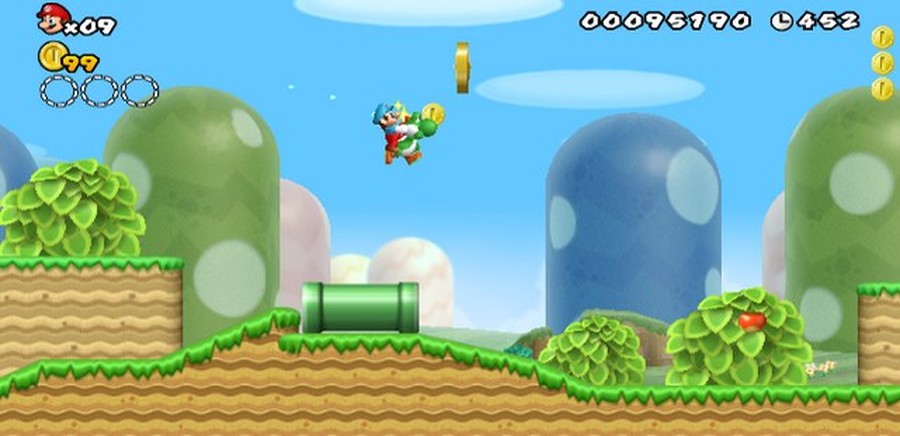
There is a special milestone in every beloved game’s life: the day its own title becomes a lie. New Super Mario Bros. Wii launched in November 2009 with ‘New’ printed proudly on the box, a promise that the side-scrolling Mario of childhood had been dusted off for the Wii generation. Enough birthdays have now passed that the joke writes itself – the new one is old, the modern revival is a retro game, and players who queued for it as teenagers are explaining it to their own children. Time, as any Koopa could tell you, is the one enemy Mario cannot stomp.
Strip away the calendar joke, though, and what remains is one of the most important Mario games ever made. This was the first home-console 2D Mario since Super Mario World, it sold more than thirty million copies, and it rewired the series around a single, glorious idea: four people, one screen, total chaos. Revisiting it now is not an exercise in nostalgia for nostalgia’s sake. It is a chance to watch the exact moment Mario stopped being a solo performance and became a team sport with friendly fire.
The long wait for a proper homecoming
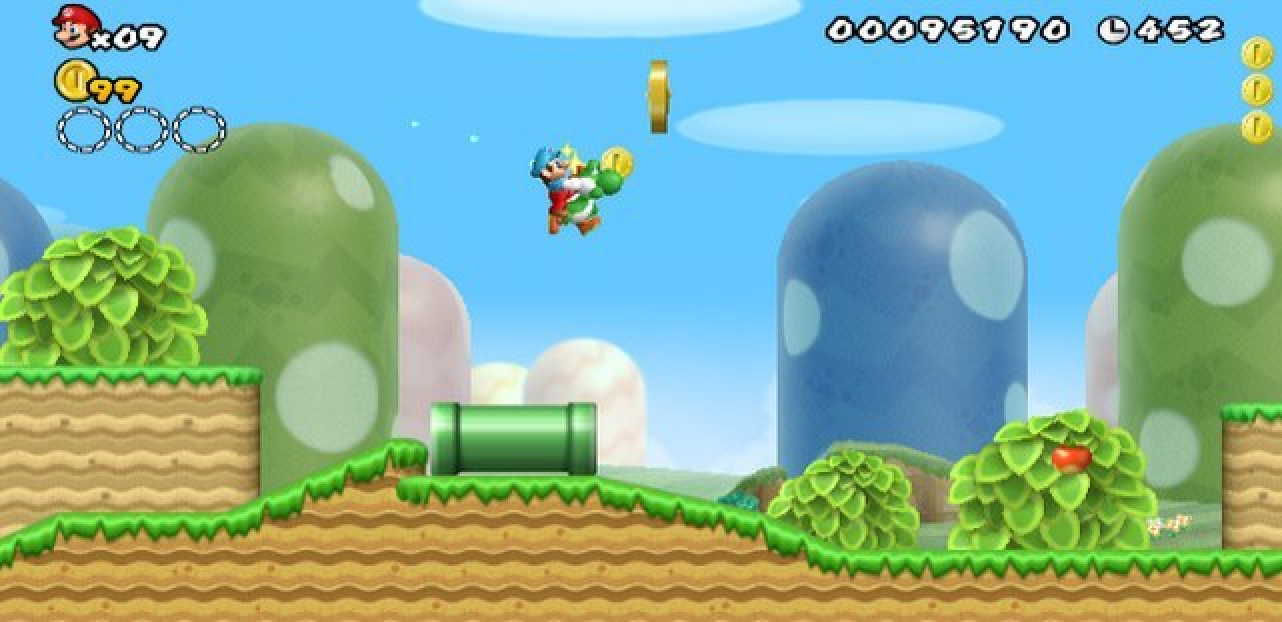
Younger players may not realise how starved the faithful were. The Nintendo 64, GameCube and early Wii years belonged to 3D Mario – magnificent, revolutionary, but a different discipline. Side-scrolling Mario survived on handhelds, and the 2006 DS game New Super Mario Bros. proved the appetite was enormous. Still, a full television-sized 2D Mario, built for the big screen and the big console, had been absent since 1991 in the West. When the Wii version was announced, it felt less like a sequel and more like a restoration.
Nintendo understood the assignment. The Wii game kept the DS revival’s clean readability – big sprites, bold colours, worlds arranged in the classic grass-desert-water grammar – and scaled it for a console that sat in more than a hundred million homes. This was deliberate, almost stubborn accessibility. No camera to wrestle, no analogue subtleties: run, jump, stomp, survive. The most advanced controller in games had a flagship platformer you could play holding it sideways like an old NES pad.
Four players, one screen, zero friendships guaranteed
The revolution was multiplayer. Up to four players – Mario, Luigi and two Toads – shared every level simultaneously, bouncing off each other’s heads, grabbing and hurling one another, competing for coins and the flagpole while supposedly cooperating. It remains one of the funniest designs Nintendo has ever shipped, because it refuses to decide whether it is a partnership or a contest. The bubble system, which let a fallen player float back to safety, kept families in the game; the ability to pick up a partner and carry them towards a pit kept families honest.
Every household developed its own treaties. No throwing near lava. The Propeller Mushroom belongs to whoever reaches it first. Dad is not allowed to bubble on purpose during the hard jumps. These unwritten constitutions are the real legacy of New Super Mario Bros. Wii: it generated stories in a genre that had traditionally been about solitary mastery. Speedrunners still chase its perfect lines, but for most of its thirty million owners, the memory is noise – a sofa full of people shouting contradictory directions at the same screen.
The Super Guide and a quiet revolution in kindness
Buried in this party game was one of Nintendo’s most humane inventions. Die enough times on a level and the Super Guide appeared: Luigi would offer to play the stage for you, letting a stuck player watch the solution and skip past with dignity rather than surrender the game entirely. Miyamoto’s team called the philosophy behind it a way to keep difficulty honest for veterans without exiling beginners, and it anticipated the assist modes modern games now wear as badges of pride.
It is easy, from here, to see how radical that was in 2009, when difficulty was still widely treated as a moral quality. New Super Mario Bros. Wii said the opposite: the point is that everybody reaches the fireworks at the end of the level, by whatever road. Combined with the mid-level checkpoints and the bubble rescues, it made the hardest 2D Mario in years also the most welcoming – a combination the series’ later entries, from 3D World to Wonder, have kept refining ever since.
Propellers, penguins and the Wii era’s toybox
The new power-ups tell the story of a design team enjoying itself. The Propeller Mushroom turned a spin of the Wii Remote into a helicopter climb, one of the few motion inputs in a game that mostly, wisely, left waggle alone. The Penguin Suit slid across ice and threw frozen enemies. The Ice Flower finally let Mario do to Koopas what Koopas had been doing to everyone’s patience since 1985. Each toy arrived with the confidence of a series that knew its own physics better than anyone alive.
And the difficulty curve had teeth. The sunshine of the early worlds gives way to precision platforming, the Koopalings returned as bosses after a long absence, and the unlockable ninth world demanded the star coins completionists had been hoarding. This was no dumbed-down party disc wearing a Mario costume. It was a full, demanding, secret-stuffed Mario campaign that happened, brilliantly, to let three extra people ride along and ruin it beautifully.
The siblings it left behind
The game’s success also quietly redrew the family tree. Its DS predecessor had restarted 2D Mario; the Wii entry made that restart a dynasty, leading directly to a Wii U sequel and, eventually, to the wild reinvention of Super Mario Bros. Wonder, whose designers openly wrestled with the New series’ long shadow. Trace the line and a pattern emerges: each generation, 2D Mario is pronounced finished, formulaic or old, and each generation it outsells the obituary. The Wii instalment is the hinge of that whole modern history, the moment the series proved it could anchor a console the way it had in the NES years.
It also remains, for many families, the definitive version precisely because of its hardware. The sideways Wii Remote, with its chunky two-button simplicity, is the friendliest controller 2D Mario has ever had – no shoulder buttons to explain, no stick to drift, nothing between a grandparent and the jump button. Later editions added features, characters and polish. None improved on a controller a first-time player could understand before the first Goomba arrived. Sometimes a game becomes old without becoming dated, and the difference, in this case, can be held in one hand.
Old, new, and entirely itself
So yes: New Super Mario Bros. Wii is now Old Super Mario Bros. Wii. It qualifies for retro shelves, retro prices and retro think pieces – this one included. But the label fits awkwardly, because the game never relied on novelty. Its pleasures are the oldest in the medium: a perfect jump arc, a hidden block, a friend laughing too hard to hold the controller straight. The ‘New’ on the box was never really about the year. It was about a promise that this formula, renewed for whoever is sitting on the sofa, does not age.
Play it today and the strangest thing is how little translation it needs. A child who has never seen a Wii picks up the sideways remote and is playing in seconds, then bouncing off a parent’s head within the minute, then demanding a rematch. Two generations, one screen, same argument about who threw whom into the lava. Some games become retro. This one just became a family heirloom with a misleading name.