
Another visitor. Stay awhile. Stay forever. If you owned a Commodore 64 in the mid-1980s, those words are probably burned into your memory in a crackling, robotic voice — and the remarkable thing is that they were coming out of a home computer at a time when most games communicated in beeps. Impossible Mission, released by Epyx in 1984 and designed by Dennis Caswell, was not just a great platform game. It was a demonstration of what the C64 could do when a talented designer treated every part of the machine — the SID chip, the sprite hardware, the memory map — as an instrument. More than forty years on, it remains one of the most perfectly judged games on the system: tense, funny, frightening and endlessly replayable.
The setup is pure Cold War pulp. Professor Elvin Atombender has seized control of a missile system and intends to end the world unless his demands are met. You are Agent 4125, dropped into his underground stronghold with six hours on the clock to search the complex, recover the pieces of a punch-card password puzzle, and reach the control room before the countdown ends. There is no scrolling world and no map screen in the modern sense. The stronghold is a grid of rooms connected by lifts, and you learn its geography the hard way — by running, jumping, falling and occasionally being electrocuted by a hovering robot for your trouble.
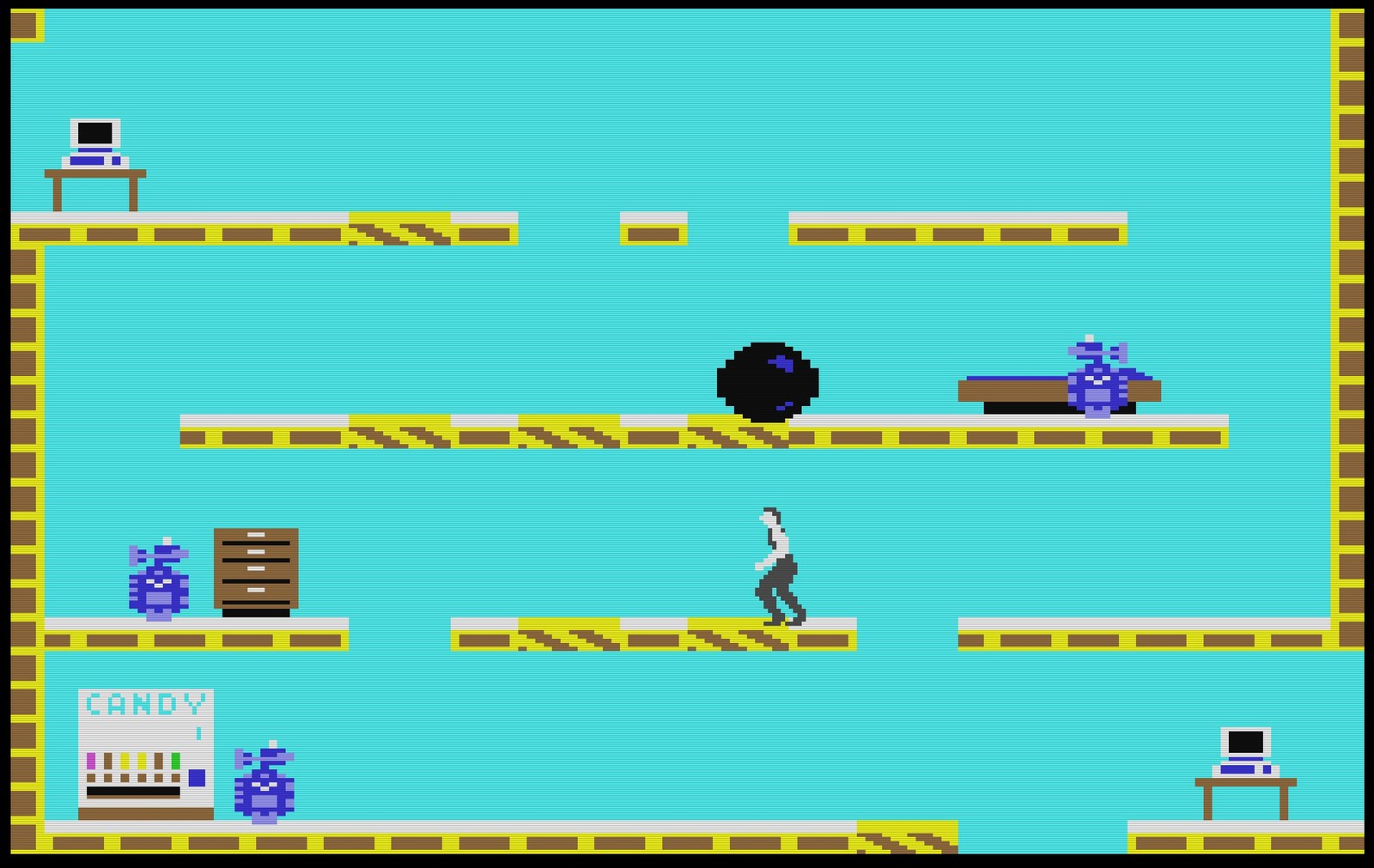
A somersault that changed platform games
The first thing anyone notices is the animation. Your agent does not scuttle around like a typical 1984 sprite. He runs with a genuine stride, launches into a graceful somersault over gaps and robots, and searches furniture with a little rummaging shuffle while a progress bar fills. Caswell’s character animation was years ahead of the field, and it is not decoration — it is the game. Because the somersault has a real arc and real commitment, every jump is a decision. You cannot change your mind mid-flight. When a robot is trundling towards you and the gap in the floor is just behind it, the game becomes a tiny drama of timing: wait, bait it closer, then flip clean over its head and land running.
The rooms themselves are single-screen obstacle courses built from platforms, lifts and gaps, patrolled by two kinds of robot. The simpler ones pace back and forth and zap anything in line of sight. The clever ones sense you, speed up, and follow. Falling into a pit or touching a robot does not take a life in the arcade sense — it costs you ten minutes of your six hours, which is a far more elegant punishment. Time is the only health bar Impossible Mission has, and it makes every mistake feel expensive without ever throwing you back to the start. Blackouts, caused by searching certain objects, freeze you in place and waste still more precious minutes.
Searching, snoozing and the puzzle at the heart of it
Strip away the platforming and Impossible Mission is a game about searching desks. Every room contains furniture — sofas, filing cabinets, fireplaces, even toilets — and hidden inside some of it are the punch-card pieces that form the password, along with useful snoozes and lift resets. Snoozes temporarily disable the robots in a room; lift resets restore moving platforms to their start positions. Both live on your wrist-computer, a chunky interface you call up with the fire button, where you also assemble the puzzle.

That puzzle deserves its reputation. Each punch-card piece is a pattern of holes that must be rotated and flipped to interlock with others, building four complete cards. It is a genuine logic puzzle layered inside an action game, and the game shuffles the stronghold layout, the room contents and the puzzle pieces every time you play. That randomisation was radical in 1984 and it is the main reason the game never went stale: you could not memorise your way through it. You had to actually get good at the searching, the jumping and the puzzling, because the stronghold would be different tomorrow.
“Destroy him, my robots”
Then there is the voice. Impossible Mission’s sampled speech — delivered through the SID chip — was a sensation. Atombender taunts you over the stronghold tannoy, ordering his robots to destroy you, and the grainy, Dalek-like delivery is perfectly in keeping with the B-movie plot. Synthesised speech existed before, but hearing a home computer talk this clearly, as part of the drama rather than a novelty title screen, felt like magic. The rest of the sound design is just as sharp: the hum of the lifts, the zap of a robot’s discharge, the agent’s very human scream when he falls down a shaft. That scream, incidentally, still startles people who have played the game for decades.
Caswell packed all of this onto a single load from tape or disk, with the whole game running in one continuous session — no multi-load, no waiting between rooms beyond the lift ride. On a machine where multi-load games could leave you staring at a border-flash for minutes, that seamlessness mattered. The stronghold felt like a place, not a series of levels, and the clock gave it a pressure that level-based games rarely achieved.

How it plays today
Beautifully — with one honest caveat. The control scheme is pure 1984: one joystick, one button, and diagonal pushes to search and somersault. It takes ten minutes to stop jumping when you meant to search, and then it clicks and never unclicks. The difficulty is real but fair; six hours of game time sounds generous until blackouts and robot zaps start eating it, and finishing the game with under an hour left is a properly sweaty achievement. Modern players raised on checkpoints may bristle at assembling most of the puzzle and running out of time, but the short session length — a full run is well under an hour of real time — means defeat never feels like theft.
It also helps that the presentation has aged so gracefully. The rooms are clean and readable, the colour palette is moody without being murky, and that animation still draws the eye. Plenty of C64 games are impressive for their time. Impossible Mission is impressive, full stop.
The sequel, the remakes and the legacy
Impossible Mission’s success made a sequel inevitable, and Impossible Mission II arrived in 1988 with a new stronghold of towers, more robot types and the same searching heart — a good game that inevitably lacked the original’s shock of the new. The original, meanwhile, never really left: it has been re-released in compilations, on retro handhelds and mini consoles, and in an officially licensed remake that brought the somersault to modern platforms. Its fingerprints are on everything from later puzzle-platformers to the modern roguelite habit of shuffling the dungeon between runs. Caswell himself moved on to other Epyx projects, but this is the game his name will always summon first — usually accompanied by somebody doing the voice. Another visitor. You know the rest.
Verdict
Impossible Mission is the complete package: a randomised stronghold that rewards skill over memory, animation that still embarrasses later games, sampled speech that became legend, and a puzzle heart beating inside a platform game. Dennis Caswell made a handful of excellent games, but this is the one that defines him — and for many owners it defined the Commodore 64 itself. If you are building a C64 library from nothing, start here. Stay awhile. Stay forever.