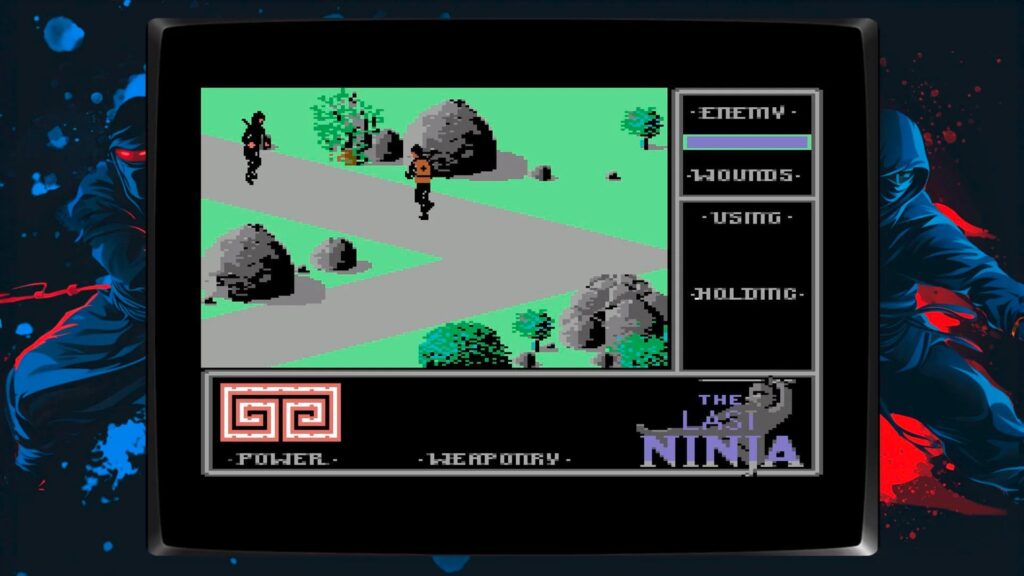
Some games sell a computer. The Last Ninja, released by System 3 in 1987, felt like it justified the entire Commodore 64. Here was a game that looked like a painting, sounded like a film score and played like nothing else on the machine — an isometric action adventure set in feudal Japan that pushed the C64’s graphics and sound hardware so hard that rival developers reportedly studied it just to work out how it had been done. It became one of System 3’s defining releases and one of the best-selling C64 games of all time. Replaying it today, the gloss has not faded — but neither has the famous difficulty, and an honest review has to talk about both.
You play Armakuni, last survivor of a ninja clan wiped out by the forces of the evil shogun Kunitoki. Your quest carries you from the wilderness and wastelands, through gardens and mountains, into Kunitoki’s palace itself, gathering weapons and objects, solving environmental puzzles and fighting guards who get smarter and better armed the deeper you go. It is a quest in six large stages, each a maze of isometric screens connected in a geography you have to learn by walking it.

Presentation that reset expectations
Start with the obvious: this game is beautiful. The isometric backdrops — credited to the System 3 team with artwork that made full use of the C64’s multicolour modes — are dense with detail: bamboo groves, ornamental gardens, waterfalls, shrines, palace interiors with patterned screens. Every screen is composed like a little diorama, and the colour work is masterful, using the machine’s muted palette to suggest wood, stone, water and foliage instead of fighting against it. Character sprites are small but characterful, and Armakuni’s animation — running, somersaulting, swinging a sword or nunchaku — is fluid enough to sell the martial arts fantasy.
Then the music starts. The soundtrack, by Ben Daglish and Anthony Lees, is one of the great SID scores. Daglish’s title and in-game themes blend pentatonic, Eastern-flavoured melodies with the SID’s grit, changing character between stages and giving the whole quest an atmosphere no other C64 game matched at the time. It sits firmly in the golden era of C64 music alongside Rob Hubbard and Martin Galway, and for many players the tunes are the first thing that comes back. This is a game people hum.
Fighting, finding and figuring it out
The Last Ninja is three games woven together. There is exploration: screens hide weapons — sword, staff, nunchaku, shuriken, smoke bombs — and quest objects in scenery you must search by standing in the right spot and probing. There is puzzle-solving, usually of the find-the-object, use-it-here variety, sometimes pleasingly lateral. And there is combat, conducted with a distinctive control scheme: hold the fire button and push directions for strikes and blocks, with different moves depending on your equipped weapon.

Combat is where modern players will either settle in or bounce off. Enemies must be worn down with well-aimed hits while you manage your own health, and the isometric perspective makes judging distance an acquired skill. Attacks that look connected can whistle past; a guard’s staff seems to have a reach yours lacks. Persevere and a rhythm emerges — close, strike, retreat — but the game makes you earn that rhythm. The same applies to the notorious precision jumps over water and hazards, where a misjudged take-off from an isometric angle means instant death. The Last Ninja was always a hard game. In 1987 we called that value for money.
The structure of the quest
What lifts the game above a pretty fighting adventure is its sense of progression. Each stage introduces its theme and its tools; weapons found early remain useful; the difficulty curve of the guards mirrors your growing arsenal. The palace stages in particular feel like an infiltration, full of screens that reward patience. Loading between stages on the original tape version was a genuine pause — the multi-load structure was the price of all that art — but on disk, cartridge re-release or modern flash storage the flow is smooth, and each stage loads in as a fresh chapter.
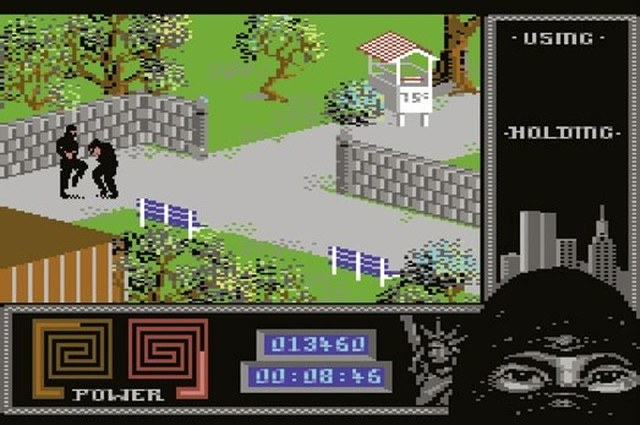
It is also worth saying how much game there is. Six stages of hand-drawn isometric screens, each requiring exploration, item hunting and several fights, made The Last Ninja a weekend-consuming quest in an era of forty-minute arcade conversions. Magazines of the day, including ZZAP!64, greeted it with the kind of scores reserved for landmarks, and the public agreed — it topped charts and spawned two sequels on the C64, The Last Ninja 2 taking Armakuni to modern-day New York.
How it plays today
With patience, superbly. The controls demand a session of adjustment — the fighting system in particular is a dialect you have to learn — and the isometric jumps will claim lives that feel unfair until you internalise the angles. But the quest structure, the exploration and above all the atmosphere remain completely absorbing. Play it on hardware or a good replica with a proper joystick, turn the volume up, and give it the evening it asks for. This is not a game to sample for five minutes; it is a place to spend time in.
One practical tip for newcomers: draw a map. The stages loop and interconnect in ways that are obvious once charted and baffling before. Players in 1987 covered school exercise books with these maps, and honestly, that is part of the pleasure.
The sequels and the long shadow
Success on this scale demanded continuation, and System 3 delivered two of the most anticipated sequels of the era. The Last Ninja 2 (1988) moved Armakuni to contemporary New York — rooftops, Central Park, a drugs baron’s empire — and repeated the trick of the original with even more lavish presentation, while Last Ninja 3 (1991) returned to a mystical setting and pushed the presentation further still, arriving late in the machine’s life to an audience that had largely moved on. The trilogy is best played in order: the original’s quest structure is the purest, and its stages are the ones that lodge in the memory. Beyond the sequels, the game’s influence ran through every isometric adventure that followed on 8-bit machines — developers chased its look for years — and its soundtrack has been remixed, orchestrated and performed live by C64 music acts ever since, Daglish’s themes proving as durable as the game itself.
It is also a game that rewards the right hardware. The fighting system was designed around a proper micro-switched joystick, with distinct directional pushes for its strikes and blocks; on a sloppy modern pad the dialect described earlier becomes harder to learn. Give it the stick it was built for, and what felt like imprecision reveals itself as choreography.
Verdict
The Last Ninja is System 3’s masterpiece and one of the essential Commodore 64 games: a gorgeous, atmospheric, demanding action adventure whose presentation reset what owners expected from the machine and whose soundtrack still ranks with the SID’s finest. Its difficulty and idiosyncratic combat keep it just short of universal — but for anyone willing to meet it on its terms, this is as good as 8-bit adventure gaming gets.