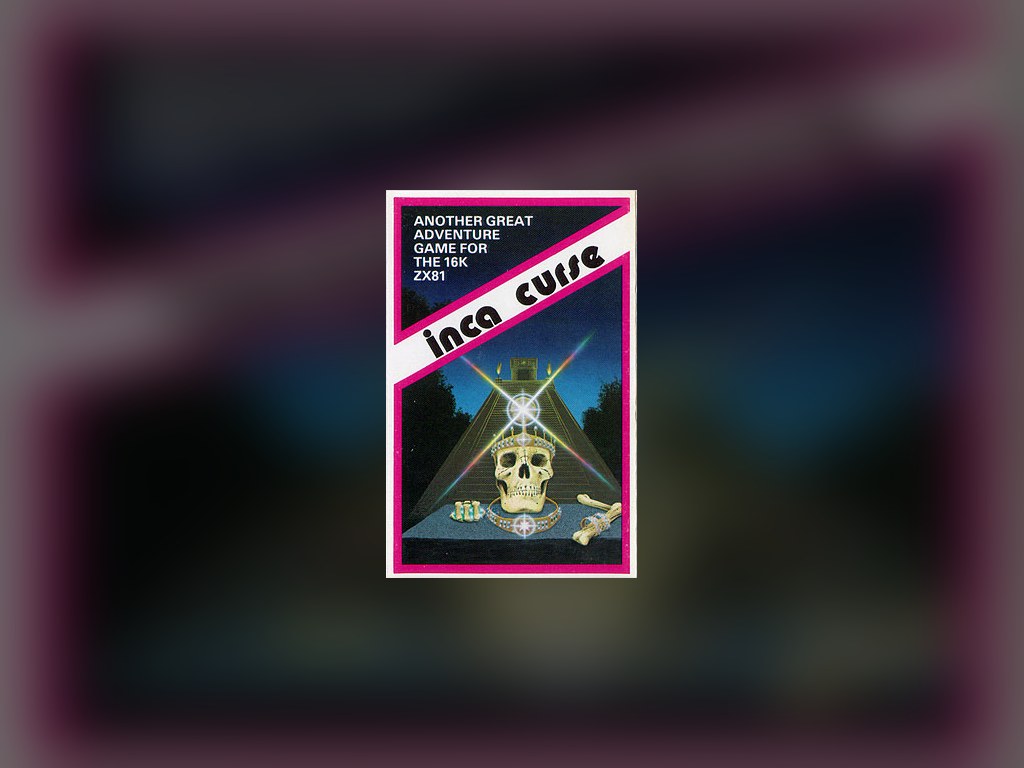
At a glance: Adventure B: Inca Curse · ZX81 · Artic Computing, 1981 · Text adventure · Score: 7.5/10
The second of Artic Computing’s lettered adventures swaps space for jungle. Adventure B: Inca Curse, published for the ZX81 in 1981, begins in a South American clearing beside an undisturbed Inca temple and sets the oldest objective in the adventure book: get inside, loot the place thoroughly, and get back out alive. Inside are treasures, each with a points value; a sacrificial chamber; a fire room; a pool; and the full apparatus of traps that the genre’s pioneers deployed against the greedy. Collect as much as you can carry and return to the jungle clearing to finish. You need only escape with a single treasure to complete the game — a mercy the design extends to beginners while quietly daring everyone else to go back in for one more.
The authorship matters. Charles Cecil joined Artic shortly after its founding and wrote Adventures B through D — meaning the man who would later co-found Revolution Software and create Broken Sword began his commercial career here, in capital letters, in a temple full of other people’s gold. Inca Curse is, by the series’ own trajectory, “a rather larger and more sophisticated game than its predecessor,” as Spectrum Computing’s retrospective put it: a bigger map, a score built from multiple treasures rather than a single goal, and the treasure-hunt structure that would become one of the text adventure’s two great templates, alongside the rescue quest its predecessor had used.
Greed, quantified
The treasure-hunt design changes the player’s relationship with the world. Planet of Death gave you a ship to recover; Inca Curse gives you a score to maximise, and with it the genre’s essential moral engine: risk, priced. Every treasure left behind is points forgone. Every treasure taken is weight, danger and time. The temple’s named horrors — the sacrificial chamber and the fire room advertise themselves honestly enough — are balanced by the game’s relative kindness: there are, as Spectrum Computing noted, “not too many instant death traps,” and the game is fairly easy to finish in its minimal form. The challenge is completion with honours. It is the difference between surviving the temple and emptying it, and it gives a short game a long tail: the perfect run, all treasures out, becomes the real objective for anyone playing twice.
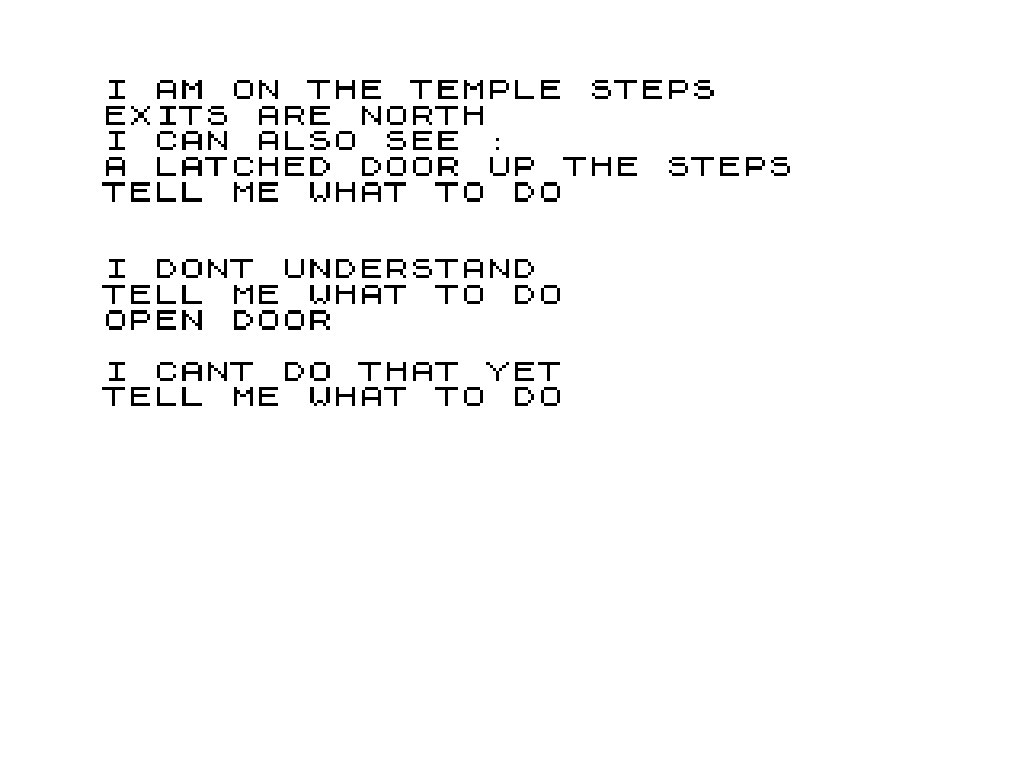
The machinery underneath remains pure Artic: a two-word verb-noun parser with a limited vocabulary, terse location descriptions, no graphics of any kind, and instructions that must sometimes be split across commands because the parser cannot hold a sentence with an instrument in it. BREAK DOOR and WITH ROCK are separate thoughts. Later reviewers, looking back from the era of Level 9 and Magnetic Scrolls, found the flaws easy to list — and then usually conceded the contemporary point: for 1981, on a ZX81, this was a reasonably good game, and for many buyers it was the first fictional place they ever robbed.
One treasure gets you out alive. All of them get you remembered. Inca Curse priced greed in points and let the player set the exchange rate.
The temple that taught a designer
There is a temptation to read Inca Curse only as a fossil — the young Cecil, the two-word parser, the all-caps jungle. Resist half of it. The other half is genuinely playable archaeology: a compact map with a real sense of interior geography, a scoring system that shapes behaviour, and the series’ widening ambition visible in every room. When the Spectrum arrived, Artic ported the whole sequence across — the Spectrum versions appearing around the same time — and B’s temple followed A to the Commodore 64 and Amstrad CPC in due course. The ZX81 original remains the leanest version of the idea: a jungle, a temple, a bag, and a moral question about how much gold is enough.

It is also, quietly, the template for a thousand later treasure runs in British gaming, from school-programmed type-ins to the looting loops of games made with budgets a thousand times its size. Cecil’s career is the famous thread, but the game’s own thread matters too: this is where Artic’s alphabet learned to count.
The temple, room by room
The surviving descriptions of the temple’s interior read like a gazetteer of early-adventure set design, and they reward a slow tour. There is a sacrificial chamber, whose purpose the player may contemplate from a safe distance. There is a fire room and a pool — elements as puzzles, the genre learning to weaponise geography. And there are treasures distributed through the complex with points attached, the whole place laid out as an argument between thoroughness and survival. The published walkthrough-summary of the game, preserved in the modern databases, is disarmingly simple — enter, loot, return to the clearing — and that simplicity is the design’s maturity showing: where Planet of Death’s spaceship was a single coveted object, Inca Curse’s temple is a portfolio, and the player’s skill is portfolio management under threat of sacrifice.
Two smaller period details deserve rescue. The first is the hidden advertisement for another product tucked into the game, which Spectrum Computing’s retrospective noted as a nod to its ZX81 ancestry — Easter eggs in 1981, in a temple, in capitals. The second is the all-caps presentation itself, retained from necessity on the ZX81 and carried into the Spectrum ports as a birthmark. Later adventures would learn lowercase, proportional fonts and eventually pictures. Inca Curse’s temple speaks in a shout because its first machine could not whisper, and the shout — terse, urgent, faintly military — suits a game about robbing the dead in a hurry.
Playing it in 2026
Inca Curse survives completely in the archives, in both Artic and Sinclair Research dress, and an evening in emulation makes its period strengths and its period ceiling equally plain. Map it on paper, as its first players did — the temple rewards cartography, and the clearing you must regain gives every expedition a shape: out, down, loot, back. First-time players should take the game’s own mercy seriously and escape with a single treasure to see the ending, then return for the full clear, which is where the design lives. The parser will refuse some perfectly reasonable sentences; split them, simplify them, and remember that two words at a time was not a failure of imagination in 1981. It was the size of the world.
Verdict
Adventure B: Inca Curse takes Planet of Death’s engine and gives it a better game: a treasure hunt with a priced conscience, a temple worth robbing twice, and Charles Cecil’s first commercial adventure writing. The parser is terse, the descriptions terser, and the instant deaths — mercifully — rationed. As a piece of 1981, it is exemplary. As a game, it is still a pleasant evening’s burglary.
Score: 7.5/10 — Artic’s alphabet learns to count: a compact, greedy, historically rich temple raid.