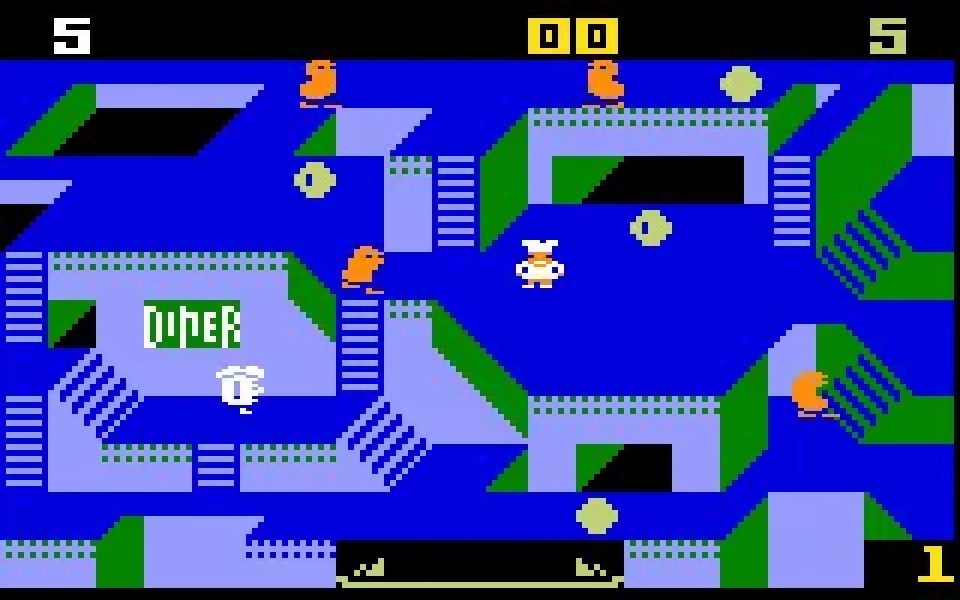
The Intellivision’s canon is well patrolled — Astrosmash, BurgerTime, the D&D games, Utopia — but the console’s second shelf is where the surprises live: sequels nobody asked for that turned out brilliantly, originals that never got their magazine covers, and late releases on a dying system that deserved a bigger audience than history gave them. These are ten genuine Intellivision releases the best-seller lists forgot. None duplicates a standalone review elsewhere in this wave; prices are deliberately not quoted, because the market moves, but each entry is honest about how hard the hunt is.
1. Diner

The BurgerTime sequel nobody played, because it arrived in 1987 on a console the shops had abandoned. Diner returns Peter Pepper to work — the food has come alive in a diner and must be kicked, rolled and dropped onto plates across isometric, multi-level kitchens that scroll and stack in ways the original never attempted. The isometric view gives the burger-building loop a whole new spatial grammar, the rogue ingredients are quicker and meaner, and the production values — this was late-era INTV, with ex-Mattel talent behind it — are as high as anything on the system. It is scarce, it is sought after, and minute for minute it may be the most purely fun maze-action game the Intellivision ever got. The hunt is hard; the reward is real.
2. Thin Ice

Duncan the penguin has a simple ambition: skate circles on the pond until the ice inside them gives way, dunking the other penguins who wander onto his rink, while a seal with strong opinions patrols the edge. Thin Ice (1983), programmed by Duncan’s namesake team at Mattel, is a territorial action-puzzler of real charm — part Qix-style enclosure game, part Saturday-morning cartoon. Closing a loop takes nerve, because Duncan is vulnerable the whole way around, and the escalating cast of skaters, bears and hazards keeps the little pond crowded with incident. It never had the marketing of the system’s sports titles, which is the only reason a game this likeable needs rescuing from obscurity. Easy to find, easier to love.
3. Snafu

Before Tron made light cycles famous, Snafu (1981) was already running the purest multiplayer argument on any console: snakes grow trails across an arena, and the last snake not to bite a trail — its own included — wins the round. Mattel’s version is definitive because it understood the social game it was selling: up to four snakes, human or computer in any mix, multiple game variants including diagonal movement and obstacle fields, and a pace calibrated for living-room treachery. Single-player it’s a pleasant diversion. With two or more rivals on the same couch it becomes one of the great party games of the entire 8-bit era — the Intellivision’s answer to Warlords for sheer shouted-at-the-television energy. Common, cheap, and endlessly replayable.
4. White Water!

Imagic’s river-running gem (1983) sends a raft of adventurers down a scrolling river of rocks, whirlpools and treacherous currents, hunting the treasures left along the banks — which means beaching the raft, sending a man ashore on foot, and getting him back before the river takes the boat without him. That two-phase structure, part arcade descent and part shore excursion, gives White Water! a texture none of its river rivals managed, and its several game variants scale from a lazy float to a genuinely dangerous expedition. The vertical-scrolling river is one of the prettiest effects on the system, all green banks and blue churn. Imagic’s catalogue is famous for its shooters; this is the company’s most original Intellivision game after Microsurgeon, and it is still oddly under-collected.
5. Pinball
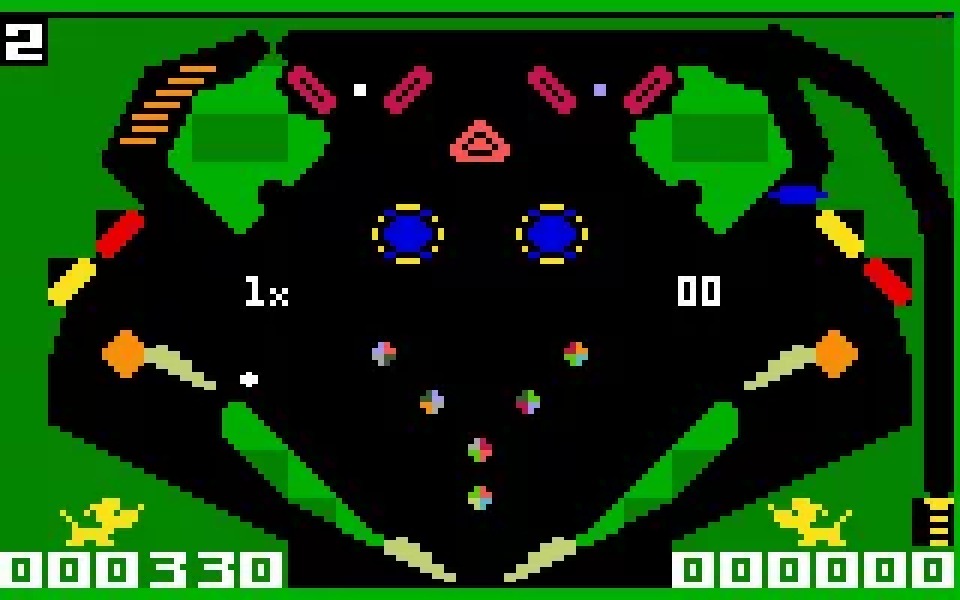
Every early console attempted pinball; the Intellivision’s attempt (1981) is the one that holds up. Rather than cramming a table onto one screen, Mattel’s Pinball scrolls: the table is taller than the display, the view follows the ball through distinct upper and lower playfields, and the physics — while simple by later standards — have weight, angle and intent. Flippers are worked by the controller’s side buttons in the natural one-hand-each arrangement, rollovers and bumpers are placed like somebody understood table design, and the whole thing moves with a smoothness that was the system’s trademark. It was a pack-in-era workhorse rather than a headline release, which kept its reputation quieter than its quality deserves. For pinball fans assembling an Intellivision shelf, this is an essential stop.
6. Buzz Bombers

A fixed shooter with a gardener’s soul: you are a can of bug spray defending a lawn from waves of bees, and every bee you blast becomes a honeycomb that narrows your movement until the friendly hummingbird drifts through and tidies up. Buzz Bombers (1982) takes the Space Invaders skeleton and grafts on a genuinely clever positional economy — your kills literally reshape the battlefield, flowers bloom to hem you in, and a spray can has limited juice in a way that forces the same triage decisions as Astrosmash’s falling bombs. It is colourful, funny and much better designed than its joke premise suggests. It tends to be passed over for the system’s famous shooters, which makes it exactly what a hidden-gems list is for. Common and inexpensive: no excuse.
7. Mission X
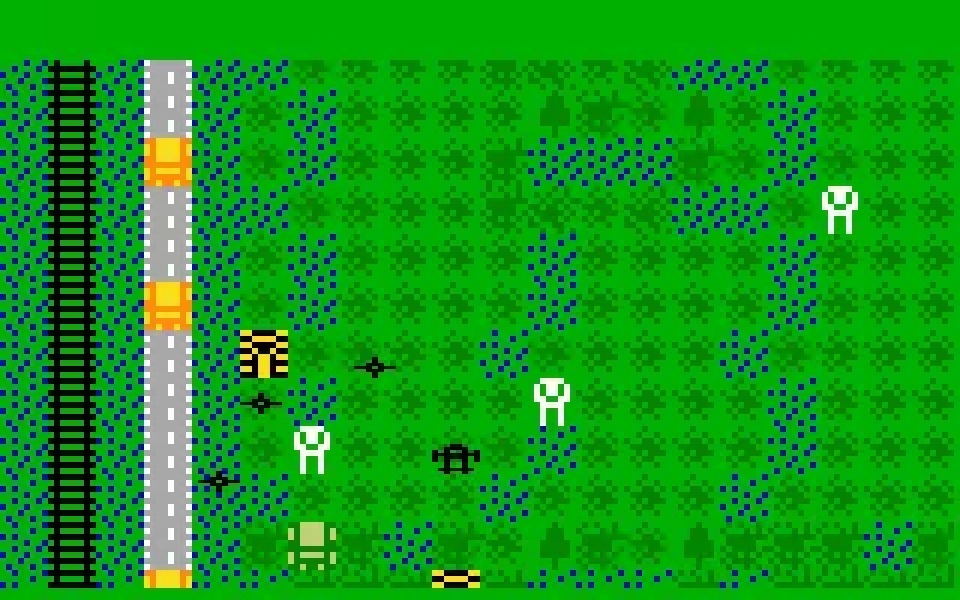
Mattel’s conversion of Data East’s vertically scrolling bomber (1982) puts you over a coastline of trains, tanks, bridges, ships and airfields, bombing ground targets while the terrain scrolls beneath and day turns to night. Mission X plays like a thoughtful person’s Xevious ancestor — slower, more deliberate, with bombing accuracy rather than survival as the central skill, and a score-and-hits readout that grades your sortie like a mission report. The scrolling on Intellivision hardware is impressively smooth, and the shift into the night sections, searchlights and all, is a lovely production touch. It lived in the shadow of B-17 Bomber’s voice-equipped spectacle, which is unfair: as pure scrolling action, this is the system’s sleeper pick.
8. Beauty & the Beast
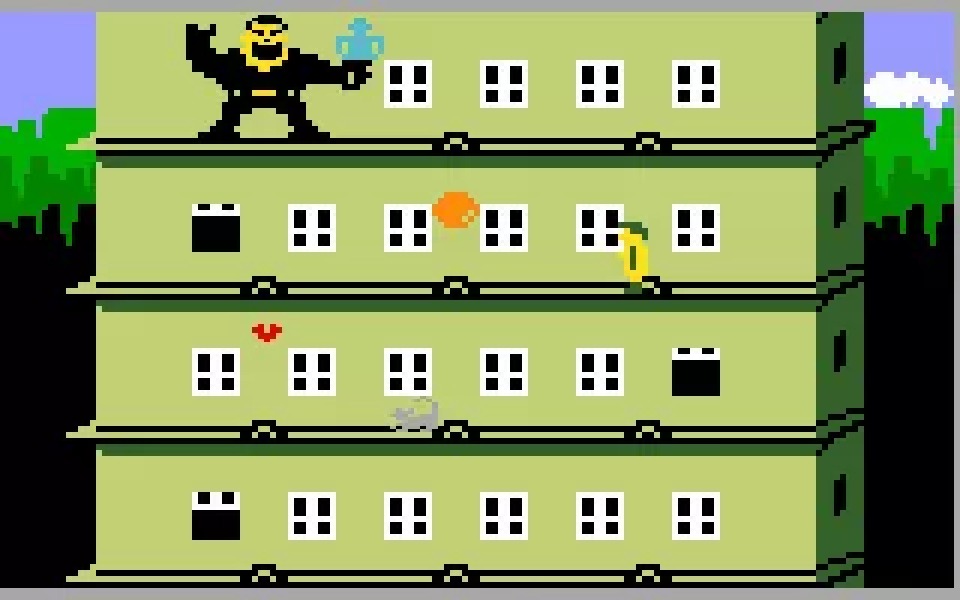
Imagic’s King Kong-flavoured climber (1982) has a lovestruck hero scaling a building, floor by floor, dodging the rocks, birds and falling hazards the Beast throws down, while the building visibly narrows the higher he climbs — a difficulty ramp drawn into the architecture itself. Beauty & the Beast is simple, precise and quietly brutal at its heights, with a visual clarity (that pale tower against the sky, windows flicking open and shut) that makes every fall feel like your own fault. It is one of those games whose reputation suffered by being neither shooter nor sport on a system typecast for both. As a pure climbing game it has few equals of its vintage, and Imagic’s polish is all over it.
9. Masters of the Universe: The Power of He-Man
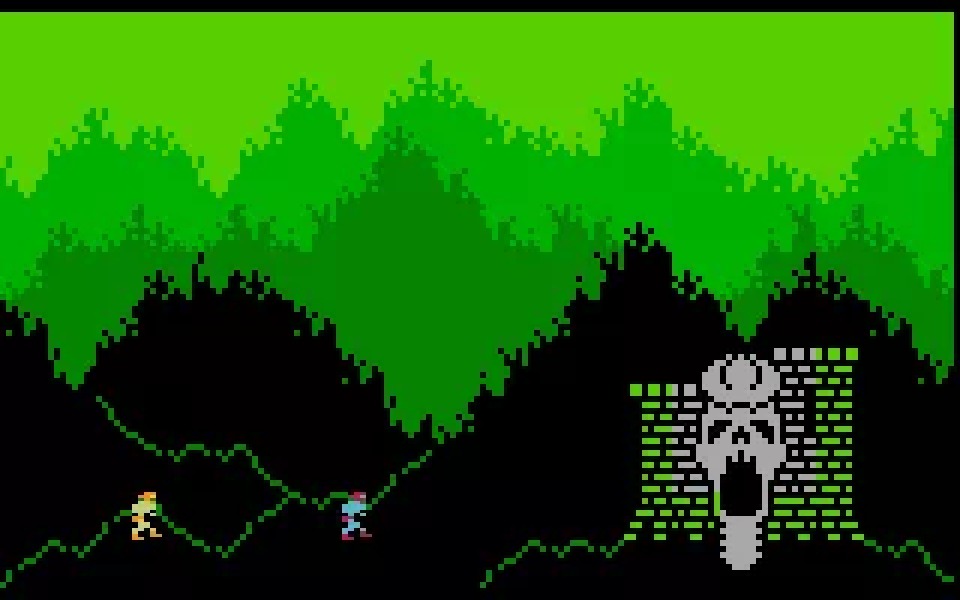
The He-Man licence could have produced a lazy maze game. Instead Mattel shipped a two-part adventure (1983): fly the Wind Raider toward Castle Grayskull in a scrolling shooter, dodging and blasting Skeletor’s fireballs, then continue on foot through the mountains and into the castle itself for a running duel. The structure gives the game a journey’s shape that no single-screen tie-in of the era attempted, the Eternia backdrops — mountains, forests, the great green skull of Grayskull — are drawn with real affection, and the difficulty is honest. Licensed games of 1983 are a graveyard of good intentions; this one is remembered fondly by everyone who actually played it, and it deserves the wider rediscovery the franchise’s modern revivals keep promising it.
10. Tron Maze-A-Tron
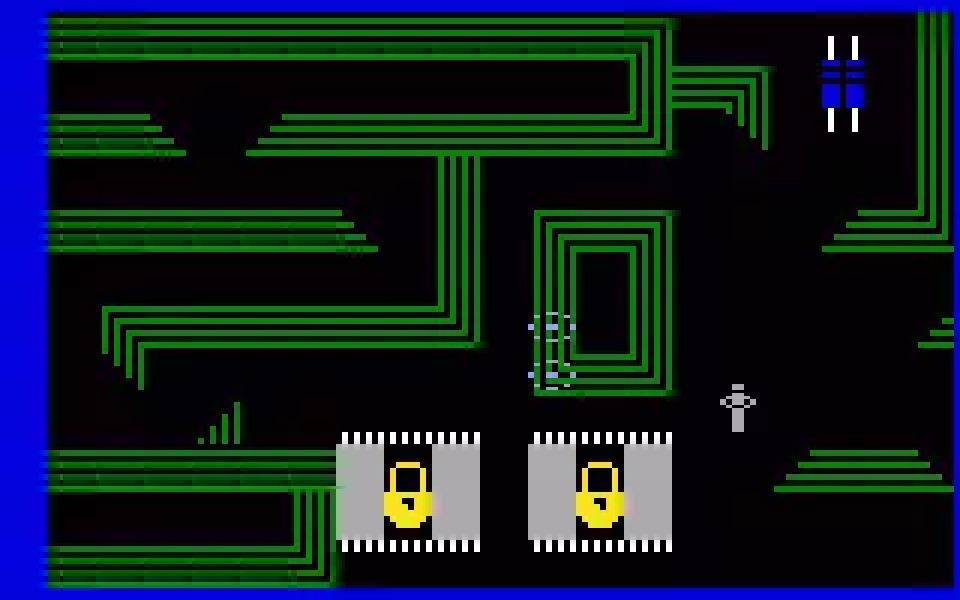
The strangest of Mattel’s three Tron games (1982) sends Flynn inside a computer rendered as a vast circuit board — chips, energy paths and the Master Control Program’s defences — on a mission to disable the MCP by reaching its RAM chips while Recognizers patrol and the phases of play shift under you. Maze-A-Tron is famously opaque: even its fans admit the manual is required equipment, and its phases do not explain themselves. But underneath the opacity is one of the most ambitious designs on the system — part maze, part shooter, part infiltration game, with a scope that dwarfs its siblings Deadly Discs and Solar Sailer. It is the deep cut for players who have mastered the famous Tron game and want the one that still has secrets. Bring patience; the computer provides everything else.
How this list was chosen
A word on method, because “hidden gems” lists attract justifiable suspicion. Every game above is a real, commercially released Intellivision cartridge from the system’s working life or its INTV afterlife — no homebrew, no prototypes, nothing you need a forum password to obtain. Each one was chosen against three tests: it had to be genuinely good (nostalgia alone didn’t qualify anything), genuinely overlooked relative to its quality (which is why the magnificent Atlantis and the system’s famous sports titles are absent — nobody who owns an Intellivision is hiding those), and mechanically distinct from the others, so the ten together sketch the console’s range: isometric sequel, pond puzzler, party snakes, river adventure, scrolling pinball, garden shooter, night bomber, building climber, licensed quest and circuit-board infiltration. If a reader buys three cartridges from this list, our honest advice is Snafu for the room, White Water! for the evening, and Diner for the trophy shelf — one for company, one for atmosphere, one for the collection. And if the list makes you curious about the system’s deeper catalogue, that is the correct outcome: the Intellivision rewards digging like few consoles of its generation, because so much of its best work was published by a company that believed its customers were smart, in years when that belief was going out of fashion.
Where to start, depending on your shelf
If your Intellivision shelf currently holds only the famous names, buy in this order. First, Snafu and Buzz Bombers — common, cheap, and the two that will actually get played at gatherings. Second, White Water! and Thin Ice — the pair that best show the system’s overlooked range, one from Imagic and one from Mattel itself. Third, Pinball and Mission X for the catalogue’s depth in genres the console supposedly didn’t do. Fourth, Beauty & the Beast and Maze-A-Tron, the pair for players who like their classics with a learning curve. Save Diner and He-Man for the deliberate hunt: both reward patience, both surface more often in complete-collection sales than alone, and both are worth waiting for a tested copy rather than grabbing the first listing that appears. That sequence builds a second shelf for less than the price of one fashionable rarity on a trendier system — which is, in the end, the whole pleasure of collecting for the thinking person’s console: the thinking still pays.
Honourable mentions:
Atlantis and Demon Attack (Imagic’s better-known shooters — Demon Attack gets a full review in this wave), Swords & Serpents for two-player dungeon crawling, and Hover Force for late-era 3D ambition. The Intellivision’s second shelf is deep. Start with these ten.