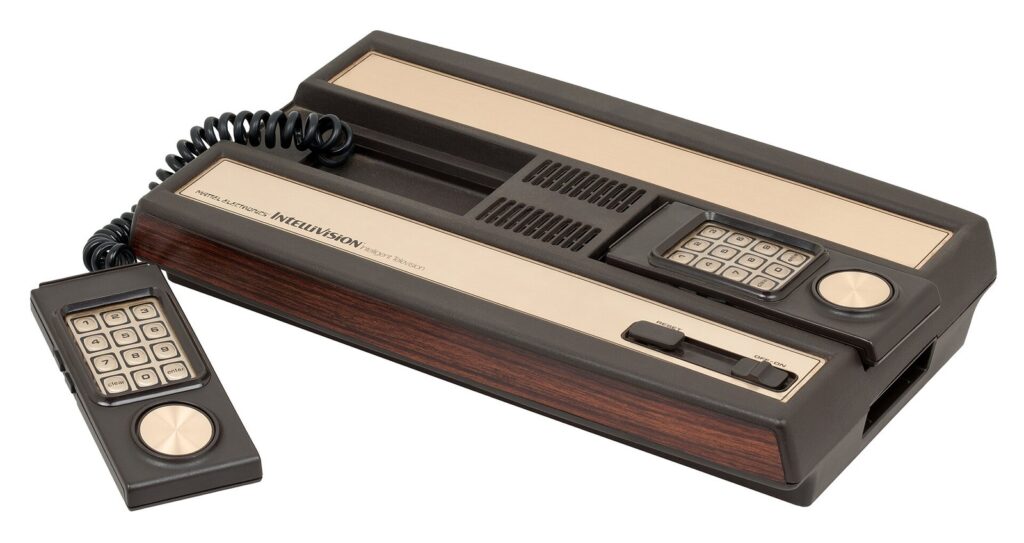
The Intellivision is the easiest of the classic consoles to fall for and one of the trickiest to buy well. Mattel’s 1979 machine sold sophistication — a keypad-and-disc controller, overlays for every game, add-ons that promised voice and computing — and nearly all of that charm lives in the details: the right console variant, working controllers, the add-ons that actually matter, and the modern gear that keeps forty-year-old hardware happy on a modern television. This guide is deliberately qualitative — the second-hand market moves too fast for printed prices to be honest — but it will tell you exactly what to look for, what to avoid, and which route into the library suits you. Everything below assumes you want to play the thing, not merely shelve it.
Step one: which console?

The original Intellivision Master Component (1979) is the default recommendation and the machine in our featured photograph: woodgrain trim, gold accents, and — critically — controllers that are hardwired to the console. That is the variant’s blessing and curse. Hardwired means no connector corrosion and no detached-controller lottery; it also means a dead controller is a repair job rather than a swap, so test both handsets properly before buying: every keypad button, the disc in all directions, both side action buttons. Sears sold the same hardware as the Super Video Arcade, and Tandy/Radio Shack the Tandyvision One — identical guts, different badges, sometimes cheaper for no good reason.
The Intellivision II (1983) is smaller, cheaper-feeling, and its controllers detach — genuinely useful — but it carries two catches: its controllers use a different, mushier design many players dislike (original-style controllers can be adapted, at extra trouble), and a small number of cartridges are incompatible with it for internal hardware reasons, most famously some Coleco-published titles. The INTV System III / Super Pro System machines from the post-Mattel INTV era are essentially the original design reissued, and play the full library. Our advice: buy the original model in verified working order first; add variants later if the collecting bug bites.
The controller is the console
No purchase matters more than the hand controllers, because the Intellivision’s disc-and-keypad is not an input device you can casually replace — it is half the games’ design. The 16-direction disc should move smoothly and centre cleanly; the 12-button keypad sits beneath a slot for each game’s printed overlay, those thin plastic cards that label the keys with the game’s own functions. Overlays matter more than newcomers expect: for simulation-heavy titles (the Intellivoice games, the strategy library, anything keypad-dense) playing without the overlay is playing from memory. When buying games, a cartridge with its overlay and manual is worth meaningfully more of your patience than a bare cart — and sellers of loose carts know it. Check the keypad’s feel button by button; the membrane design means individual keys can die while the rest live, and it will always be the key your favourite game needs most.
The add-ons that earn their shelf space

Intellivoice is the essential add-on. The voice-synthesis module plugs into the cartridge port, games pass through it, and a small library of voice games — Space Spartans, B-17 Bomber and Bomb Squad at launch, a few more later — becomes a completely different, talking console. Modules are plentiful second-hand; test with a voice game before committing, since a silent Intellivoice is just a plastic pass-through. The ECS (Entertainment Computer System) is the connoisseur’s extra: a module-plus-keyboard that turned the console toward a home computer, required by a handful of its own titles (including the ECS edition of World Series Major League Baseball) and interesting mostly to completionists — the keyboard in our photograph is the giveaway that this rabbit hole has a bottom, but it’s a deep one. Skip the ECS until the main library is built.
Modern ways in

If original hardware feels like a commitment, the Intellivision Flashback (2014, AtGames) is the honest budget door: a mini console styled on the original, with dozens of built-in games and — unusually for its class — detachable controllers with proper keypads that accept the original overlays, a detail fans rightly praised. It is emulation in a nostalgic shell, its game selection has licensing-shaped holes (some famous titles are absent), and it will never feel like the real thing; as a taster before buying forty-year-old hardware, it does its job well. The Amico saga needs careful words: a modern successor console was announced with great fanfare, pre-orders were taken, and after years of delays the project stalled without a general retail release of the console itself — some of its remake titles have since appeared through other channels under “Amico Home” and ports to mainstream platforms. Treat Amico hardware listings with caution, verify exactly what is being sold, and do not pay collector prices for promises: what exists to buy today is software and memorabilia, not a shipped console ecosystem.
For original-hardware owners, the modern essential is a flash cartridge — the long-standing favourite is the LTO Flash, a USB-loading cart that holds the library on one cartridge with menu software, letting you keep fragile originals shelved while you play; availability has historically come in batches, so expect to hunt or wait. Pair it with a sensible video solution: the Intellivision outputs RF only in stock form, so budget for either a decent RF-to-modern-display chain, a composite modification by a reputable technician, or a small CRT — still, honestly, the way these games look best.
Faults to check before money changes hands
Forty-year-old hardware fails in characteristic ways, and the Intellivision’s are knowable in advance. On consoles: check the power switch and reset button for positive action (both get tired), confirm the cartridge slot grips firmly, and let the machine run a game for ten minutes — heat-related faults in these machines often hide until the chips are warm. A picture that rolls, buzzes or fades as the console warms up is a negotiation point, not necessarily a dealbreaker, but price it as a repair. On controllers: beyond the button-by-button test, flex the cable gently at both ends while playing; intermittent discs are very often cable breaks at the strain relief, and a controller that only fails when its cord moves is telling you its future. On cartridges: Intellivision carts are robust, but contacts oxidise; a game that boots to garbage and then works after reseating is usually just dirty, while one that never boots is dead. On the Intellivoice: the only honest test is a voice game actually speaking. Sellers who will not demo equipment are telling you something — listen.
Region is mercifully simple. The library is overwhelmingly NTSC; SECAM and PAL variants of the console exist from the system’s European life, and a small number of titles differ by market, but a North American buyer assembling a North American set will rarely need to think about it. Boxes, gatefold packaging and overlays are where condition grading gets serious for collectors — Mattel’s early packaging is handsome and fragile in equal measure — but a player-first buyer can cheerfully let the box collectors pay their premium and take the loose, tested, working set.
Building the library without wasting money
Strategy matters because the library’s pricing is lopsided: the great majority of Intellivision games are inexpensive, and a small tail of late INTV-era releases — Tower of Doom, Diner, Thin Ice’s rarer contemporaries and their kin — carries nearly all of the cost. The sensible order is the reverse of the tempting one. Build the foundation first from the common classics, which are common precisely because they sold in the millions and are therefore cheap, plentiful and usually in fine condition. Play the system for a season. Then buy the scarce titles one at a time, tested, from sellers who demo their stock — because at those prices, the difference between a working Tower of Doom and a decorative one is the whole purchase. Bundles and lots are the veteran’s shortcut: Intellivision collections surface regularly as complete estates, and a tested lot with overlays included routinely beats the sum of its parts. Finally, keep perspective — this is a library where a genuinely great twenty-game shelf can still be assembled for less than many single cartridges cost on trendier systems. That will not be true forever, but it is true now, and it is the best argument for starting this year.
Care, feeding and first games
Ownership is simple by vintage standards. Keep the console ventilated and out of direct sun — the woodgrain-era plastics yellow and embrittle with heat and light. Clean cartridge contacts with proper contact cleaner or high-percentage isopropyl on a swab, never abrasives. Store overlays flat, ideally in the boxes or a card sleeve; a creased overlay is a permanent annoyance in a way a scuffed cartridge is not. If you mod for composite video, choose a technician who has done Intellivisions before and keep the RF output intact if the work allows — originality protects both value and options. And buy a surge protector: the power supplies in these machines were built for a gentler grid.
For the first games, sequence for pleasure rather than prestige. Night one: Astrosmash and Night Stalker — the two poles of Mattel action design, both instant. Week one: BurgerTime and Lock ‘n’ Chase for the arcade shelf, Shark! Shark! for the room’s favourite. Month one: Utopia with a second player, Cloudy Mountain with the lights low, and — once the Intellivoice is home and tested — Space Spartans with the volume up, so the console can introduce itself properly, in its own voice. That is a library core any system would envy, and it leaves the D&D depths, the INTV rarities and the hidden gems of our companion list as the delightful long tail. The Intellivision rewards exactly this kind of patience: it was built for people who read manuals, and it is still, all these years later, keeping its side of the bargain. Buy well, test honestly, keep the overlays flat, and the machine will do the rest — it has had more than four decades of practice at being underestimated, and it wears the role beautifully.
A buying checklist, in order
1. Console: original Master Component (or its Sears/Tandy twins), tested on a television, both controllers verified button by button. 2. Power and picture: original supply working, RF picture stable. 3. Intellivoice module, tested with a voice cartridge. 4. Games with overlays first — start with the system’s pillars (Astrosmash, BurgerTime, Night Stalker, Utopia, the D&D pair, Demon Attack) before rarity-hunting. 5. Then modernise: flash cart, video solution, spare controller if one crosses your path. Buy condition over completeness, test everything in person where you can, and remember the platform’s great advantage: outside a handful of late INTV releases, this is still one of the most affordable serious libraries in retro gaming. The thinking person’s console rewards a thinking buyer.